
HYDRA: Linking Social Identities Through Behavioral Heterogeneity and Structural Consistency
Structured Learning from Heterogeneous Behavior for Social Identity Linkage
2015-02-02
Summary
Problem
Method
Results
Takeaways
Abstract
This paper introduces HYDRA, a multi-objective learning framework for Social Identity Linkage (SIL) across heterogeneous social media platforms. By combining multi-dimensional behavior modeling with core social structure consistency, it achieves state-of-the-art performance, outperforming existing baselines by over 20% in precision and recall across datasets involving 10 million users.
## TL;DR
Social Identity Linkage (SIL)—the task of identifying that "User A" on Twitter is the same person as "User B" on Facebook—is notoriously difficult due to noisy data, missing attributes, and behavioral asynchrony. **HYDRA** breaks through these barriers by moving beyond simple attribute matching. It introduces a multi-objective optimization framework that aligns users not just by what they say, but by the **structural consistency of their social circles** and the **temporal patterns of their behavior**.
## Problem & Motivation: The Identity Fragmentation
Most existing SIL methods suffer from "attribute myopia." They assume usernames or profile bios are stable, but in reality:
- **Deception/Noise**: People use pseudonyms or eccentric characters.
- **Information Sparsity**: Over 80% of users miss at least two major profile attributes.
- **Platform Divergence**: A user might post political rants on Twitter but share family photos on Facebook, making content-only matching fail.
The authors' core insight is that while a user's *content* might change, their **core social structure** (their closest friends) and their **behavioral trajectory** (temporal patterns) exhibit high long-term consistency.
## Methodology: The HYDRA Framework
HYDRA (Structured Learning from Heterogeneous Behavior) operates on three sophisticated levels:
### 1. Multi-Resolution Behavior Modeling
Instead of a flat comparison, HYDRA uses "pattern-matching sensors" across multiple temporal scales. It analyzes:
- **Topical Interests**: Using LDA to map long-term interests.
- **Temporal Trajectories**: Using $l_q$-norm non-linear stimulation functions to match check-ins and multimedia shares even if they occur asynchronously.
- **Style**: Capturing unique linguistic "fingerprints."
### 2. Core Social Structure Consistency
This is the technical highlight. If Alice and Bob are linked, and Alice is friends with Henry on Platform S, finding a friend of Bob on Platform S' who looks like Henry provides strong evidence for a new link.
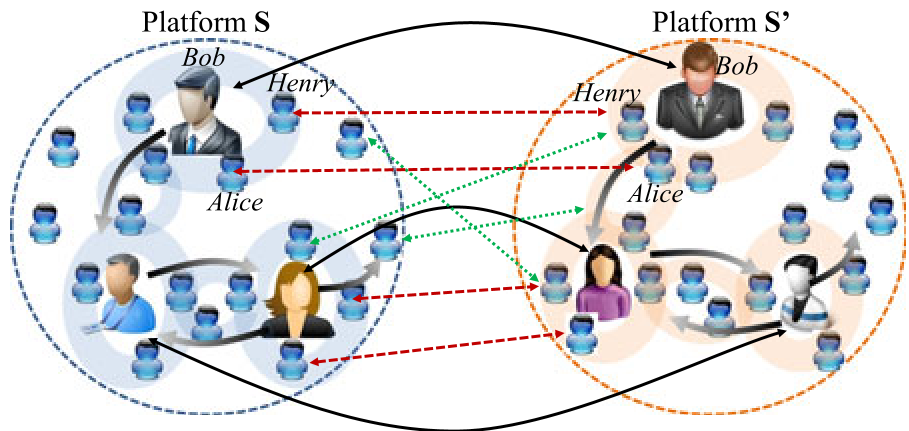
*Fig 1: The intuition of propagating linkage through social clusters. Red arrows indicate ground truth, while green/dashed arrows indicate structural propagation.*
### 3. Multi-Objective Optimization (MOO)
The system solves a dual-objective problem:
1. **Direct Supervised Loss**: Minimize error on known linked pairs.
2. **Structural Consistency**: Maximize the agreement between the social graphs of the two platforms.
To handle missing data, they implement a **normalized-margin** SVM variant that avoids the pitfall of "zero-filling" missing features, which often misleads standard classifiers.
## Experiments & Results: Dominating the Large-Scale Social Web
The authors tested HYDRA on a massive scale: 10 million users across 7 platforms (Twitter, Facebook, Sina Weibo, etc.), involving 10TB of data.
### SOTA Comparison
HYDRA significantly outperformed state-of-the-art methods like MOBIUS and Alias-Disamb. In scenarios with high unlabeled data, HYDRA's ability to leverage structural information allowed it to maintain high precision where other methods collapsed.
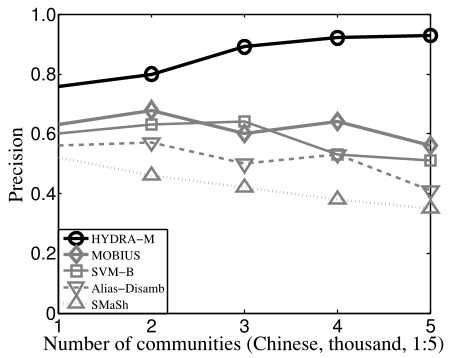
*Fig 2: Performance comparison against #unlabeled pairs. HYDRA (red/blue lines) stays robust as the problem complexity increases.*
### Key Findings:
- **Missing Data Resilience**: The "HYDRA-M" (Missing-aware) variant showed superior stability compared to the zero-filled version.
- **Cultural Differences**: Linking Chinese platforms was found to be harder than English ones due to higher information diffusion speeds and more complex social structures (as seen in the retweet/follower distributions in the paper).
## Critical Analysis & Conclusion
**Takeaway**: HYDRA proves that "who you know" is as definitive as "what you say" for digital identity. By treating SIL as a structural alignment problem rather than just a classification problem, it overcomes the noise inherent in social media.
**Limitations**: The computational cost of building the structure consistency matrix $M$ is high, though the authors mitigate this with distributed optimization (ADMM) and sparsity techniques. Future work might explore using Graph Convolutional Networks (GCNs) to automate the feature extraction of these social circles.
**Conclusion**: For businesses looking to build 360-degree user profiles, HYDRA provides a mathematically rigorous roadmap to navigate the fragmented landscape of the modern social web.