
MTC: Structuring Human Digital Memories for Scalable Social P2P Networks
Structuring communities for sharing human digital memories in a social P2P network
The paper proposes a novel Memory Thread-based Communities (MTC) framework for social P2P networks (ESP2PN) to manage "Human Digital Memories." It leverages "Entities" and linear "Memory Threads" to partition the network into similar peer groups, achieving approximately 95% query success rates and significantly reducing network overhead compared to unstructured and Interest-Based Communities (IBC).
TL;DR
As we digitize every aspect of our lives, from photos of the Eiffel Tower to school reunions, sharing these "Human Digital Memories" becomes a massive data challenge. This paper introduces Memory Thread-based Communities (MTC), a system that organizes Peer-to-Peer (P2P) networks based on the history of "Entities." By moving away from random peer connections and toward structured "Memory Threads," MTC achieves a 95% search success rate while cutting network traffic by up to 12x.
Problem & Motivation: The Chaos of Digital Overload
In standard unstructured P2P networks, peers connect randomly. Searching for a specific event feels like finding a needle in a haystack—resulting in high "flooding" traffic and frequent failures. While Interest-Based Communities (IBC) improved this by grouping "like-minded" peers, they still treat the community as a "black box" without internal order.
The authors argue that human memory doesn't work randomly; it works through cues and associations. When you see a location, you remember the friends you were with. This paper translates this biological intuition into a network topology: Entity-based Social P2P Networks (ESP2PN).
Methodology: The Architecture of Memory Threads
The core innovation lies in the Memory Thread. Instead of just labeling data, the system identifies "Entities" (People, Places, Objects) and organizes them using two specific criteria:
- Selection Criteria: The "Reference Key" (e.g., "Eiffel Tower").
- Indexing Criteria: The ordering principle (e.g., "Time" or "History").
1. Extant vs. Virtual Memory Threads
- Extant Memory Threads (EMT): Managed by a single peer (your private memories).
- Virtual Memory Threads (VMT): Decentralized threads spanning multiple peers who all share memories about the same entity.
2. Topological Awareness
Peers in an MTC are not just members; they have a defined position in a linear sequence (e.g., sorted by the year a photo was taken). To prevent network fragmentation (if a peer goes offline), each peer maintains links to 2-hop or 3-hop neighbors.
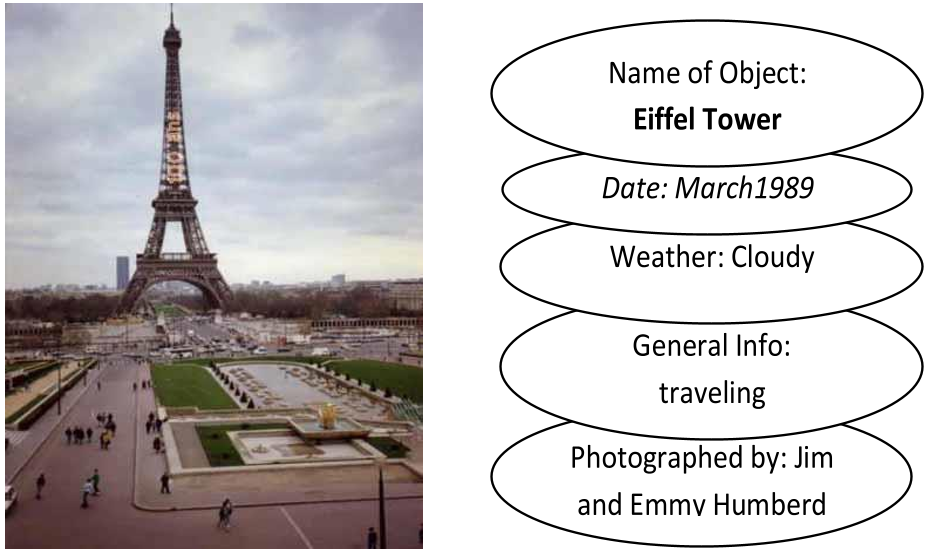 Figure: Virtual Memory Threads (VMTs) connect various Extant Memory Threads (EMTs) through networking points.
Experiments & Results: Efficiency at Scale
The authors simulated a network of up to 20,000 peers using a power-law distribution to mimic real-world social networks. They compared MTC against Unstructured and IBC models.
Key Breakthroughs:
- Query Success: MTC hit a 95% success rate, whereas Unstructured networks languished at 75%.
- Stability: The Standard Deviation (SD) of MTC's performance was significantly lower, meaning it stays reliable even when the network is under heavy load.
- Traffic Reduction: Because peers have "topological awareness" (they know their place in the thread), queries are routed with surgical precision rather than blind flooding.
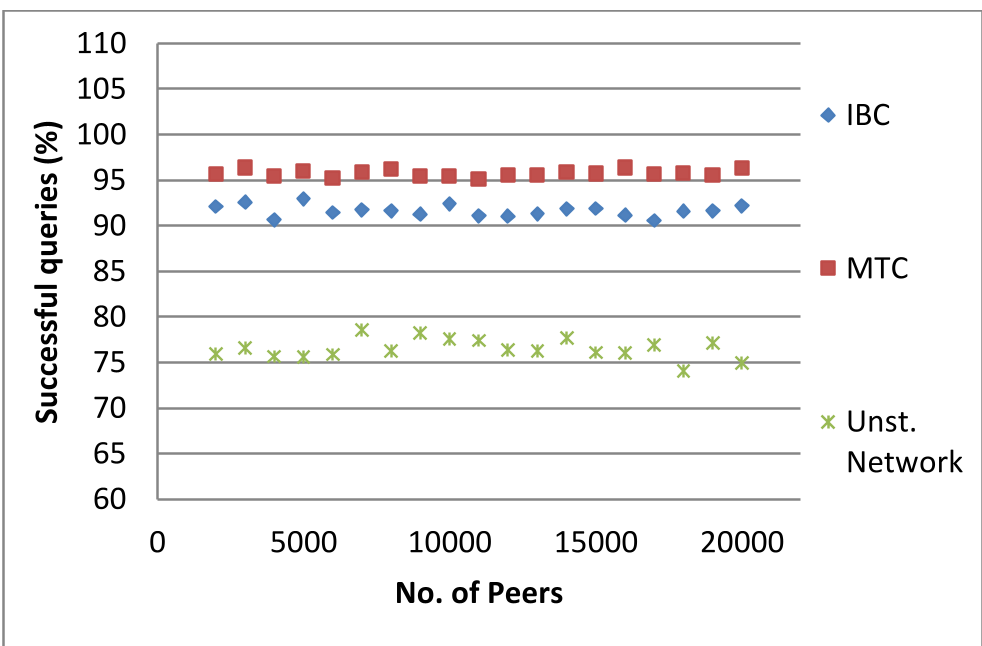 Figure: MTC maintains a consistent ~95% success rate regardless of the network growing from 2,000 to 20,000 peers.
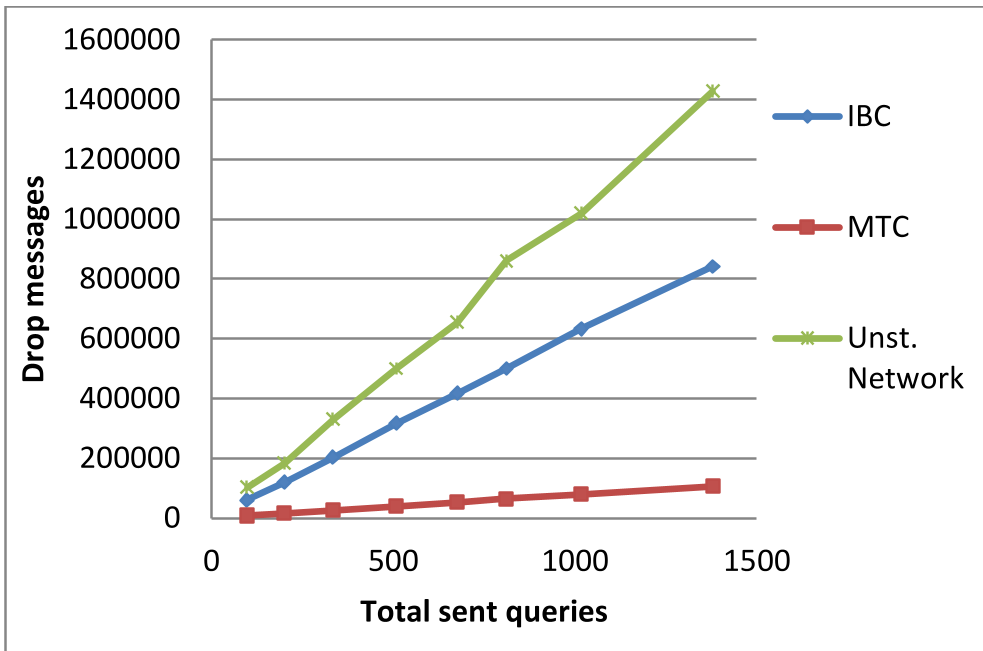 Figure: MTC demonstrates drastically lower overhead compared to IBC and Unstructured networks as traffic increases.
Critical Analysis & Conclusion
The beauty of MTC is that it "lets the data speak for itself." By structuring the network to mirror the metadata of the files it carries, the topology becomes self-optimizing for search.
Takeaway: This research proves that decentralized social networks don't have to be slow or "chatty." By using entities and chronological threads, we can build social platforms that are both private (P2P) and high-performance.
Limitations & Future Work: Currently, the model assumes a somewhat "static" entry/exit of peers. The authors acknowledge that the next step is handling "Churn" (peers frequently joining and leaving) and moving beyond linear threads to more complex multidimensional structures (e.g., Location-based indexing).