
Structuring the Chaos: Can Message Links Save Collaborative Learning?
Structuring the discourse on social networks for learning: Case studies on blogs and microblogs
The paper investigates how discourse structuring on blogs and microblogs influences collaborative learning. It proposes a classification of social networks into "author-based" (push) and "reader-based" (pull) and evaluates the impact of List, Tree, and Graph message structures on student interaction.
TL;DR
Collaborative learning in social networks often suffers from fragmented discourse. This paper explores whether adding Hierarchical (Tree) and Net (Graph) structures—via "Reply" and "Quote" functions—to blogs and microblogs can improve educational interactions. While students felt the platforms boosted their learning, they struggled to break away from familiar, linear commenting habits due to cultural and interface hurdles.
Problem: The "Divergent Discussion" Trap
In the early 2010s, the shift towards Web 2.0 brought social networks into the classroom. However, educators noticed a recurring problem: Linear Organization. When messages are simply listed by date, complex ideas get buried. If a student replies to a post three days later, the "flow" is broken.
The authors argue that without proper discourse structuring, discussions become "divergent"—they wander off-track rather than "converging" into synthesized knowledge.
Methodology: Author-Based vs. Reader-Based
The paper introduces a critical distinction in how we view social platforms:
- Author-Based (Blogs): Focuses on the "Notice Board." The reader must "Pull" information.
- Reader-Based (Microblogs): Focuses on the "News Feed." The system "Pushes" information to the reader.
The researchers implemented three types of discourse organization:
- List (Linear): Simple sequence (e.g., standard comments).
- Tree (Hierarchical): One message belongs to one parent (e.g., Reddit-style replies).
- Graph (Net): One message can link to multiple others (e.g., quoting multiple sources).
 Figure 1: Comparison of Linear, Hierarchical, and Net organizations of messages.
Case Study: The "Blog" and "Youflow" Experiments
The authors tested these structures using two platforms. In the blog study, 26 students project-shared over 8 stages. In the microblog study (using a tool called "Youflow"), 15 students experimented with different enabled functionalities.
The Interaction Gap
The data revealed a stark contrast between available features and actual behavior:
- Common Comments: Used 290 times.
- Replies-to-Comments: Used 38 times.
- Quotations (Net Structure): Used only 5 times.
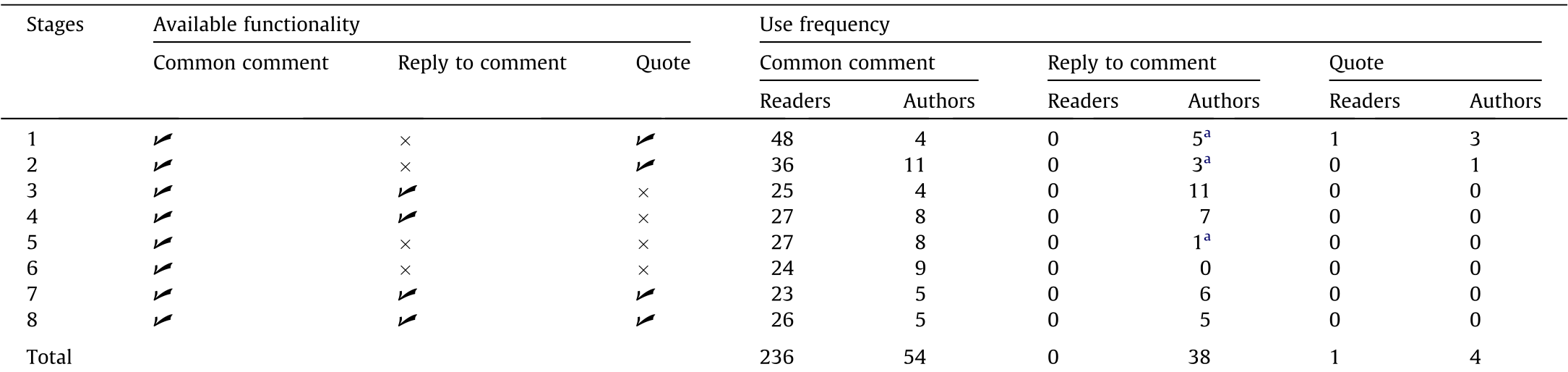 Table 1: Usage frequency across different blog interaction stages.
Critical Insight: Why Don't Students Quote?
The results suggest that "Technical Capability" "Pedagogical Utility." Even when given the power to create complex Net structures (Graphs), students defaulted to linear Lists.
The authors identified three barriers:
- Usability: The "Reply" and "Quote" buttons weren't always noticeable.
- Cognitive Load: It was "laborious" to manage complex links during a fast-paced discussion.
- Cultural Habit: Students are conditioned by mainstream social media (like early Twitter or Facebook) to just "post and move on," rather than "link and synthesize."
Conclusion & Future Work
The paper proves that Social Networks are highly motivating—82% of students reported better learning outcomes. However, to move from "socializing" to "deep learning," we cannot simply change the software architecture.
The Takeaway: Future educational technology must bridge the gap through training and interface design. If we want students to engage in convergent, graph-like thinking, the tool must make "linking" as effortless as "liking."
Limitations: The sample size was small (undergraduate freshmen), and the duration of the studies was limited, which may have hindered the evolution of a more complex "discourse culture" within the groups.