
STrust: Reimagining Social Trust through the Lens of Social Capital
STrust: A Trust Model for Social Networks
The paper introduces STrust, a comprehensive social trust model for online social networks based on the concept of Social Capital. It bifurcates trust into "Popularity Trust" and "Engagement Trust" to build secure trust communities where members can share openly without privacy fears.
TL;DR
STrust is a novel trust model designed to foster "Trust Communities" within social networks. Unlike traditional systems that treat all interactions as equal, STrust derives its value from Social Capital, separating trust into Popularity (reputation) and Engagement (activity). This dual-approach allows social platforms to provide better recommendations while handling the temporal decay of human relationships.
Problem & Motivation
In the era of ubiquitous social media, privacy is increasingly under threat. Users are often hesitant to share authentic feelings due to the fear of being judged or having their data misused. The authors argue that the "open" nature of these platforms lacks a foundational layer of Social Trust.
Existing trust research primarily focuses on active interactions (likes, comments) but fails to capture:
- Passive Participation: Many users consume value without contributing (lurking), which is still a form of engagement.
- The "Why" of Trust: Differentiating between someone being "popular" versus someone being "highly engaged" with others.
- Context & Decay: Trust is rarely permanent; it weakens without consistent interaction and varies across different topics (e.g., trusting a friend for movie tips but not for financial advice).
Methodology: The STrust Architecture
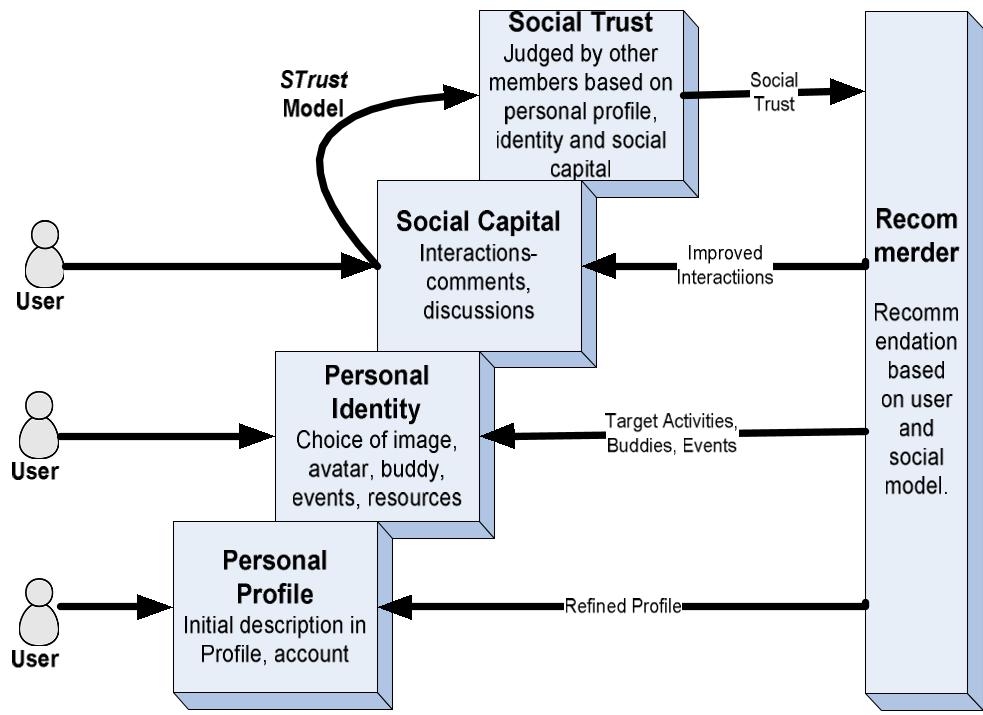
The STrust framework is built on a five-step lifecycle: Personal Profile → Personal Identity → Social Capital → Social Trust → Recommendation.
1. Social Capital: The Input
The core innovation lies in treating interactions as "Social Capital." The authors categorize these interactions into a directed graph where:
- Incoming Edges: Contribute to Popularity Trust (PopTrust). If many people interact with your posts, you are deemed trustworthy/popular.
- Outgoing Edges: Contribute to Engagement Trust (EngTrust). If you frequently interact with others, it signifies your level of trust in the community.
2. Mathematical Modeling
STrust uses the Beta Family of probability distribution functions to calculate trust. The trust value is not a static score but a calculation of positive () vs. negative () interactions.
The final Social Trust (STrust) of a user is a weighted sum:
- When , the model reflects Reputation.
- When , the model reflects Integration.
Experiments & Results
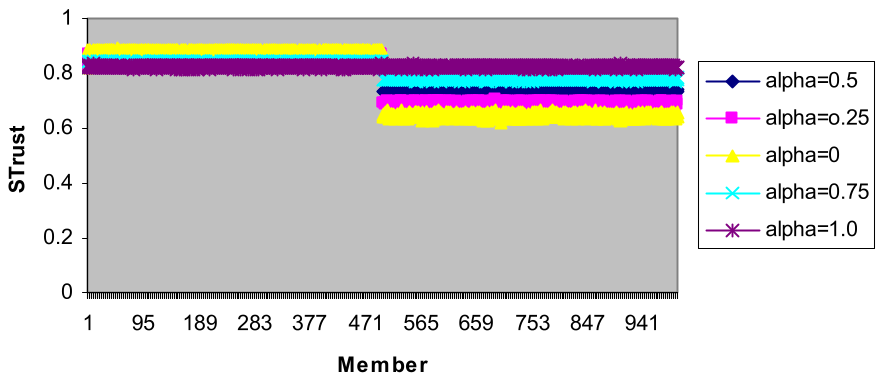
To validate the model, the authors simulated a community of 1,000 users. The analysis focused on how varying the weight affects perceived trust and how the temporal decay factor () causes trust to erode if interactions cease.
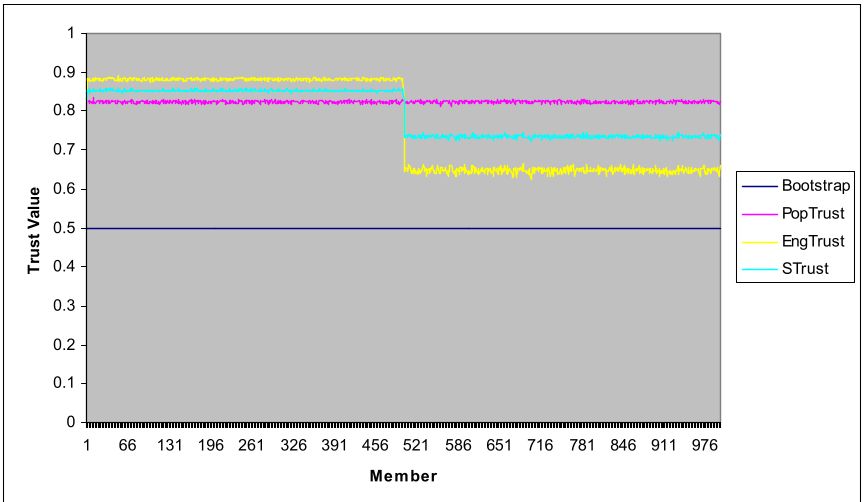
Key findings include:
- Interaction Density: The model clearly separated highly engaged users from passive ones.
- Temporal Forgetting: Using a decay function allows the model to reflect real-world social dynamics where trust is "forgotten" over time, preventing stagnant high-trust scores for inactive accounts.
Critical Analysis & Conclusion
Takeaway
STrust provides a more granular view of social dynamics than simple "follower counts" or "upvote scores." By separating popularity from engagement, platform designers can create recommendation systems that identify leaders (high PopTrust) versus community builders (high EngTrust).
Limitations & Future Work
- Bootstrapping: The "Cold Start" problem remains; how do we assign trust to a brand-new user without interactions?
- Thresholds: Determining the exact cut-off (e.g., STrust > 0.75) for what constitutes a "Trust Community" is still subjective and requires empirical testing in real-world deployments.
- Adversarial Behavior: The model assumes "positive interactions" are easily identifiable, but the paper does not deeply explore how to handle malicious users who might "farm" engagement trust to gain influence.
Future research aims to implement this in e-government service portals to evaluate how STrust improves user sharing in high-stakes human services environments.