
Beyond Immersion: Why Student Participation is the Secret Ingredient for VR Education
The Application of Student Participation in the Design of Virtual Reality Educational Products
This paper explores the integration of "Participatory Design" (PD) into the development of Virtual Reality (VR) educational products. By utilizing the Beijing Subway Maintenance Teaching System (BSMTS VR) as a case study, the authors demonstrate how involving students in iterative design cycles can significantly boost educational accomplishments and user engagement.
TL;DR
Is VR in the classroom just a "fancy toy" or a powerful tool? This paper argues that the difference lies in who designs the experience. By moving from "Designing For" students to "Designing With" them, the authors transformed a subway maintenance training program from a passive video into a high-stakes, gamified VR simulation that significantly improved learning retention and user satisfaction.
The "Pretty Graphics" Trap: Why VR Often Fails
In the rush to adopt cutting-edge hardware, many developers fall into a trap: they focus on visual fidelity at the expense of pedagogical utility.
The researchers analyzed two existing apps: THE BODY VR (theoretical/visual) and Seismic VR (operational/practical). They discovered a startling insight: despite THE BODY VR having superior aesthetics, students learned less. The "wow factor" of the visuals actually served as a cognitive distraction. The core problem identified is the lack of Constructivism—the idea that students should actively build their own knowledge network through interaction rather than passively receiving data.
Methodology: The Four Generations of Design
To bridge the gap, the authors adopted the Participatory Design philosophy, specifically the "Designing Within" approach. In this model, the student is not just a tester; they are a member of the design team.
The Evolutionary Path of BSMTS VR
The development of the Beijing Subway Maintenance Teaching System (BSMTS) followed an iterative path:
- Version 1 (Video): Low engagement, poor memory retention.
- Version 2 (Basic VR): High "cool factor," but students were lost without guidance.
- Version 3 (Instructional VR): Added visual labels and step-by-step procedures.
- Version 4 (Gamified VR): Integrated voice hints and a competitive scoring system.
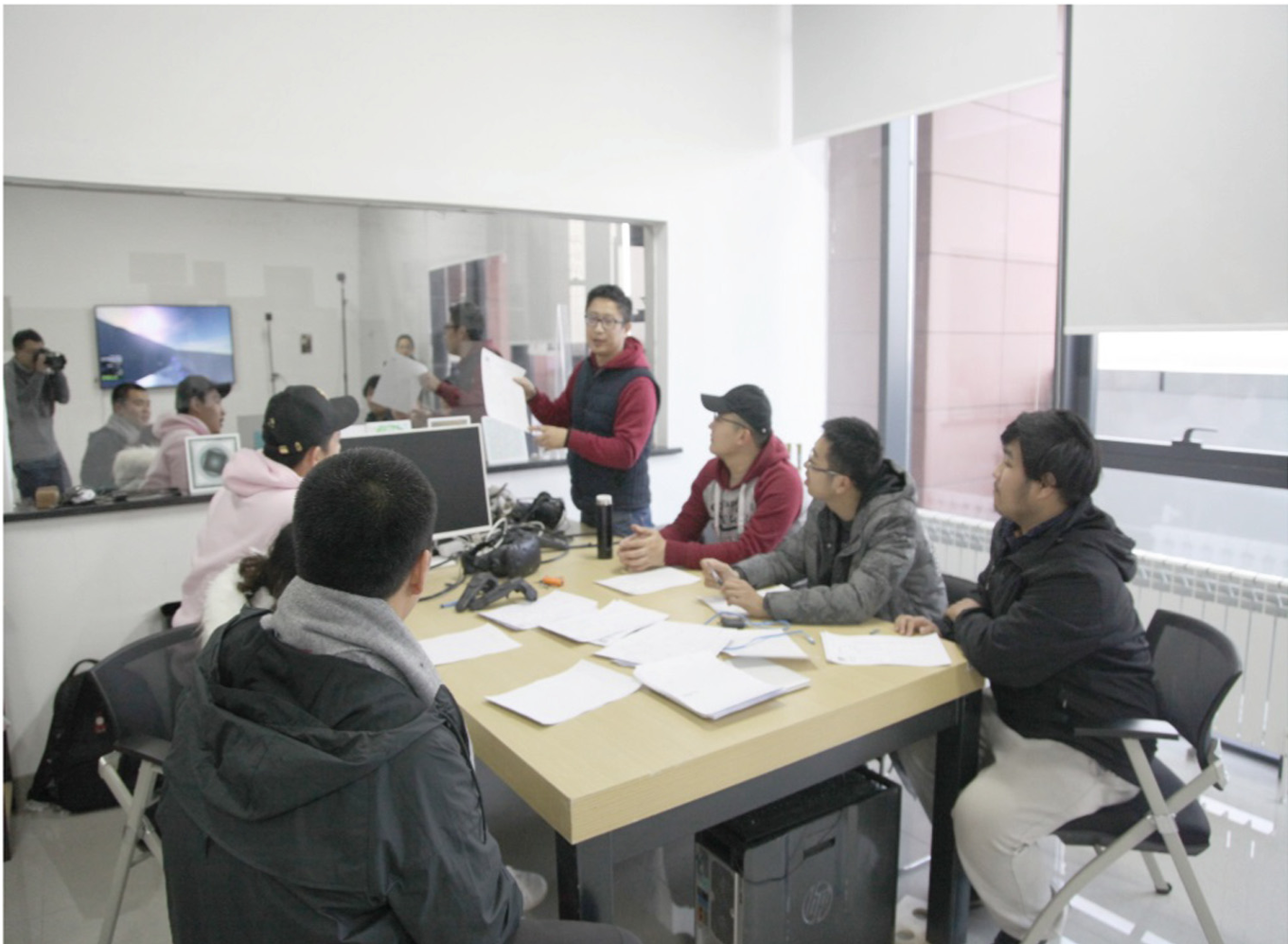 Caption: The simulation of subway maintenance where students practice high-risk locomotive screw cleaning in a safe, virtual environment.
Experiments & Results: The Data doesn't Lie
The researchers tracked six key metrics: Audiovisual experience, Usability, Exploratory nature, Direction/Feedback, Enjoyability, and Accomplishments.
The comparison across the four versions revealed that Usability and Accomplishments only spiked once active guidance and feedback (Versions 3 and 4) were introduced. Interestingly, while Version 2 (introductory VR) increased enjoyment, it didn't solve the educational problem until student feedback led to the implementation of "Voice Hints" and "Ranking Mechanisms."
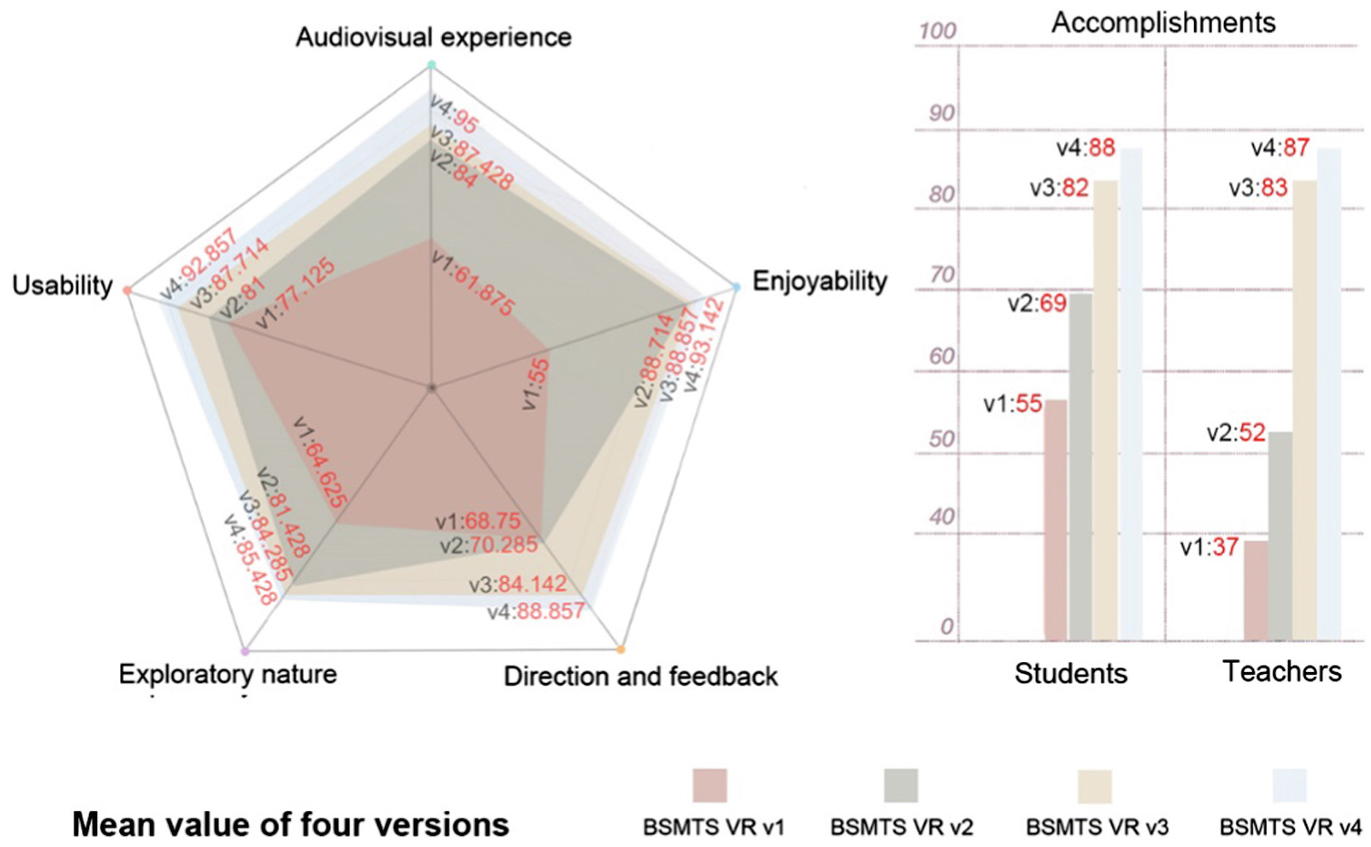 Caption: The Mean Value Comparison across the four versions demonstrates a clear upward trend in accomplishments as the design became more participatory and operation-oriented.
Critical Analysis & Conclusion
The Takeaway
VR is most effective when applied to operation-based or practice-based activities (like high-risk industrial maintenance) rather than purely theoretical subjects. The core contribution of this paper is the validation that student-centered participatory design is an efficient route to optimizing educational ROI in VR software.
Limitations & Future Work
While the results are promising, the sample size (7-11 students) is relatively small for broad statistical generalization. Furthermore, the "Enjoyability" metric might be influenced by the "Novelty Effect" of VR. Future research should look into long-term knowledge retention—testing students weeks after the VR session to see if the participatory design leads to "sticky" skills.
Final Thought: If we want VR to revolutionize education, we need to stop treating students as passengers and start treating them as architects.