
Neural Networks in the Classroom: Predicting Student Success via Educational Data Mining
Student Performance Prediction using Multi-Layers Artificial Neural Networks: A Case Study on Educational Data Mining
This paper presents a Multi-Layer Feed-Forward Neural Network (MLFFNN) approach to predict student academic performance using Learning Management System (LMS) data. By analyzing Moodle logs from 900 students across 10 diverse university courses, the study achieves a peak classification accuracy of 97.4% in identifying students at risk of failure.
TL;DR
Educational institutions are sitting on a goldmine of data. This paper explores how Multi-Layer Feed-Forward Neural Networks (MLFFNN) can process Moodle/CMS log data to predict whether a student will pass or fail with up to 97.4% accuracy. By focusing on behavioral features like "session regularity" rather than just final grades, the research provides a blueprint for early academic intervention.
The Motivation: Moving Beyond "Small Data"
In the field of Educational Data Mining (EDM), most studies are historically limited. They often focus on a single course or rely on small sample sizes that lack statistical diversity. Furthermore, many models depend on historical GPA, which isn't always available for new students.
The researchers in this study aimed to overcome these hurdles by using a larger dataset (900 students across 10 different technical and liberal arts courses) to answer a critical question: Can a neural network learn the universal patterns of "at-risk" students, regardless of the subject matter?
Methodology: The Architecture of Prediction
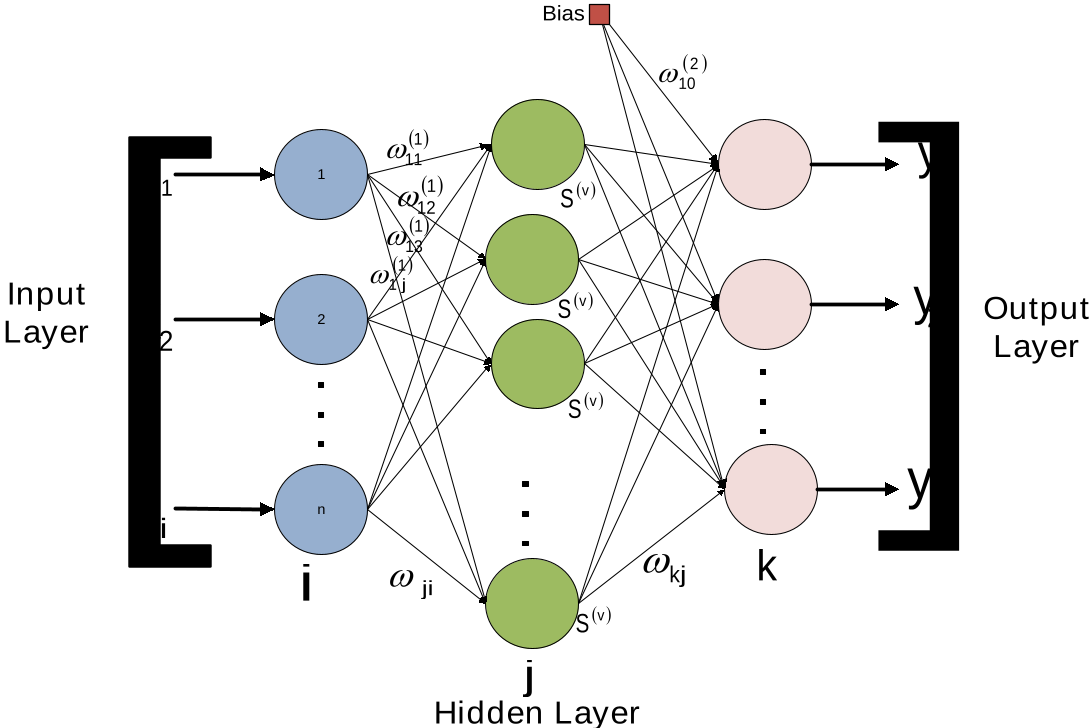
The researchers proposed a Multi-Layer Perceptron (MLP) employing a Back-Propagation (BPNN) algorithm. The intuition here is that student behavior—expressed through sessions, forum posts, and email activity—forms a non-linear manifold that a standard linear classifier cannot fully capture.
Key Predictors
The model is fed a feature vector containing 10 primary predictors, including:
- Total learning sessions and session length.
- Participation (Email count, Forum posts).
- Mid-term metrics (Quiz grades, Assessment counts).
Neural Network Schematic
The architecture relies on an input layer, an optimized hidden layer, and an output layer for binary classification ("Requires Assistance" vs. "Does Not Require Assistance").
Experimental Insights: What Actually Matters?
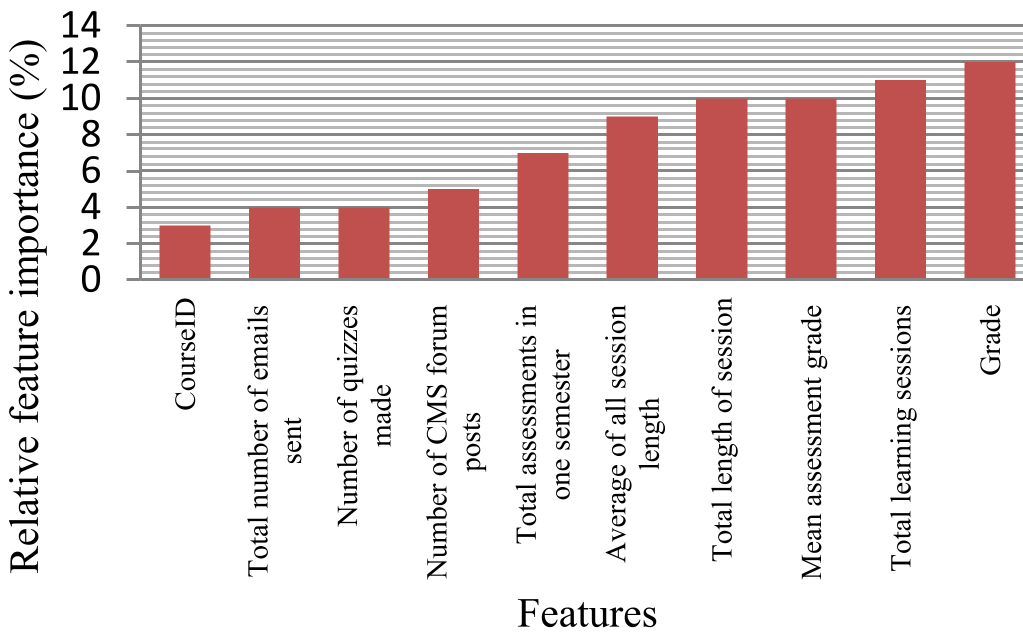
Through a Random Forest feature importance analysis, the study revealed surprising insights into student behavior.
- Regularity is King: The most informative feature was the regularity of course access (12.9%), proving that consistent engagement is a better predictor than sporadic "cramming."
- Course Independence: Interestingly, removing the "CourseID" predictor did not significantly degrade performance. This suggests that the indicators of success (or failure) are remarkably consistent across different academic subjects.
Performance Benchmarks
The researchers tested several architectures (e.g., [4x8x3], [4x12x3], [4x15x3]). The [4x12x3] configuration consistently yielded the lowest Mean Squared Error (MSE).
| Architecture | MSE | Accuracy | Error Rate |
|---|---|---|---|
| [4x8x3] | 5.69x10⁻³ | 91.5% | 8.5% |
| [4x12x3] | 9.02x10⁻³ | 97.4% | 2.6% |
| [4x15x3] | 8.11x10⁻³ | 92.1% | 7.9% |
The confusion matrices across multiple samples validated that the model maintains high precision for both categories (pass/fail), minimizing the risk of "false negatives" where a struggling student might be overlooked.
Critical Analysis & Future Outlook
The strength of this work lies in its generality. By demonstrating that a single model can handle 10 different courses effectively, the authors move EDM toward more scalable, "plug-and-play" solutions for universities.
Limitations:
- Cold Start Problem: While behavioral logs are used, the model still benefits significantly from "Mean Assessment Grade." It remains to be seen how early in the semester (e.g., week 1 or 2) the model becomes truly reliable.
- Feature Sparsity: Some predictors (like forum posts) were only available for a fraction of the students, which may introduce bias.
Future Work: The next frontier involves applying complex deep learning techniques (like RNNs or LSTMs) to look at the temporal sequence of student actions, rather than just aggregate totals.
Conclusion
This case study proves that Multi-Layer Neural Networks are not just for high-tech industries; they have a vital role in the classroom. By reducing the error rate in student performance prediction to just 2.6%, educators can move from reactive grading to proactive mentoring.