
Decoding Quality: Predicting Contest Success in Crowdsourced Development
Student Research Abstract : Predicting the Quality of Contests on Crowdsourcing-Based Software Development Platforms
This paper introduces Quality of Contest (QoC), a predictive measure designed to assess the quality of software development tasks on crowdsourcing platforms like TopCoder. By analyzing historical contest data such as prize amounts and developer ratings, the author uses regression models to help requesters predict the success and quality of future contests.
TL;DR
Crowdsourcing software development is a double-edged sword: you get a global talent pool but face high risks of inconsistent quality. This research abstract proposes Quality of Contest (QoC), a metric that uses historical data (prizes, ratings, bonuses) to predict the quality of a contest before it starts. Validated on TopCoder data, the model explains 85% of the variance in participant eligibility, offering a roadmap for customers to optimize their crowdsourcing strategy.
The Trust Gap in Crowdsourcing
Why haven't more enterprises fully migrated their software development to the "crowd"? The primary hurdle is uncertainty.
Unlike traditional firms with fixed teams, crowdsourcing relies on decentralized actors. Previous work has highlighted several "pain points":
- Submission Noise: A high volume of low-quality entries.
- Lack of Continuity: Developers rarely stay for the entire lifecycle of a product.
- The "Amateur" Myth: The fear that the crowd consists of hobbyists rather than professionals.
The author's insight is simple: if we can't control the process, we must predict the outcome by analyzing the economic and reputational signals of the contest.
Methodology: The QoC Framework
The core idea is to measure the "Quality of Contest" by looking at the participation of "Eligible" developers—those with the skills to actually deliver. The research focuses on the TopCoder platform.
Data Mining
The author implemented a custom crawler to extract nine key attributes from completed development tasks. After filtering for quantitative data, the final model focused on:
- Eligible: Total qualified developers.
- Prize: The primary financial incentive.
- Rating_Winner: The skill level of the eventual winner.
- Bonus: Extra incentives offered.
- Avg_Rating: The collective skill level of the participant pool.
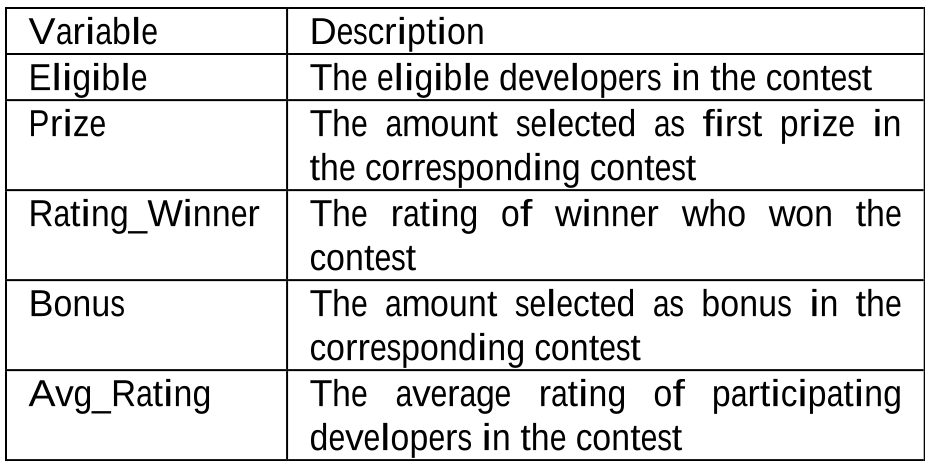 Figure 1: Definition of key metrics used to determine contest quality.
Does Money Buy Quality? (Experimental Results)
The study applied Regression Analysis to determine which factors actually influence the number of eligible developers who participate.
Key Findings:
- High Explanatory Power: An of 0.85 suggests that participation isn't random; it is highly predictable based on the contest configuration.
- The "Winner" Signal: The
Rating_Winner(β=0.03) is a significant predictor. High-quality contests attract high-quality winners. - The Incentive Paradox: Interestingly, the
Bonusshowed a negative coefficient (β=-0.02) in this specific model, suggesting that simply throwing more small bonuses at a task might not be as effective as a high base prize for attracting the right talent.
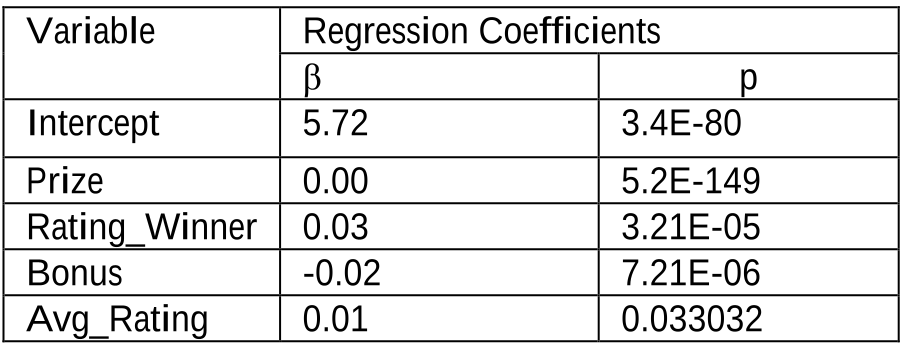 Figure 2: Statistical significance of quality predictors.
Critical Insight & Future Outlook
This work shifts the perspective from post-hoc evaluation (checking if the code is good after it's done) to ex-ante prediction (predicting success based on contest design).
Limitations:
- The model primarily measures "quality" via developer eligibility and ratings rather than direct code analysis (e.g., bug density or maintainability).
- It is currently limited to TopCoder's specific competitive structure.
The Takeaway for Requesters: If you want high-quality results from the crowd, don't just hope for the best. Focus on the structural parameters of your contest: set a competitive prize and target a specific average developer rating. As the author concludes, the QoC measure serves as a "valid assessor" for any customer looking to adopt a crowdsourcing platform.
Conclusion
As crowdsourcing matures, "Gut feeling" is being replaced by "Data Mining." By quantifying the relationship between incentives and talent, this research provides a vital bridge between the chaotic nature of the crowd and the quality requirements of professional software development.