
Deciphering Student Satisfaction: Bridging the Gap Between Black-Box AI and Management Intuition
Gaining insight into student satisfaction using comprehensible data mining techniques
This study presents a methodology for identifying drivers of student satisfaction using multi-class classification techniques at two business schools (IESEG and University of Verona). By implementing a "Rule Extraction" (Rulex) approach from Support Vector Machines (SVM), the authors developed highly comprehensible univariate decision trees that achieve competitive performance while remaining strategically actionable for educational management.
Executive Summary
TL;DR: In an increasingly competitive global education market, understanding what makes students "satisfied" is a strategic imperative. This paper demonstrates how advanced data mining—specifically Rule Extraction from Support Vector Machines (SVM)—can distill thousands of student surveys into simple, actionable decision trees. The result? Managers at two European business schools discovered that subjective "Ease of Learning" and "Trainer Performance" far outweigh traditional metrics like "Professor Availability."
Background: Positioned at the intersection of Operations Research and Educational Evaluation, this work moves beyond simple statistical correlations to provide a Knowledge Discovery from Data (KDD) framework that favors "comprehensiblity" for the C-suite.
The "Black Box" Dilemma in Management
Educational managers face a paradox: linear models (like standard regression) are easy to read but often miss the subtle, nonlinear nuances of human satisfaction. Conversely, "black box" models like Neural Networks or SVMs can predict satisfaction with high accuracy but offer zero insight into why a student gave a low score. For a Dean, a model that says "Satisfaction is 85%" is useless; a model that says "Satisfaction drops if you use too many expensive manuals" is gold.
The authors' insight was to treat the complex SVM as a "teacher" for a simpler "student" model (a CART tree), capturing the nonlinear logic while presenting it in a symbolic format.
Methodology: The Rule Extraction (Rulex) Pipeline
The authors employed a generic methodology applicable to any service industry:
- Preprocessing: Aggregating student data per course and using the mRMR (minimum Redundancy, Maximum Relevance) filter to select the most potent features.
- The Hybrid Approach: Training a Least Squares SVM (LSSVM) to define the optimal decision boundaries.
- Knowledge Elicitation: Using the labels predicted by the SVM to train a univariate CART tree. This ensures the tree patterns reflect the "intelligence" of the SVM rather than just the noisy raw data.
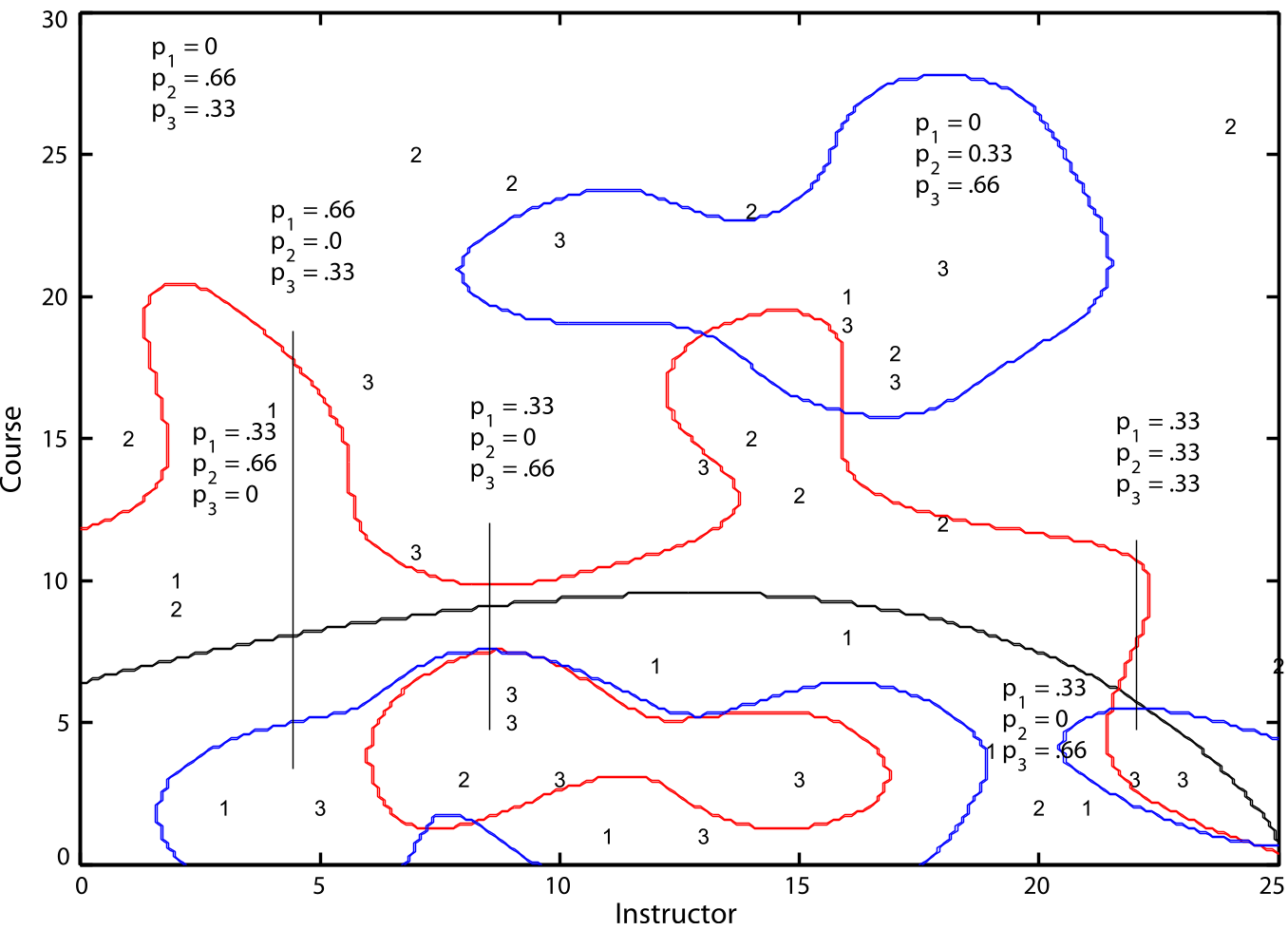 Figure: The One-versus-One learning schema used to handle multi-class satisfaction levels (1 to 4 scores).
Strategic Insights: What Actually Matters?
The results from IESEG (France) and the University of Verona (Italy) revealed fascinating cultural and strategic differences:
The IESEG Tree: Ease of Learning is King
For the French private school, Perceived Ease of Learning (PEL) was the primary splitter. If the material was too complex, satisfaction plummeted regardless of how "dynamic" the professor was.
- Action taken: Management shifted focus toward "learning facilitators" rather than just "subject experts" and strictly monitored workloads to match credit hours.
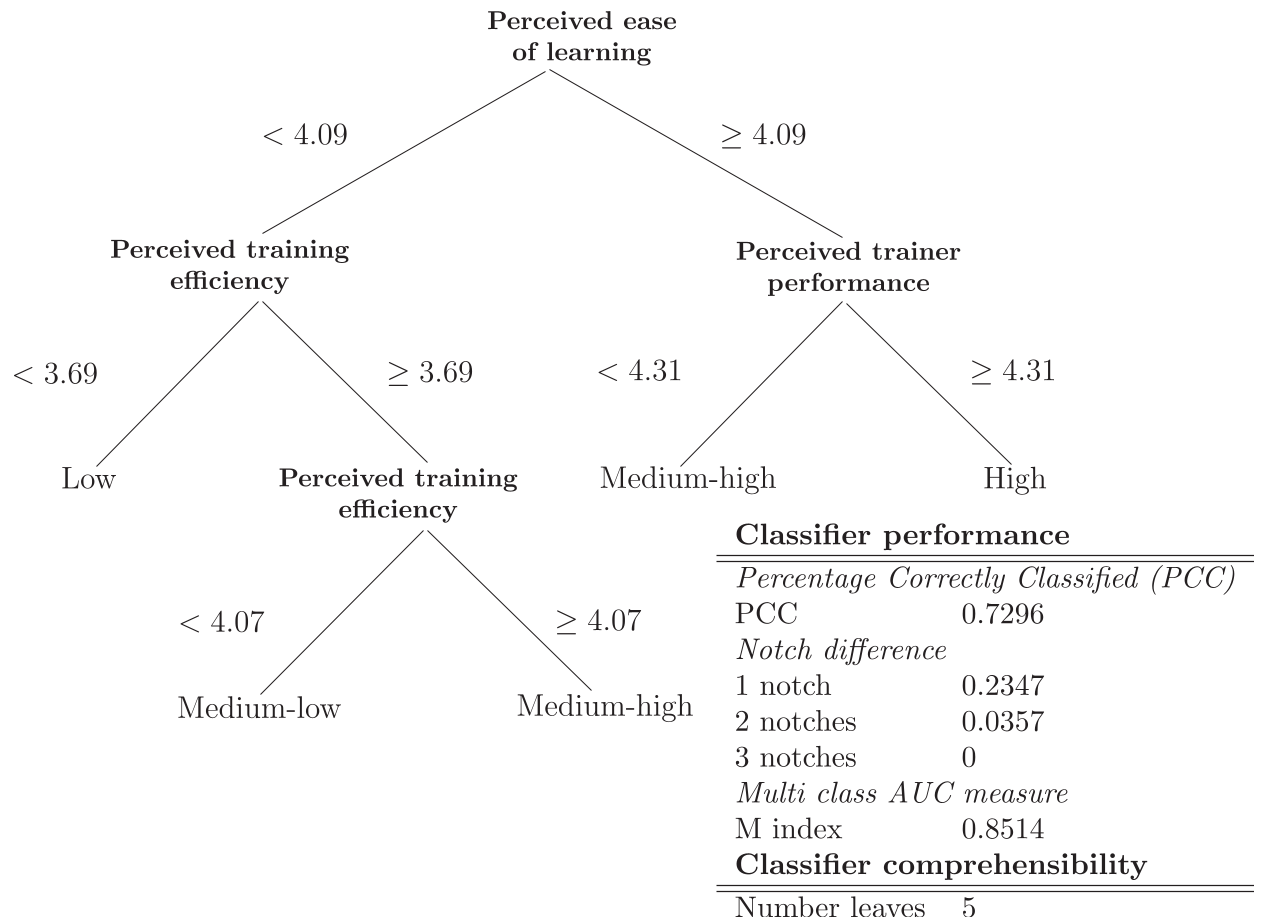 Figure: The final Rulex SVM tree for IESEG shows high reliance on PEL and Trainer Performance (PTP).
The Verona Tree: The Cultural Divide
In Italy, students viewed it as their own duty to master the material, so PEL vanished from the tree. Instead, Perceived Trainer Performance (PTP)—the atmosphere and clarity—became the sole dominant factor.
The "Non-Event" Attributes
Perhaps the biggest win for faculty was what the models didn't include. Professor Availability outside class hours did not appear in any final tree. This allowed management to grant professors more flexibility (e.g., working from home for research) without fear of damaging student satisfaction scores.
Critical Analysis & Conclusion
Takeaways
The study proves that Data Mining in OR isn't just about "beating the baseline"; it's about Knowledge Elicitation. By using Rule Extraction, the authors provided a "mental fit" between the data and the decision-makers.
Limitations
- Stakeholder Bias: The study exclusively uses student data. It ignores other crucial metrics like research output or financial sustainability.
- External Validity: As the authors note, these specific trees are "local." A tree for a university in India or the US would likely look different due to varying internet penetration and cultural expectations of the "Professor" role.
Looking Forward
This "Comprehensible Data Mining" approach is a blueprint for service industries. Whether in hospitals or hotels, the goal of AI should be to simplify the complex world into a few "IF-THEN" rules that a human manager can act upon on Monday morning.