
Deciphering the Digital Classroom: How Student Viewing Behaviors Predict Academic Success
Exploring Student Viewing Behaviors in Online Educational Videos
This paper evaluates a framework for monitoring and analyzing student interactions with online educational videos. By logging granular media actions and viewing sequences, the authors categorize specific behaviors and quantify the impact of video consumption on academic performance in higher education settings.
TL;DR
Educational videos have become a cornerstone of modern pedagogy, but how students actually watch them remains a mystery to most instructors. This study validates a framework that moves beyond "did they watch it?" to "how did they watch it?". By analyzing over 6,000 viewing sessions, the research proves that specific interaction patterns correlate with a significant increase in final grades, while exposing a massive discrepancy between what students claim to do and what they actually do.
Background Positioning
Sitting at the intersection of Learning Analytics and Educational Data Mining, this work transitions from descriptive statistics (surveys) to behavioral informatics. It validates the "Viewing Behavior Framework" by applying it to two specific higher-education courses (Computer Science and Communication Tech), providing empirical evidence for the efficacy of video-based learning.
The Motivation: Why Surveys Are Not Enough
The authors highlight a critical "honesty gap" in educational research. In their "IC1" course, 66 students claimed in surveys to have used video lessons, but system logs proved only 47 actually did. This triangulation gap necessitates automated monitoring tools.
Beyond simple attendance, the authors seek to understand the Inductive Bias of different viewers:
- Is a student rushing through (Zapping)?
- Are they struggling with a concept (Re-watching)?
- Are they using the video as a primary source or a last-minute exam cramming tool?
Methodology: Mining the Media Stream
The heart of the research is a data model that captures "Media Actions." Unlike standard players that only track "View Count," this framework logs:
- Discrete Events: Pauses, resumes, and jumps.
- Sequence Graphs: Visualizing the path a student takes through a video's timeline.
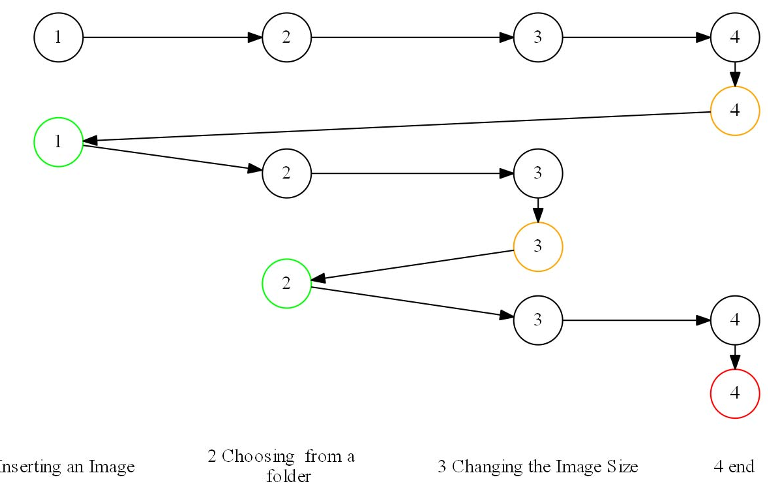
Figure 1: A sequence graph showing a non-linear interaction where a student re-watches specific sections, indicating a deep dive into complex material.
Experimental Results: The Proof in the Performance
The most compelling finding is the direct correlation between video engagement and academic outcomes.
1. Performance Boost
Using an independent samples t-test, the researchers found a statistically significant difference in grades. Students interacting with the video content outperformed their peers by nearly 25% on average.
| Group | Mean Grade | Significance |
|---|---|---|
| Did not watch | 5.68 | p=0.000 |
| Watched ≥1 video | 7.04 | p=0.000 |
2. Behavioral Patterns
The study classified 5,331 viewings into distinct styles. While "Sequential Viewing" (watching start to finish) remains the gold standard (61%), the "Sequential Drop-off" (11.95%) highlights where content might be losing student interest.
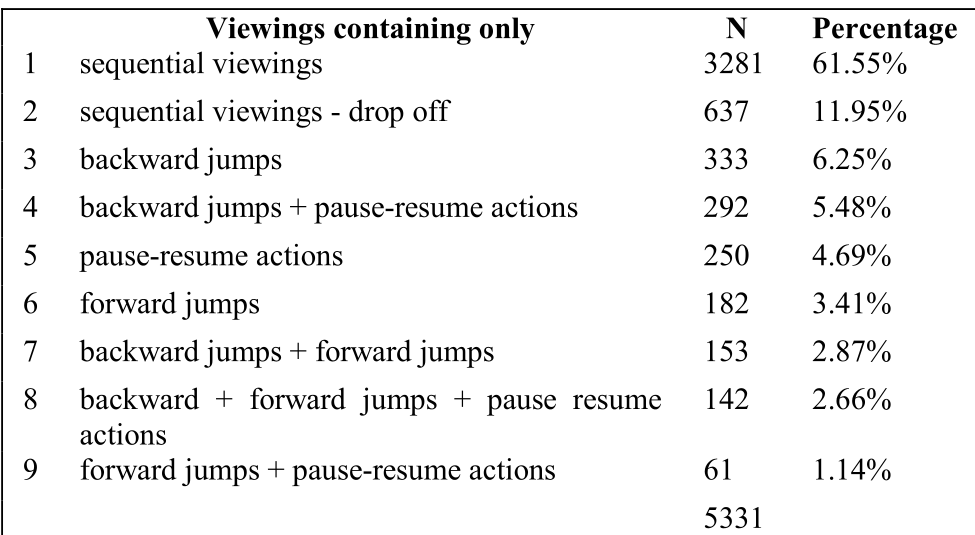
Table 2: Breakdown of viewing actions. Notably, backward jumps (re-watching) are significantly more common than forward jumps (skipping), suggesting that students use videos primarily for clarification.
Critical Insights & Conclusion
The "Exam Crunch" Phenomenon
Data shows that 50-60% of all viewings occur in the seven days preceding an exam. This indicates that while videos are effective, they are often used as "salvage tools" rather than consistent learning aids throughout the semester.
Takeaway for Educators
- Video > Text: Students overwhelmingly preferred video demonstrations over equivalent text/image handouts (6,043 vs 475 interactions).
- Actionable Analytics: Educators can use "Backward Jump" hotspots to identify which parts of their lectures are confusing and require further clarification in class.
Limitations
The study is limited to specialized technical courses (Word, Excel, Dreamweaver). The "optimal" viewing behavior might change significantly in more theoretical or abstract disciplines (e.g., Philosophy or High-level Mathematics) where "elaborative" viewing styles might become even more dominant than linear ones.
Future Work: The authors aim to utilize this dataset for more advanced data mining to predict learning outcomes in real-time, potentially flagging "at-risk" students based on their viewing sequences before they even sit for an exam.