
Social Media in the Classroom: Bridging the Gap Between Hype and Higher Education
Students’ Experience and Perception on E-Learning Using Social Networking
This paper explores first-year higher education students' experiences with Social Networking (SN) and their perceptions of its utility for e-learning. Utilizing a quantitative survey at the Caritas Institute of Higher Education, it identifies SN as a potent latent platform for collaborative learning and community building.
TL;DR
Is Facebook just a distraction, or is it the future of the classroom? This study analyzes how first-year college students interact with social networking (SN) and whether those habits can be harnessed for e-learning. The verdict: Students love the community of SN, but half of them are still stuck in traditional learning ruts. The key to the future lies in merging social habits with academic goals.
Background & Motivation: The Looming LMS Fatigue
For years, higher education institutes have poured resources into specialized Learning Management Systems (LMS). Yet, these platforms often feel like "ghost towns" compared to the bustling activity of Facebook or Twitter (now X).
The authors recognize a critical paradox: while students spend hours on Web 2.0 applications—sharing insights and building communities—they don't necessarily transfer those collaborative behaviors to their formal studies. The researchers set out to determine if a student’s "loyalty" to social media could be the "X-factor" that motivates them to engage in digital learning.
Methodology: Measuring the "SN Loyalty"
The research team surveyed 70 first-year students to minimize bias from prior exposure to the institute's specific LMS. They focused on two core factors:
- SN_loyalty_attitude: Do students feel like members of an online community? Do they feel "lagged behind" if they don't log in?
- SN_learning_perception: Do students believe SN helps them learn? Do they prefer it over traditional LMS for assignment discussions?
By using Linear Regression Analysis, the authors sought to prove that if you can capture a student's social interest, you've already won half the battle in e-learning.
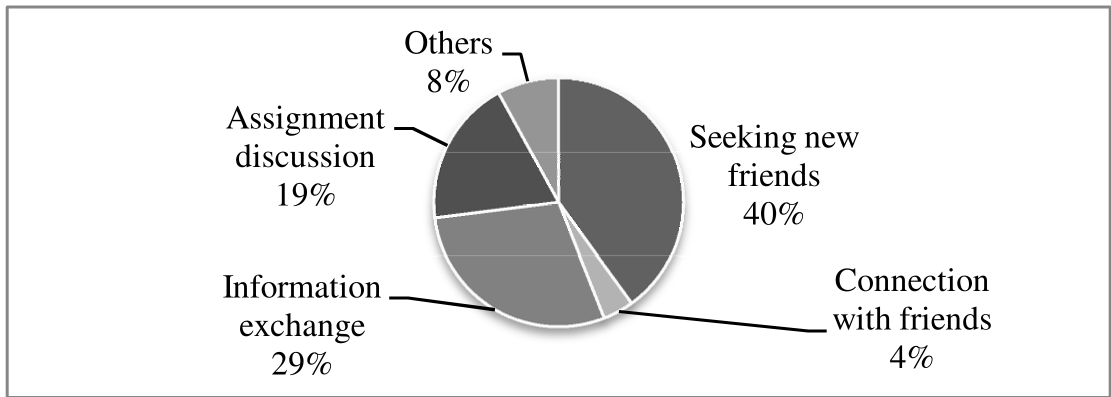 Figure 4: Students are already using social networks for information exchange (29%) and homework discussion (19%), proving the educational potential is already being tapped informally.
Key Results: A Divided Digital Generation
The study revealed a stark divide in student behavior:
- The Pro-Tech Group: There is a statistically significant correlation (Beta = 0.415, p = 0.006) between SN loyalty and positive learning perceptions. The more ingrained SN is in a student's life, the more likely they are to see it as a valid learning tool.
- The Traditionalist Resistance: Paradoxically, 50% of respondents still do not regularly use any technology-based tools to assist their learning. They remain hesitant to move away from traditional paper-and-pen or face-to-face strategies.
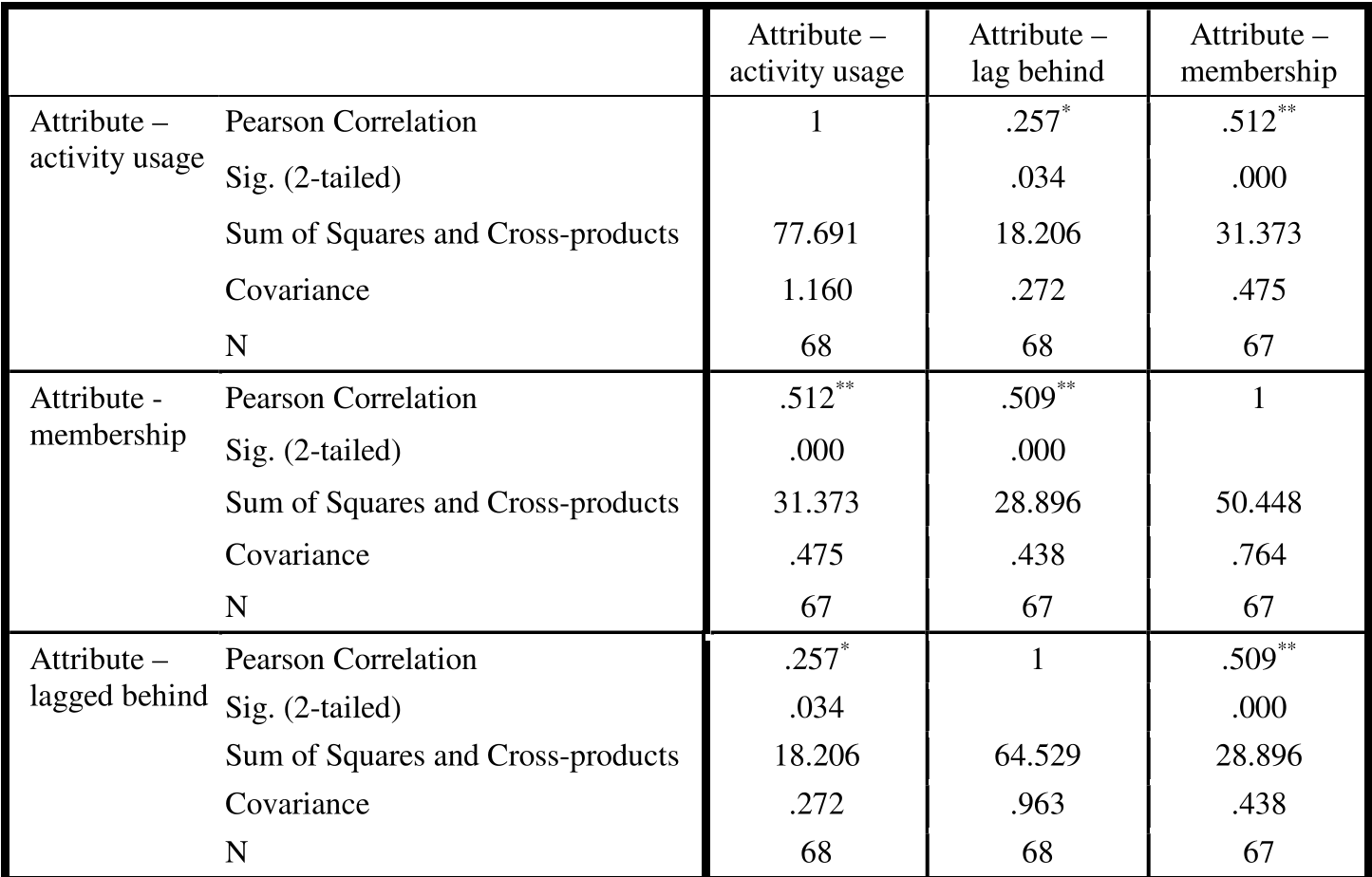 Table 1: High correlations between activity usage, membership feeling, and the fear of "lagging behind" indicate that SN is a psychological necessity for modern students.
Deep Insights: Why Students Resist
The paper posits that "technology resistance" isn't about the capability to use the tools—since 97% have accounts—but rather a lack of intention. Students view SN as a social space and LMS as a "chore" space.
The authors suggest that the "Ideal Platform" isn't a new piece of software, but a Blended Strategy. If instructors design activities within the social spaces students already inhabit (e.g., Facebook groups for peer modeling), they can leverage "Situated Learning Theory" to make education a natural part of social life.
Critical Analysis & Conclusion
Takeaway
The study successfully correlates social media habituation with e-learning readiness. It suggests that the future of pedagogy is not in building better silos (LMS), but in breaking down the walls between social interaction and academic collaboration.
Limitations
- Sample Size: With only 70 students, the results are "preliminary" and specific to a Hong Kong context.
- Platform Shift: The study focuses heavily on Facebook (popular in 2012-13). Modern students have shifted to platforms like Instagram, TikTok, and Discord, which may require different pedagogical strategies.
Future Outlook
For educators, the path forward is clear: Don't fight the feed. Instead of banning social media or forcing students into clunky LMS forums, integrate academic tasks into the social stream. Meeting students where they are is the most effective way to foster a 21st-century "Community of Practice."