
Proactive Guardians: Leveraging SNS Data Mining for Student Mental Crisis Intervention
Research on Students' Mental Crisis Monitoring and Intervention Mechanism Based on Online Social Network
This paper proposes a students' psychological crisis monitoring and intervention mechanism leveraging school domain networks and Social Networking Services (SNS). It utilizes web robots for real-time data collection and data mining techniques to identify high-risk emotional patterns in students' online posts.
TL;DR
This research addresses the urgent need for a proactive mental health warning system in universities. By monitoring school-domain social networks (SNS) and applying data mining to student-generated content, the authors propose a mechanism to identify psychological crises in their infancy, bridging the gap between digital "cries for help" and real-world clinical intervention.
Background & Motivation: The "Invisible" Warning Signs
In the Web 2.0 era, students express their deepest emotions through blogs and micro-blogs. A tragic example cited in the paper—a Tsinghua University student who left a "DIE" signature on her blog before committing suicide—highlights a systemic failure: the warnings are there, but no one is watching the digital space in real-time.
The core challenge is two-fold:
- Data Volume: The speed and capacity of internet updates outpace human surveillance.
- Lag in Intervention: Traditional methods are "reactive," occurring only after a student reaches out or a tragedy happens.
Methodology: The Architecture of Digital Vigilance
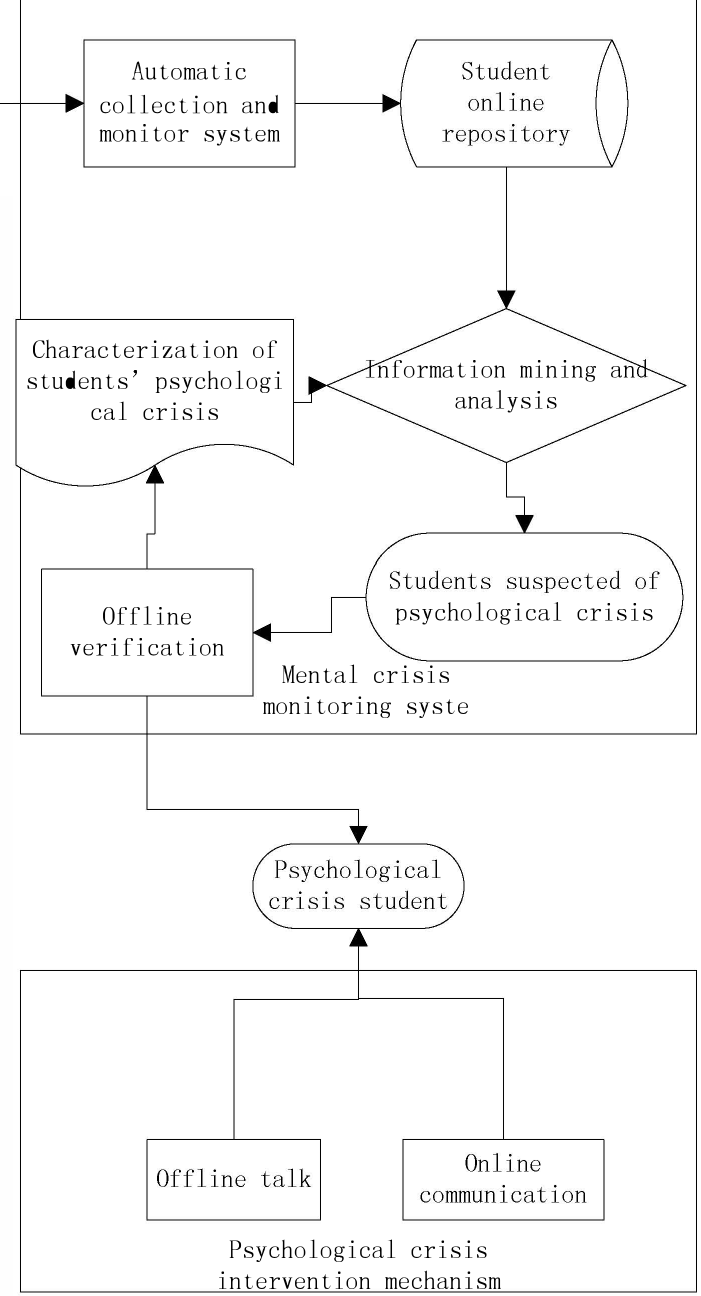
The authors propose a closed-loop system that moves from automated data scraping to human-centric intervention.
1. Automated Collection (The Web Robot)
The system utilizes web robots tailored to school-specific domains (like the then-popular xiaonei.com). Since these sites use dynamic templates, the robots are programmed to recognize structural patterns and extract real-time status updates, moods, and profile signatures.
2. Formal Representation & Data Mining
To identify a "crisis," the paper defines a taxonomy of four crisis types:
- Situational: Unexpected trauma (e.g., loss of a relative).
- Development: Growth-related conflicts (e.g., family issues).
- Inner: Subconscious outbreaks (e.g., extreme inferiority).
- Existing: Loss of life meaning or goals.
By matching keywords derived from professional psychological frameworks against the scraped database, the system flags "suspected" individuals for review.
Parallel Intervention: Scaling the Solution
The method doesn't stop at detection. It advocates for a Parallel Intervention Mechanism:
- Online: Utilizing instant messaging and anonymous "mental health emails." This lowers the barrier for students who are "afraid to go mad" or feel shame in seeking face-to-face help.
- Offline: Establishing "Psychological Navigation" newspapers, hotlines, and training campus counselors to act immediately once a digital flag is confirmed.
Critical Insight & SOTA positioning
While this paper (circa 2009-2010 context) focuses on keyword matching and basic web crawling, it laid the foundational "Logic Flow" for modern AI-driven mental health monitoring.
The SOTA (State of the Art) has since moved toward Transformer-based sentiment analysis, but the Core Intuition remains the same: The digital self is often more honest than the physical self. The paper's strength lies in its "Parallel" philosophy—acknowledging that technology can detect, but only humans can truly intervene.
Conclusion & Future Outlook
The research underscores that mental health education must be "scientific and operational."
Limitations: The paper relies heavily on keyword matching, which may miss nuanced cries for help (sarcasm, metaphors). The Future: Modern iterations of this work would likely incorporate Multimodal Analysis (analyzing images/emojis) and Graph Analysis to see if a student is becoming socially isolated from their digital peers.
Ultimately, this work serves as a blueprint for "Smart Campuses" where the network serves not just as a tool for information, but as a sentinel for student well-being.