
Securing the Social Mind: A Stochastic Defense Against Malicious Opinion Manipulation
A study on the security of public opinion in social networks
This paper introduces a tri-categorical opinion dynamics model (Suspects, Defenders, Masses) aimed at securing social networks against malicious "terrorist" influences. Leveraging an extended Friedkin-Johnsen (FJ) model with random communication probabilities, it provides a strategy to prevent universal consensus on harmful ideologies.
TL;DR
Social networks are vulnerable to "ideological hijacking" by malicious actors (terrorists or bad actors). This paper proposes a tripartite model—Suspects, Defenders, and Masses—to study how government-backed positive signals can prevent society from falling into a malicious consensus. By factoring in the randomness of human interaction, the study provides a mathematical proof for maintaining ideological diversity and social stability.
Background: Beyond Simple Consensus
Most classical models (like DeGroot) treat social influence as a path toward one of three ends: Consensus (everyone agrees), Clustering (echo chambers), or Polarization (two extremes). However, these models rarely account for a coordinated attack on public opinion. This paper positions itself as a "Security Study," treating certain opinions not just as data points, but as threats to social stability.
The Problem: The Fragility of the "Masses"
The authors identify two fatal flaws in existing social network research:
- Lack of Dynamic Defense: They don't account for proactive "Defenders" who push stabilize the system.
- Over-Idealized Communication: They assume neighbors talk all the time. In reality, fatigue, lack of interest, or algorithm shifts mean we only interact with a fraction of our network at any given moment.
Methodology: The Suspect-Defender-Masses (SDM) Framework
The core of the paper is an extended discrete-time network dynamics model.
1. The Tripartite Actors
- Suspects (): Influenced by a "terrorist" input () at . They unknowingly spread malicious opinions.
- Defenders (): Influenced by a "pro-government" input (). They act as stabilized anchors.
- Masses (): Neutral individuals who only update based on their neighbors.
2. Random Communication Probability
Interaction isn't guaranteed. The adjacency matrix is stochastic: an edge only "activates" if a random variable is less than a threshold . This adds a layer of robustness (and complexity) to the linear algebra.
3. The Mathematics of Convergence
The system is represented by the vector form: The authors use the spectral radius () of the weighted transition matrix to determine if the system will stabilize. Specifically, they prove that the "Proximity Degree"—the distance between public opinion and malicious input—can be controlled via the influence of defenders.
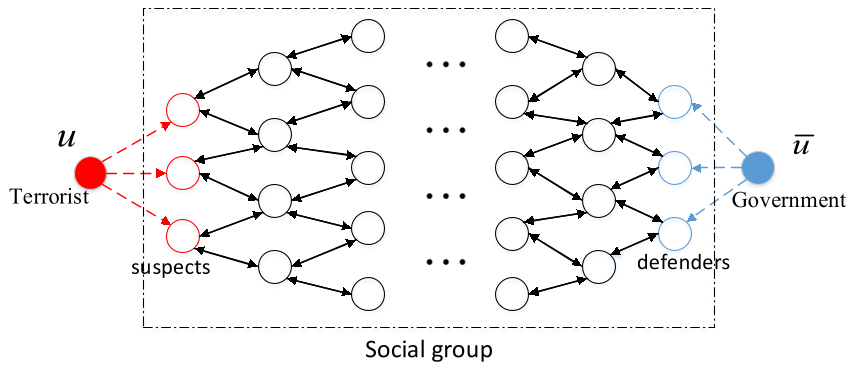 Fig 1: The social topology showing the terrorist (red) influencing suspects and the government (blue) influencing defenders.
Experimental Insights: Numerical Proof
The authors simulated a network of 8 agents and a larger network of 1,000 agents to test their hypotheses.
The "No-Defender" Catastrophe
As shown in Fig 2, when only suspects and masses exist, the Expected Opinion converges purely to the malicious vector . In a real-world scenario, this represents a total public opinion crisis where the entire network adopts a harmful ideology.
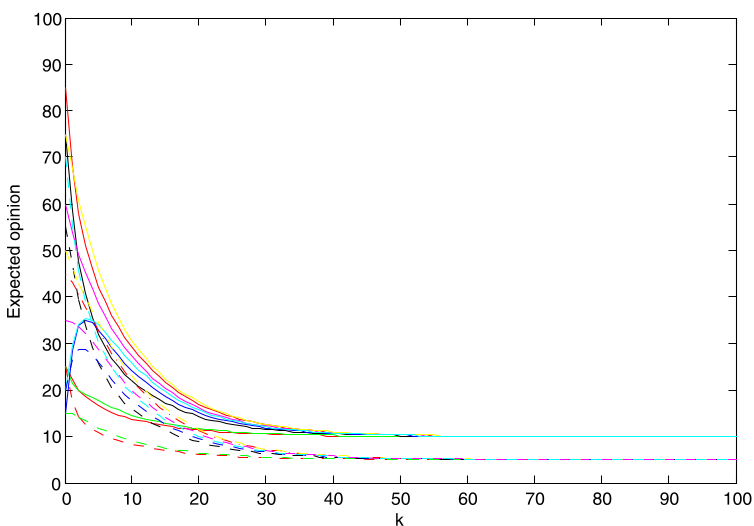 Fig 2: Trajectory of expected opinion WITHOUT defenders—consensus on malice.
The Defender Shield
When defenders are introduced (Fig 3), the network breaks into Opinion Clusters. Crucially, the masses are no longer absorbed by the malicious signal. Instead, they find a "middle ground" influenced by both sides, preserving social stability.
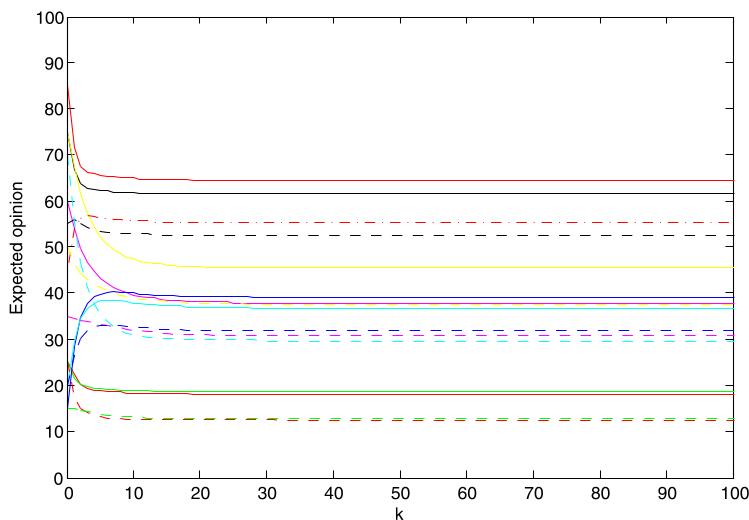 Fig 3: Trajectory of expected opinion WITH defenders—ideological clustering prevents crisis.
Critical Analysis & Future Work
Takeaway: The most significant finding is that "Defenders" don't need to be overwhelmingly powerful; they just need to exist. Their presence shifts the "spectral balance" of the social network matrix, preventing the malicious eigenvalue from dominating.
Limitations:
- Synchronicity: The model currently assumes all agents update their opinions at the same timestep ().
- Static Topology: While communication is random, the underlying friendships (edges) are fixed.
Future Outlook: The authors suggest moving toward Asynchronous Communication models and optimizing the amount of defenders. In the era of LLM-driven botnets, this research provides a vital mathematical foundation for "Defense-in-Depth" within digital social spaces.