
Urban Vitality Decoded: Ranking Public Plazas through PageRank and Foursquare Data
Studying Successful Public Plazas in the City of Murcia (Spain) Using a Ranking Nodes Algorithm and Foursquare Data
This paper presents a comparative analysis of public plazas in Murcia, Spain, by integrating the Adapted PageRank Algorithm (APA) with social media data from Foursquare. The study establishes a dual-ranking system that correlates theoretical urban centrality with real-world user preferences, identifying the historic center as the primary hub of urban success.
TL;DR
This research investigates what makes a public plaza "successful" by merging traditional urban graph theory with modern social media analytics. By applying an Adapted PageRank Algorithm (APA) to the city of Murcia, Spain, and comparing it with Foursquare check-in data, the authors reveal a striking alignment between a plaza's mathematical importance and its popularity among citizens—driven largely by the density of cafes and small shops.
Problem & Motivation: The Gap in Urban Analysis
Urban planners have long struggled to bridge the gap between form (the physical layout of streets) and function (how people actually use those spaces). Traditional fieldwork is accurate but labor-intensive and static. On the other hand, social media data—specifically Location-Based Social Networks (LBSNs)—offers a treasure trove of "living" data, yet it lacks the structural context of the urban fabric.
The authors' intuition was simple: A plaza isn't just a node in a graph; its success is a product of its connectivity and the commercial "magnets" (like restaurants and shops) surrounding it.
Methodology: From Web Search to Street Search
The study employs a dual-layered methodology:
1. The Primal Graph & APA Algorithm
The city center of Murcia is modeled as a Primal Graph, where intersections are nodes and streets are edges. To calculate the importance of these nodes, the authors use the Adapted PageRank Algorithm (APA). Unlike the standard Google PageRank that looks at link structures, APA incorporates a Data Matrix (D) representing local facilities:
- Type I: Bars, restaurants, and cafes (Food-service).
- Type II: Small retail shops.
- Type III: Banks and offices.
- Type IV: Large department stores.
2. Social Media Validation (Foursquare)
The researchers extracted data for 72 plazas from Foursquare, focusing on the number of Visits and Check-ins. This served as the ground truth for "user preference."
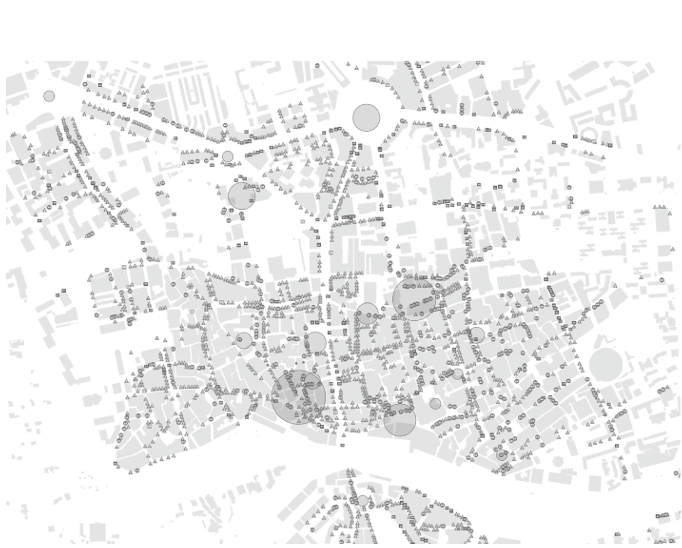 Figure: The distribution of plazas overlaid on the food-service facility density map.
Experiments & Results: Where Math Meets Reality
The results confirm that the "heart" of Murcia resides in its historic center. The APA algorithm generated a chromatic scale ranking (from cold to warm colors) that visually identified the most influential plazas.
- Top Performer: The Plaza de las Flores achieved a perfect match, ranking #1 in both the APA theoretical model and Foursquare popularity.
- Commercial Drivers: There is a nearly direct correlation between the success of a plaza and the presence of Type I facilities (Food & Drink). Successful public spaces in Murcia are effectively "food hubs."
- Spatial Concentration: The visualization shows that success is not evenly distributed; it heavily clusters in the narrow, irregular layout of the ancient city center, proving that "place identity" and historic density play roles that newer, wider urban layouts struggle to replicate.
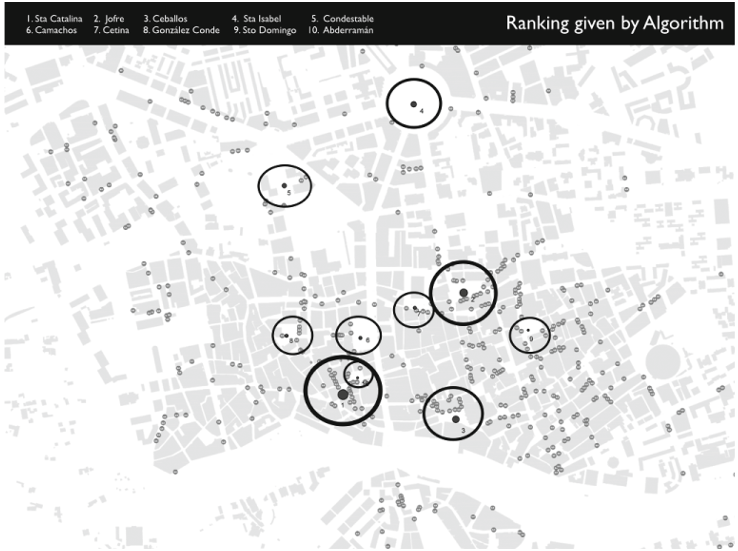 Figure: The APA Algorithm results visualized across the urban graph. Warm colors indicate nodes with higher centrality and commercial weight.
Critical Analysis & Conclusion
Takeaway
The study successfully demonstrates that urban centrality is a weighted phenomenon. You cannot understand a plaza's success by looking at geometry alone; you must look at the "digital breadcrumbs" left by users and the commercial offerings of the space.
Limitations
- Demographic Bias: Foursquare users typically represent a specific demographic (younger, tech-savvy), which might overlook how the elderly or children interact with these plazas.
- Temporal Limits: The data is "historical accumulated," meaning it doesn't account for how a plaza's popularity might shift between day and night or across seasons.
Future Outlook
This framework provides a scalable way for city "Smart City" initiatives to monitor urban health. Future iterations could integrate real-time data or sentiment analysis from social media reviews to determine not just if a plaza is visited, but why people love or dislike it.