
Stumbl: Bridging the Gap Between Digital Socializing and Physical Contacts
Stumbl: Using Facebook to collect rich datasets for opportunistic networking research
This paper introduces Stumbl, a Facebook-based application designed to collect multi-dimensional datasets for opportunistic networking research. It successfully captures the tripartite correlation between physical mobility (contacts), social relations, and digital communication patterns within a unified user group.
TL;DR
Opportunistic networks (OppNets) rely on human movement to pass data. To optimize these networks, we need to know who meets whom, who likes whom, and who talks to whom. The Stumbl application, built on Facebook, creates a unique "trinity" dataset by combining automated digital interaction logs with daily self-reported face-to-face meeting data. The killer insight? Digital communication is a massive force multiplier for physical proximity—you are 10x more likely to message a friend you see in person.
The Missing Link in OppNet Research
Most researchers in the Delay Tolerant Networking (DTN) space are flying blind. They might have a Bluetooth trace of who was near whom (Mobility), or they might have a crawl of a social graph (Social), but they rarely have both for the same group of people.
Why does this matter? Because a "contact" between a colleague and a family member has different implications for data routing. A short meeting at a coffee machine has low data capacity, while an evening at home has high capacity. Existing datasets lacked the context of "Why" and "How" people interact.
Methodology: Social Media as a Research Sensor
Stumbl utilizes the "habitual" nature of Facebook usage to reduce participant attrition. It functions in two phases:
- Initialization: Users categorize their top 20 "frequent" contacts into Family, Friend, Colleague, or Acquaintance.
- Reporting: A lightweight daily survey captures the duration and context of meetings from the previous day. Simultaneously, the Facebook API scrapes "Wall Posts," "Comments," and "Likes" to quantify digital intimacy.
 Figure 1: The Stumbl reporting interface, designed for quick, 5-minute daily data entry.
The "Local" Nature of Digital Communication
The core finding of the Stumbl experiment is a strong argument for the viability of opportunistic networks. Researchers found that digital communication is not used just to "keep in touch" with distant friends; rather, it is heavily used to supplement face-to-face relationships.
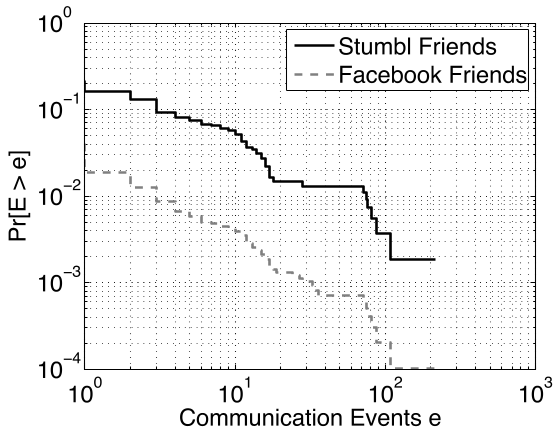 Figure 2: CCDF showing that "Stumbl Friends" (those met in person) have significantly higher interaction rates than general Facebook friends.
Key Breakthroughs:
- The 10x Factor: On average, a user interacts digitally 10 times more with someone they meet physically than with a random Facebook friend.
- Relationship Heterogeneity: Family ties result in long, frequent meetings. Colleagues meet often but briefly (transient "crossing" events).
- Context Matters: Most meetings (work/fun) happen in specific clusters, which is vital for building predictive "Traffic Models" in mobile networks.
Critical Analysis & Conclusion
The Stumbl experiment demonstrates that Social Tie Type is a powerful predictor for both mobility and communication. For developers of routing protocols like Bubble Rap or PeopleRank, this suggests that integrating OSN data isn't just a "nice-to-have"—it provides a precise roadmap of the most reliable data "mules" in a network.
Limitations & Future Work
While the study is pioneering, the sample size (39 participants) is a "PhD-level" pilot rather than a global scale-up. The authors also acknowledge a "Facebook bias"—these users are more technologically savvy than the average population. Future iterations involve gamifying the reporting process to scale the dataset and potentially integrating automated sensing (like GPS) to reduce self-reporting errors.
Takeaway: The correlation between physical and digital presence is the "secret sauce" for future 6G and opportunistic systems. If you know who someone comments on, you likely know who they will physically bump into tomorrow.