
STUN: Scaling Spatio-Temporal Uncertainty in Massive Social Networks
STUN: Spatio-Temporal Uncertain (Social) Networks
This paper introduces STUN (Spatio-Temporal Uncertain Networks), a framework extending social networks with spatial regions, temporal intervals, and uncertainty certainty factors. It proposes a formal query language and an efficient disk-oriented indexing structure based on k-merges to enable complex subgraph matching on massive real-world datasets like YouTube.
TL;DR
STUN (Spatio-Temporal Uncertain Networks) is a breakthrough framework that allows researchers to query social networks where relationships aren't just "who knows whom," but also where, when, and how certain تلك relationships are. By combining a novel k-merge graph index with spatio-temporal pruning, the authors achieve sub-second query speeds on datasets with millions of edges, significantly outperforming previous in-memory state-of-the-art methods.
Background & Motivation: Beyond the Static Graph
Most social network models view relationships as static links. However, real-world data is messy:
- Time: Friendships begin and end.
- Space: Events happen at specific coordinates or regions.
- Uncertainty: Inferred relationships (e.g., "A and B are likely friends because they attended the same party") come with probabilistic weights.
Previous attempts to solve this, like Annotated RDF, were strictly in-memory. As networks grow to millions of nodes, these systems hit a wall. The authors of STUN identified that the key to scalability lies in disk-oriented indexing that understands the "physics" of the data—its location in space and time.
Methodology: The Power of Multi-Dimensional coarsening
The core innovation is the STUN Index, a balanced tree structure where every node is a summary of a subgraph.
1. The k-Merge Concept
To manage massive graphs on disk, STUN uses "k-merges"—a process that collapses multiple vertices into a single representative node while preserving the connectivity, spatial bounds (MBRs), and temporal bounds (MBIs). This creates a hierarchy of abstractions.
2. Spatio-Temporal Partitioning
When building the index, the algorithm doesn't just look at who is connected to whom. It uses a distance function () that considers:
- Temporal Overlap: Do these two nodes share time intervals?
- Spatial Proximity: Are they physically close?
- Certainty: High-certainty edges are prioritized for clustering.
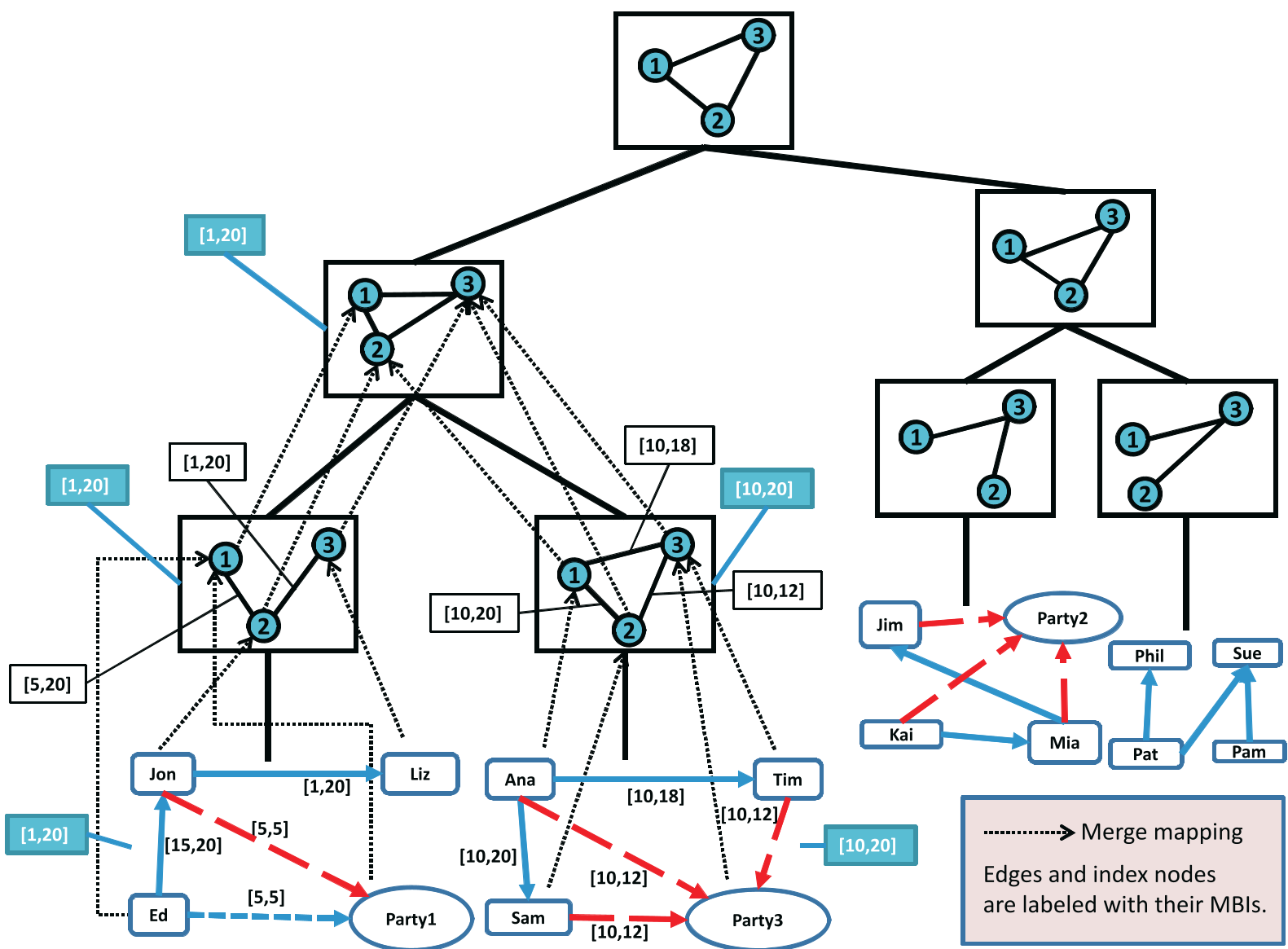 Figure 1: The STUN index structure showing how knowledge base edges are merged and annotated with Spatio-Temporal MBIs.
Querying the Chaos
The STUN query language allows users to define subgraphs with constraints like inside(?location, Maryland) or during(?time, [2020, 2021]).
The answerQuery algorithm uses a "Greedy Variable Choice" strategy. It starts by finding candidates for the variable with the fewest possibilities. As it traverses the index, it uses the MBRs and MBIs of the higher-level nodes to rule out entire branches of the disk-stored graph that cannot possibly satisfy the query constraints.
Experimental Results: Complexity is an Advantage
The authors tested STUN on a YouTube dataset. The results reveal a counter-intuitive but brilliant insight: The more constraints you add (Space/Time/Uncertainty), the faster the query runs.
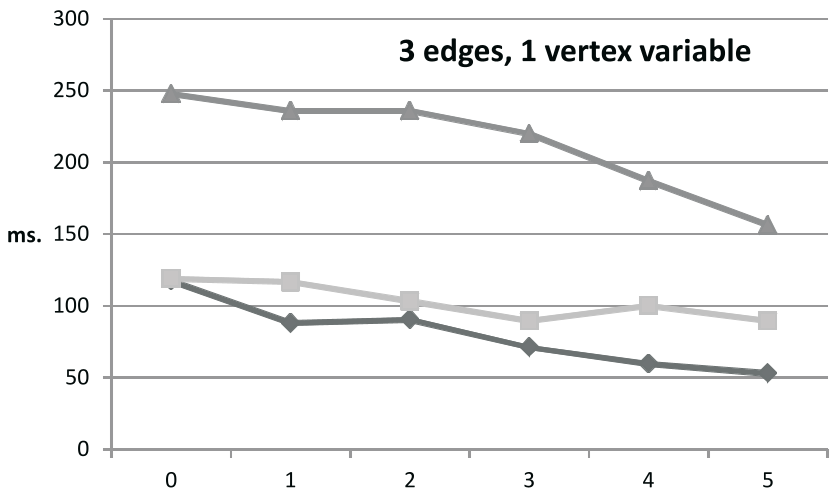 Figure 2: Query execution time drops as the number of constraints increases, demonstrating effective search-space pruning.
- Scalability: On a 1-million-edge graph, complex 5-variable joins were resolved in under 2 seconds.
- Efficiency: Simple queries often took less than 0.5 seconds, even when reading from disk.
Critical Analysis & Future Outlook
STUN successfully fills a critical gap in graph database research by moving beyond simple topology. However, there are a few areas for further exploration:
- Dynamic Updates: The current index construction (coarsening) is computationally expensive. Future work should address how the index behaves when nodes/edges are added in real-time.
- Complex Geometry: The use of MBRs (rectangles) is efficient but can be "loose" for complex, non-rectangular regions (like winding rivers or administrative boundaries).
Conclusion: STUN is a masterclass in integrating multi-dimensional constraints into graph theory. For developers building the next generation of logistics, social, or intelligence platforms, the STUN architecture provides a blueprint for making "uncertainty" computationally affordable.