
Subconscious Crowdsourcing: Decoding Mental Health through Behavioral Ripples on Social Media
Subconscious Crowdsourcing: A feasible data collection mechanism for mental disorder detection on social media
This paper introduces "Subconscious Crowdsourcing," a hybrid data collection mechanism for mental disorder detection (BPD and Bipolar) using Twitter. By combining manual verification with behavioral and linguistic pattern analysis, the authors developed a Random Forest classifier that achieves a 96% precision in user classification.
TL;DR
Mental disorders often lead patients toward social isolation, yet they paradoxically seek connection in digital "safe havens" like Twitter. This paper introduces a novel framework—Subconscious Crowdsourcing—to harvest this data reliably. By moving beyond simple word-matching to analyze "Pattern of Life" (PLF) features, the researchers developed a system capable of distinguishing patients from medical experts with high accuracy, addressing the critical problem of selection bias in clinical data science.
The "Expert-Patient" Paradox: Why Keyword Matching Fails
Most prior research in digital mental health operates on a simple premise: if a user mentions clinical terms or self-reports a diagnosis, they are a patient. However, this creates a massive Selection Bias.
On platforms like Twitter, medical professionals, clinics, and health influencers use the exact same terminology (e.g., "Bipolar," "BPD," "Lithium") as the patients they treat. A standard TF-IDF (Term Frequency) model sees no difference between a doctor sharing a research paper and a patient sharing a crisis. This paper argues that the way people interact—their emotional volatility and social engagement—is a more reliable biomarker than the words they choose.
Methodology: The Subconscious Crowdsourcing Framework
The authors propose a hybrid approach that recognizes that users "subconsciously" provide rich mental state data through their daily digital habits.
1. Data Harvesting Pipeline
The workflow involves identifying "Community Portals" (e.g., @HealingFromBPD), scraping their followers, and then manually verifying self-reported labels. This ensures the ground truth is grounded in real-world clinical status rather than just noisy keywords.
2. Feature Engineering: Beyond Text
The core innovation lies in the Pattern of Life (PLF) features, which quantify:
- Emotional Volatility (Flips Ratio): The frequency of sudden shifts from positive to negative sentiment within 30 minutes.
- Manic/Depressive Traits (Combos): Continuous streams of extremely positive or negative posts.
- Social Connectivity: Measuring "Unique Mentions" and "Tweeting Frequency" to capture signs of social withdrawal or hyper-activity.
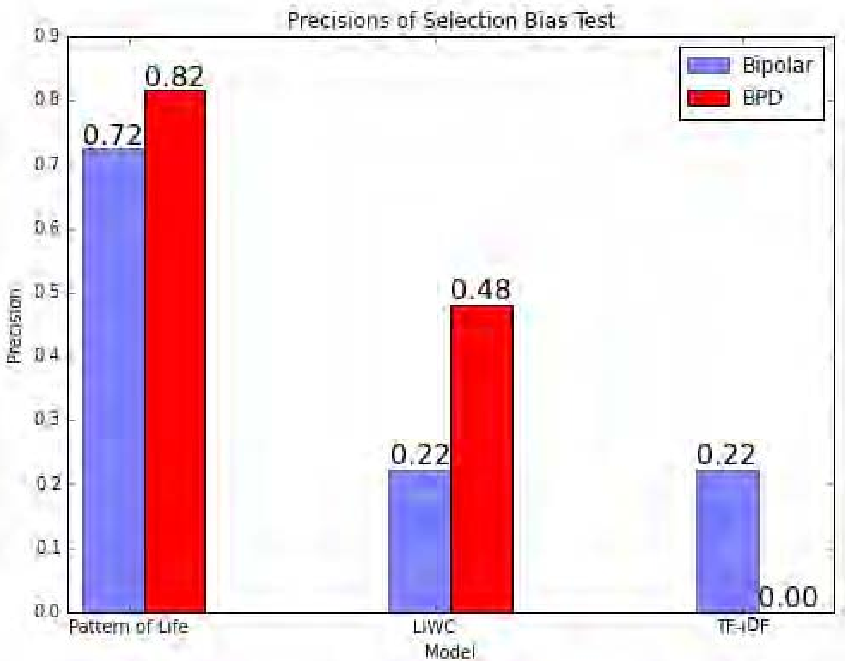 Fig 1: A comparison showing how PLF models outperform traditional TF-IDF and LIWC models in the critical selection bias test.
Experimental Insights: TF-IDF is a False Prophet
The study's results offer a cautionary tale for NLP researchers. During standard 10-fold cross-validation, the TF-IDF model boasted a staggering 96% precision. This usually indicates a "solved" problem.
However, when the authors ran a Selection Bias Test (testing the model on Expert accounts), the TF-IDF model's precision plummeted to 0% for BPD. It incorrectly labeled every single expert as a patient.
In contrast, the Pattern of Life features held steady:
- BPD Detection: 82% precision in the bias test.
- Bipolar Detection: 72% precision in the bias test.
This proves that behavioral features—like how often you mention others or how fast your mood "flips"—are the true differentiators between someone talking about a disorder and someone living with one.
Critical Analysis & Conclusion
The Value
This research shifts the focus from content to context. By formalizing "Subconscious Crowdsourcing," it provides a scalable way to build high-quality datasets that are resistant to the noise of the medical community.
Limitations
The study relies on a relatively small set of expert accounts (20 total) for its bias testing. Furthermore, as the authors note, differentiating between an expert specializing in Bipolar vs. BPD is difficult, as most clinicians are generalists.
Looking Forward
The integration of Emotion Classification and Social Interaction metrics marks a transition toward "Digital Phenotyping." Future work could involve real-time monitoring systems that alert healthcare providers when a user's "Flip Ratio" or "Negative Combo" scores cross a critical threshold, potentially preventing depressive episodes or self-harm before they occur.
Keywords: Mental Disorder Detection, Crowdsourcing, Pattern of Life, Social Media Analytics, Selection Bias.