
DECNN: Revolutionizing Cross-Subject Emotion Recognition with Dynamic EEG Features
Subject-Independent Emotion Recognition of EEG Signals Based on Dynamic Empirical Convolutional Neural Network
This paper introduces DECNN, a novel framework for subject-independent EEG emotion recognition that combines Empirical Mode Decomposition (EMD) with Dynamic Differential Entropy (DDE). Evaluated on the SEED dataset, it achieves a state-of-the-art accuracy of 97.56% for cross-subject classification.
TL;DR
Recognizing human emotions via EEG is notoriously difficult due to "brain-fingerprints"—the unique signal patterns specific to individuals. This paper presents DECNN, a hybrid approach that fuses Empirical Mode Decomposition (EMD) with Convolutional Neural Networks. By extracting Dynamic Differential Entropy (DDE), the system achieves a massive 97.56% accuracy on the SEED dataset, setting a new benchmark for subject-independent affective computing.
The "Subject Gap" Problem
Why can't we just plug EEG data into a standard AI? The "Subject-Independent" challenge is the "Holy Grail" of BCI (Brain-Computer Interface). Every person’s brain responds to the same movie clip differently based on culture, gender, and experience. Traditional models suffer from:
- Non-stationarity: EEG signals change over time.
- Noise: Eye blinks and muscle movements submerge actual emotional signals.
- Redundancy: 62 channels of raw data create a "curse of dimensionality" for small datasets.
Methodology: The DE + CNN Synergy
The authors' core "Insight" is that emotion isn't a static point in a frequency band; it's a dynamic trajectory.
1. DDE: Capturing the Pulse
Instead of analyzing the raw signal, the authors use EMD to decompose the EEG into Intrinsic Mode Functions (IMFs). Think of this as separating a choir into individual voices. They then calculate Differential Entropy (DE) within sliding windows to track how the "complexity" of these voices changes.
2. CNN: The Feature Refiner
The DDE features are organized into a 2D-like structure (Space x Time/Entropy). The CNN acts as a spatial-temporal filter, identifying higher-layer semantic information that is common across all humans, effectively ignoring the subject-specific noise.
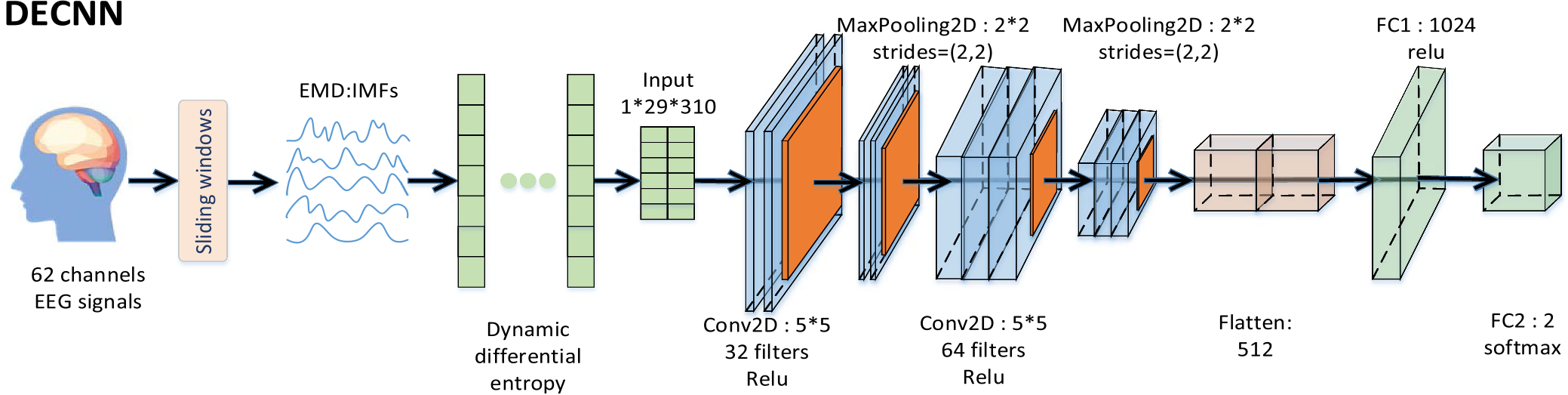 Figure: The DECNN pipeline showing the flow from raw EEG to EMD-DDE feature extraction and final CNN classification.
Experimental Breakthroughs
The team tested their model on the SEED dataset, focusing on Positive and Negative emotional states.
Performance vs. The Field
DECNN didn't just win; it dominated. With an accuracy of 97.56%, it outperformed established methods like BDAE and STRNN by a significant margin (ranging from 3% to 13%).
| Method | Accuracy | Sensitivity |
|---|---|---|
| BDAE [51] | 91.01% | 85.18% |
| DECNN (Proposed) | 97.56% | 98.67% |
The "Temporal Lobe" Secret
One of the most valuable findings for hardware developers is the Electrode Placement Study. By mapping feature differences across the scalp, the authors found that the Temporal Lobe is the "hot zone" for emotion.
Strikingly, using 20 key electrodes actually performed better than the full 62-channel set. This suggests that "less is more"—extra channels often just add noise.
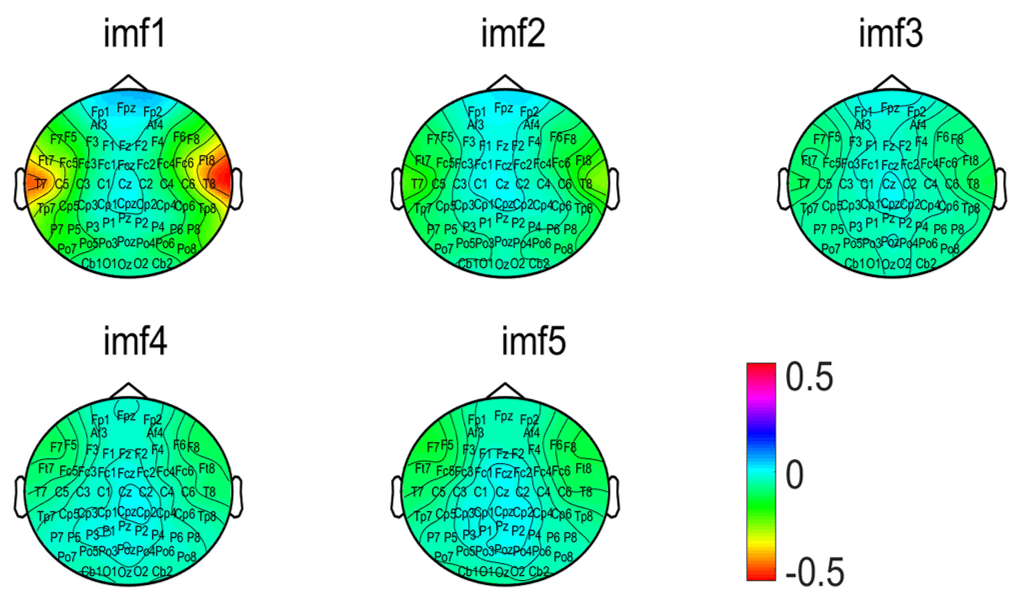 Figure: Scalp map showing the distribution of feature differences. The high-frequency IMF1 component shows the most distinct emotional separation in temporal regions.
Deep Dive: Why it works
The physical intuition behind DDE is that emotional transitions involve a shift in the brain's information processing complexity (Entropy). By using EMD, the model focuses on the Beta and Gamma bands—the frequency "channels" where high-level cognitive and emotional processing actually happens. The CNN then learns the "shape" of these entropy shifts, which are more consistent across different people than the raw waveforms themselves.
Conclusion & Future Outlook
DECNN provides a robust roadmap for real-world affective computing. By proving that high-accuracy emotion recognition is possible even across subjects and with fewer electrodes, it paves the way for wearable EEG devices that could help in diagnosing depression or enhancing human-machine interaction.
Limitations: While the cross-subject accuracy is high, the model's performance on "Neutral" states and its computational load during the EMD phase remain areas for future optimization.
Final Takeaway: To solve biological data problems, don't just throw "more layers" at the problem—clean the signal with domain-specific tools like EMD first.