
Subjective Trust in SIoT: Building Reliable Social Networks for Autonomous Objects
A subjective model for trustworthiness evaluation in the social Internet of Things
This paper introduces a subjective trustworthiness evaluation model specifically designed for the Social Internet of Things (SIoT). By integrating P2P reputation mechanisms with social relationship factors, the model enables autonomous objects to calculate trust levels of nodes, achieving high resilience against malicious and collusive attacks in service discovery tasks.
TL;DR
As the Internet of Things evolves into the Social Internet of Things (SIoT), objects are no longer just passive sensors—they are social actors. This paper presents a Subjective Trustworthiness Model that allows objects to judge their peers using a combination of personal experience, "word-of-mouth" from common friends, and the inherent social relationships (like belonging to the same owner). The result is a system remarkably resistant to malicious nodes and collusive "liar" groups.
The Need for "Social" Trust
In a world with billions of heterogeneous devices, centralized discovery is a bottleneck. The SIoT paradigm suggests that objects can discover services by navigating social links. However, this raises a critical question: How can a toaster trust a weather sensor it just met?
Traditional P2P trust models often rely on global reputation scores, which are prone to tampering. This paper argues that trust must be subjective. Each node should maintain its own "black book," weighing the opinions of its friends more heavily than those of strangers, and considering the "intelligence" of the device—because a smartphone has more capacity to cheat than a simple RFID tag.
Methodology: The Trust Equation
The core of the paper is the formalization of the trustworthiness (how much node trusts node ). The model breaks this down into a sophisticated weighted formula:
Key Components:
- Direct Opinion (): Based on personal history. It uses a Dual-Window mechanism (long-term vs. short-term) to detect "oscillation attacks" where a node builds trust and then suddenly turns malicious.
- Centrality (): Measures how many common friends the two nodes share. In a social context, "friends of friends" are statistically more reliable.
- Relationship Factor (): A unique SIoT contribution. Objects owned by the same person (OOR) are given a high base trust (0.9), while objects that only share a manufacturer (POR) start with lower trust (0.5).
- Intelligence (): The model recognizes that high-capability devices (Class 1: Smartphones) are riskier potential attackers than Class 4 (RFID) devices.
 Figure 1: The Trustworthiness Formula and Relationship Weight settings.
Experimental Validation
Using the Small World In Motion (SWIM) mobility model, the authors simulated 800 nodes. They tested the model against "Social" (benevolent) and "Malicious" (opportunistic) behaviors.
Resilience to Collusion
A major challenge in trust systems is collusion—groups of malicious nodes praising each other to inflate scores. Because this model is subjective, node weights indirect opinions by the credibility it has assigned to the recommender based on its own experience. This "filter" effectively isolates collusive groups.
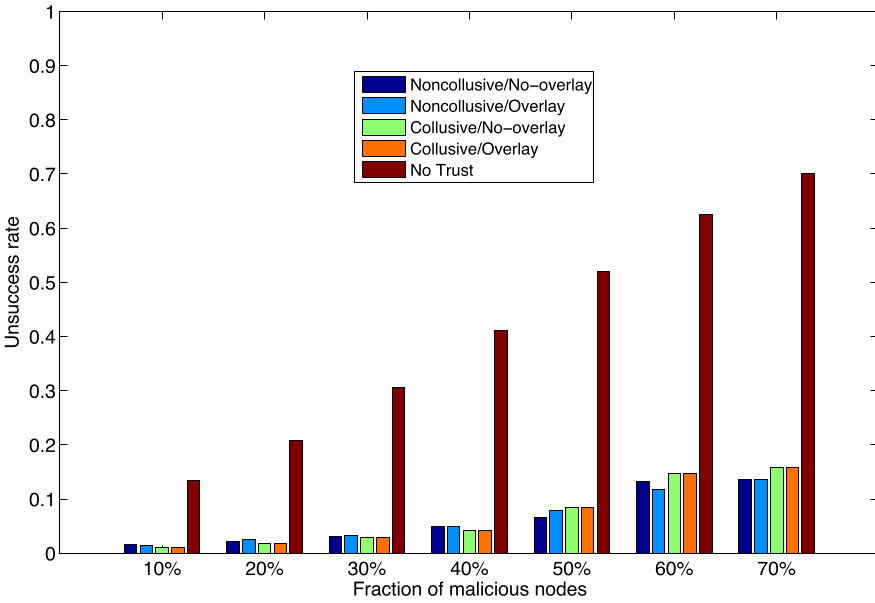 Figure 2: Transaction error rate remains stable even as the percentage of malicious nodes () increases.
Critical Insight & Conclusion
The brilliance of this work lies in the Relationship Factor. By mapping physical/human relationships (Ownership, Co-location) onto digital trust, the authors provide the system with a robust "starting point" for trust that doesn't require thousands of transactions to converge.
Limitations: While the model is robust, the Runtime Overhead (Fig. 3 in the paper) shows that as the network grows, the computational cost of querying friends increases. Future work will likely need to integrate this with "Homophily" principles—the idea that devices with similar interests cluster together—to limit the search space for trust evaluations.
In summary, this subjective model transforms the SIoT from a mere collection of connected hardware into a sophisticated, self-policing social ecosystem.