
SARD: De-biasing the Crowd through Subjectivity-Aware Label Aggregation
A Subjectivity-Aware Algorithm for Label Aggregation in Crowdsourcing
This paper introduces SARD (Subjective-Aware model with Reliability and Difficulty), a novel label aggregation algorithm for crowdsourcing. It utilizes an Expectation-Maximization (EM) framework to simultaneously estimate instance difficulty, worker reliability, and worker subjectivity to infer ground truth labels, achieving new SOTA performance across ten real-world datasets.
TL;DR
Crowdsourcing often suffers from noisy labels because workers aren't just "unreliable"—they are biased. This paper introduces SARD, an EM-based algorithm that models Subjectivity, Accuracy, Reliability, and Difficulty. By distinguishing between a worker's skill and their subjective tendency, SARD identifies the "ground truth" even when the majority of the crowd is swayed by personal bias.
Academic Positioning: This work builds upon the classic Dawid-Skene (DS) and GLAD models, positioning itself as a more robust solution for tasks where "right or wrong" is often clouded by "opinion."
The "Cat-Dog" Dilemma: Why Subjectivity Matters
In traditional crowdsourcing research, we assume a worker is "good" or "bad." However, reality is more nuanced. Consider an image of an animal that looks like both a cat and a dog. One worker might focus on the ears (concluding "dog"), while another focuses on the face ("cat").
Previous methods (like Majority Voting) fail here because they don't account for why workers disagree. If 60% of people have a specific subjective bias, the majority vote will lead to a biased ground truth.
 Fig 1: Ambiguity in crowdsourcing leads to subjective grouping of workers.
Methodology: The SARD Framework
The core innovation of SARD is the transformation of the worker's decision process into a logistic function where reliability () and subjectivity () are separate latent variables.
1. The Probabilistic Model
The probability of a worker providing the true label for instance is defined as:
- (Difficulty): As difficulty increases, the probability of a correct answer approaches 0.5 (random guess).
- (Reliability): Higher reliability increases the chance of correctness.
- (Subjectivity): This represents the worker's tendency toward category . SARD effectively "subtracts" this bias to find the objective reliability.
2. The EM Optimization
The model uses an Expectation-Maximization approach:
- E-Step: Given current estimates of reliability and subjectivity, calculate the probability of each category being the true label.
- M-Step: Update the latent parameters () to maximize the likelihood of the observed crowd labels.
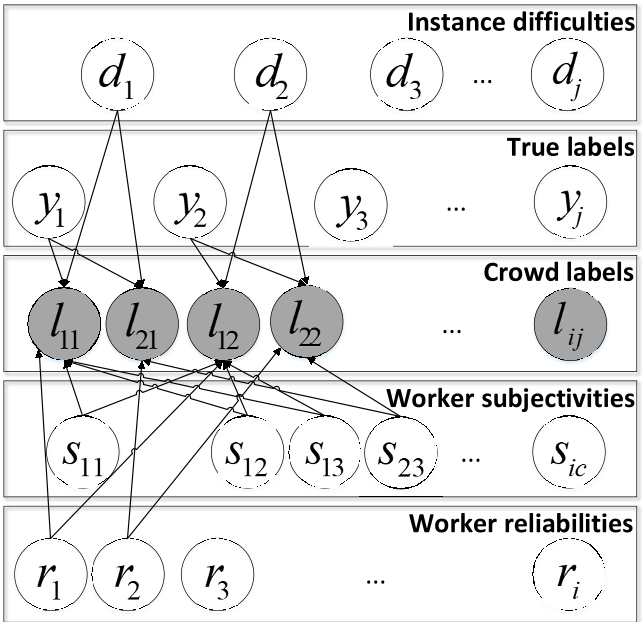 Fig 2: Graphical model showing the relationship between Latent Parameters (difficulty, truth, reliability, subjectivity) and Observed Labels.
Experimental Validation
The authors tested SARD on 10 real-world datasets, ranging from objective "Leaf" identification to subjective "Emotion" analysis in news headlines.
Key Findings:
- Superior Accuracy: SARD outperformed Majority Voting (MV), Dawid-Skene (DS), and GLAD across the board.
- High-Subjectivity Stability: In the "Emotion" datasets (Anger, Joy, etc.), where worker opinions vary wildly, SARD showed significant gains (e.g., +18% over MV in the "Anger" dataset).
- Robustness: ROC curve analysis proves that SARD remains stable even when worker quality is inconsistent.
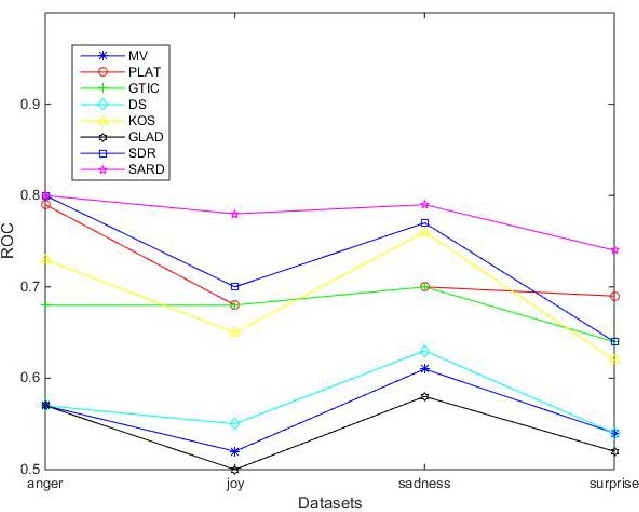 Fig 4: ROC curves on Emotion datasets demonstrate SARD's resilience to high subjectivity.
Critical Insight & Conclusion
The brilliance of SARD lies in its Fairness through De-biasing. By explicitly modeling , the algorithm doesn't just penalize a "bad" worker; it identifies where the worker is biased and adjusts their contribution accordingly.
Future Implications: While SARD is powerful, the authors note it could be further enhanced by incorporating Incentive Mechanisms—training workers to recognize their own biases—or Topic Modeling to estimate subjectivity based on the thematic content of the tasks. For any enterprise relying on LLM RLHF (Reinforcement Learning from Human Feedback), SARD offers a blueprint for cleaner, more objective data signals.