
Subsethood Networks: Bridging Linguistic Intuition and Gradient-Based Learning
10463_Subsethood based adaptive linguistic networks for pattern classification.
This paper introduces a novel fuzzy-neural network architecture that utilizes a mutual subsethood measure for signal transmission and a fuzzy inner product for activity aggregation. The model achieves SOTA-level performance in pattern classification tasks, such as the Iris and Telegu vowel datasets, while maintaining high parameter efficiency.
TL;DR
The paper presents a hybrid fuzzy-neural network designed to ingest both raw numbers and linguistic labels (like "HIGH" or "LOW") simultaneously. By replacing standard logic gates with a Mutual Subsethood measure and a Fuzzy Inner Product, the authors created a model that is not only highly accurate on benchmark datasets but also remarkably "slim" in terms of parameter count and fully differentiable for standard training.
Background: The Gap Between Logic and Learning
In the early 2000s, the challenge was to combine the interpretability of fuzzy logic (If-Then rules) with the learning power of neural networks. Most existing systems were either hard to train because they weren't differentiable, or they "squashed" linguistic data into numeric approximations too early, losing the nuance of human-like reasoning.
The authors' central insight: Signal transmission shouldn't just be a multiplication of weights; it should be a measure of compatibility between fuzzy sets.
Methodology: The Geometry of Overlap
The "Subsethood Model" represents every rule and input as a Gaussian fuzzy set defined by a center () and a spread ().
1. Mutual Subsethood Signal Transmission
Instead of , this network uses the Mutual Subsethood , which measures the commonality between the input signal and the rule's weight. This allows the network to handle cases where an input "mostly" or "partially" fits a rule's antecedent.
2. The Fuzzy Inner Product
To decide how much a rule "fires," the network uses a product of these subsethood measures. Unlike the "Min" operator, the product is smooth and differentiable, allowing the error to flow backward through the network to fine-tune the rule centers and spreads via gradient descent.
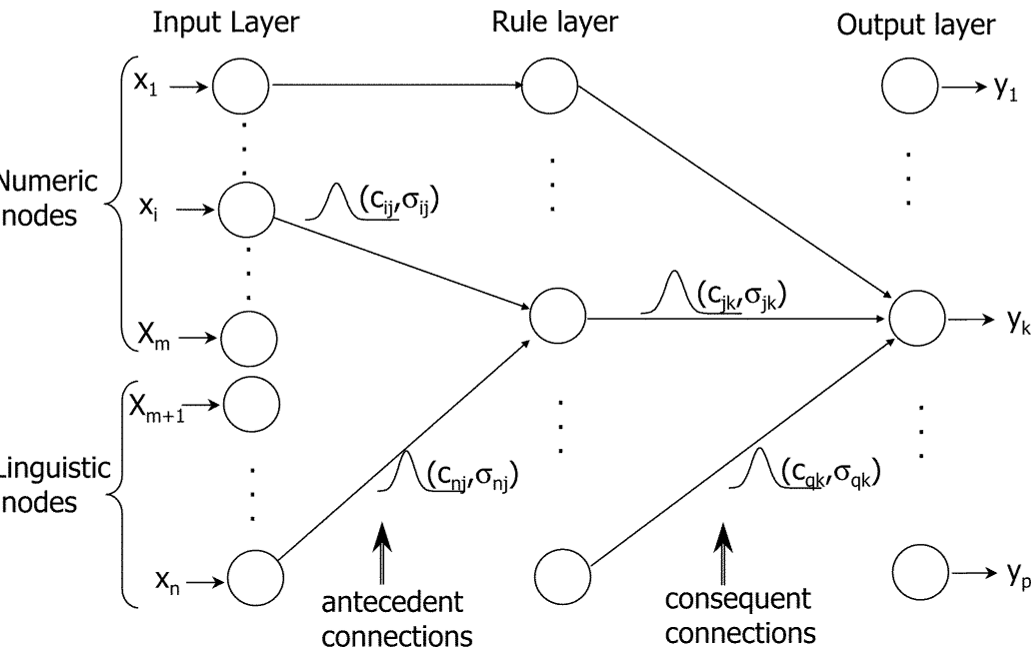 Figure 1: The architecture directly transforms fuzzy If-Then rules into a layer-based network.
Experiments: Efficiency Meets Accuracy
The model was put to the test against several benchmarks:
- Iris Data: The model achieved only 1 error with just 3 rules. Competing models like Genetic Algorithms (GA) or Learning Vector Quantization (LVQ) typically required more complex structures to reach similar results.
- Telegu Vowel Data: In this difficult speech recognition task, the Subsethood model matched the performance of established SOTA models while using 70% fewer parameters.
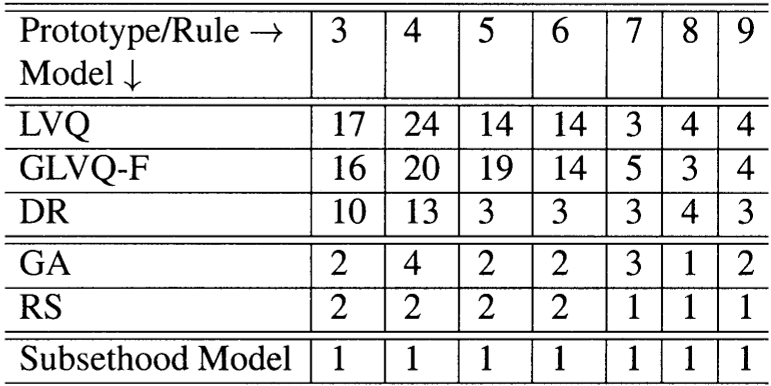 Table 1: Comparison of resubstitution errors across different models. Notice the Subsethood model's consistency.
Critical Insight: Why Does It Work?
The effectiveness of this model stems from its Physical Intuition. By treating weights as "regions of interest" (rule patches) in the feature space rather than just scalar multipliers, the network creates a Voronoi-like partition that is anchored in fuzzy logic.
As shown in the petal width-length subspace (Figure below), the rules act as adaptive "prototypes" that move and stretch to cover the data density.
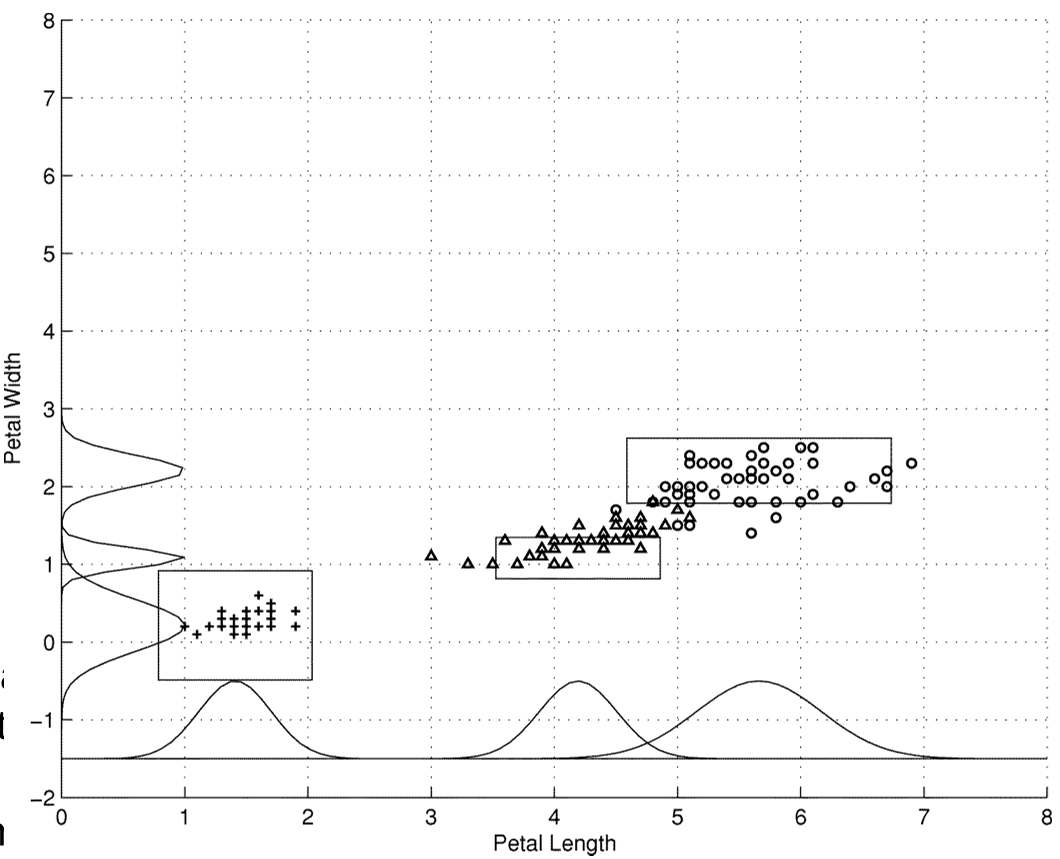 Figure 2: Learned rule patches in the feature space.
Conclusion and Legacy
The Subsethood Based Adaptive Linguistic Network stands as a testament to the power of hybrid modeling. It solves the interpretability vs. performance trade-off by:
- Allowing expert knowledge to seed the network.
- Using a mathematically robust measure of set similarity.
- Remaining computationally efficient enough for real-time inference.
For modern researchers, this work serves as an early blueprint for Explainable AI (XAI)—reminding us that the most powerful models are often those that can explain "why" they fired in terms humans can understand.