
Substantiating Agent-Based Quality Goals: Bridging the Gap Between Ethnography and Engineering
Substantiating agent-based quality goals for understanding socio-technical systems
The paper proposes a novel methodology for substantiating agent-based quality goals using ethnographic field data to understand socio-technical systems. It specifically demonstrates this through the "Electronic Magic Box," a domestic application designed to support intergenerational bonding between grandparents and grandchildren, achieving more nuanced social requirements engineering.
TL;DR
This research introduces a method to transform abstract social aspirations—like "having fun" or "showing affection"—into actionable software requirements. By using agent-oriented modeling and ethnographic field studies of grandparents and grandchildren, the authors demonstrate how to "substantiate" vague quality goals with concrete human behaviors, ensuring that technology serves social ends rather than just functional ones.
The "Soft" Problem in "Hard" Engineering
Most software engineering processes are built for the office: tasks are hierarchical, outcomes are measurable, and goals are instrumental. But the home is a "territory of meaning." How do you measure if an app is successful at "sharing fun"? Traditionally, these non-functional requirements are either ignored or over-specified until they lose their human essence.
The authors argue that socio-technical systems fail not because of bugs, but because they don't account for the Inductive Bias of social life—the unwritten rules of empathy, play, and connection.
Methodology: The Magic of Quality Clouds
The core of this work is the Motivation Model. In this framework:
- Roles (Stick figures) interact with Goals (Parallelograms).
- Crucially, Quality Goals (Clouds) are attached to functional goals to describe how a goal should be achieved.
To test this, they built the Electronic Magic Box, a "technology probe." It allowed families to send photos and messages hidden behind a game-like interface.
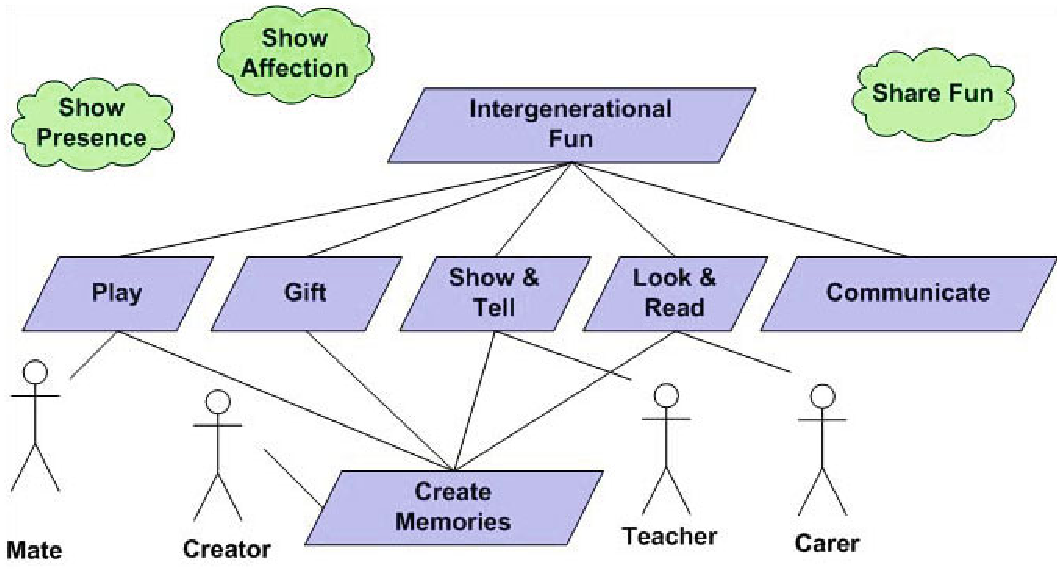
The researchers didn't just look at logs; they conducted deep interviews to see how users "filled" these clouds. They treated the quality goals as templates to organize rich, messy field data.
Experiments & Results: Discovering the "Other Side of Fun"
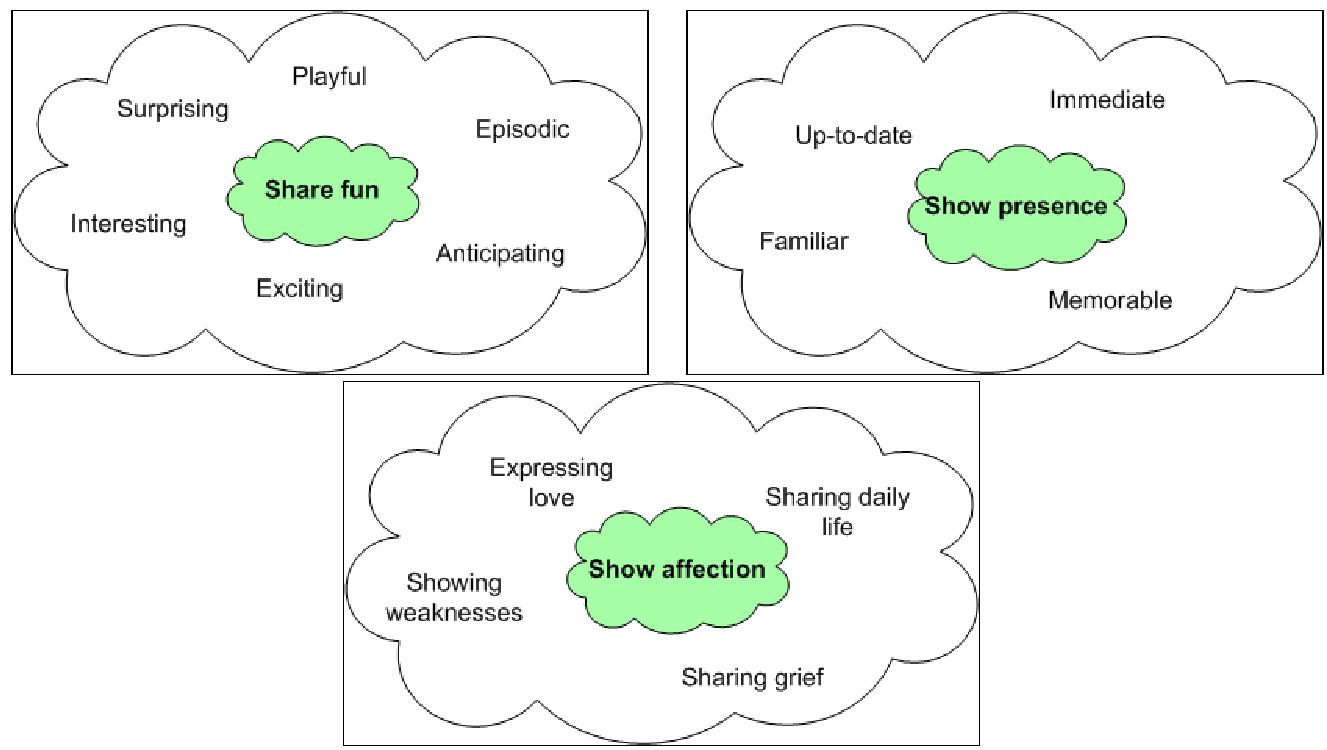
By analyzing 102 "boxes" sent between three families, the researchers expanded their understanding of social qualities. One of the most striking findings was the discovery of sub-themes that traditional engineering would never have predicted:
- Anticipation & Surprise: Fun wasn't just about the content; it was the "seal" on the virtual box that created excitement.
- Shared Vulnerability: A grandparent sending a photo of a burned steak or a messy desk was an act of intimacy and "showing affection."
- Shared Grief: The system became a vessel for comfort when a family pet died, proving that "fun" technologies must also handle serious emotions.
Perhaps most importantly, they discovered a brand-new quality goal: Build up Confidence. Grandparents weren't just using the tech; they were gaining pride in mastering it, which became a social value in itself.
Deep Insight: Empathy as a Requirement
The fundamental takeaway here is that social technologies should be "layered" and "simple." By resisting the urge to resolve every quality goal into a metric (like "clicks per minute"), designers can maintain Interpretive Flexibility.
This allows the technology to act as a mediator for the relationship rather than the focus of it. The "Quality Cloud" serves as a shared artifact—a Rosetta Stone—between the ethnographer who understands human behavior and the engineer who builds the system.
Conclusion & Future Outlook
This work pushes the boundaries of Agent-Oriented Requirements Engineering (AORE) into the domestic sphere. While the study focused on families, the implications for Policy Making and AI alignment are clear: we must build systems that understand the "why" and "how" of human connection, not just the "what."
Limitations: The study was small (three families) and the analysis was time-intensive. Future work should look toward more scalable ways to substantiating these social goals without losing the "vitality" of field data.