
Personalizing the Academic Journey: How Data Mining Predicts University Success
Success Chances Estimation of University Curricula Based on Educational History, Self-Estimated Intellectual Traits and Vocational Ambitions
This paper presents a data-driven framework for estimating the success chances of university curricula using "Storyboarding" and personalized data mining. By integrating educational history, Gardner-inspired self-estimated intellectual traits, and vocational ambitions, the system provides tailored grade predictions and path recommendations.
TL;DR
Choosing the right university path is often a high-stakes gamble for students. This paper introduces a sophisticated system that uses Storyboarding and Personalized Data Mining to estimate a student's success chances. By comparing a student's educational history and self-perceived talents (like logic or linguistics) against historical data, the system can predict GPAs with an impressive average error of just 0.43.
Background: Navigating the Academic Jungle
Most universities function as research-heavy institutions where didactic (teaching) design often takes a backseat. Students are frequently lost in a "jungle" of elective courses, struggling to find a path that aligns with both their career goals and their inherent talents. The authors argue that a one-size-fits-all curriculum recommendation is insufficient because it ignores the subjective variance between individuals.
The Problem & Motivation
Previous models focused solely on "what" courses were taken. However, a student gifted in creative arts (Spatial Intelligence) will have a vastly different success trajectory in a programming course compared to a student with high Logic-Mathematical intelligence. The gap in existing research was the lack of a comprehensive student profile that combined:
- Past Performance: Historical grades and pre-university credits.
- Self-Estimation: How students view their own "Multiple Intelligences."
- Future Ambition: Where they want to work after graduation.
Methodology: Storyboarding and Profiling
The authors utilize a concept called Storyboarding, where learning activities are modeled as nodes in a directed graph.
1. The Decision Tree Logic
The system "learns" from former students by bundling common starting sequences into a decision tree. Each node represents a learning activity (scene), and the branches represent the outcomes (marks).
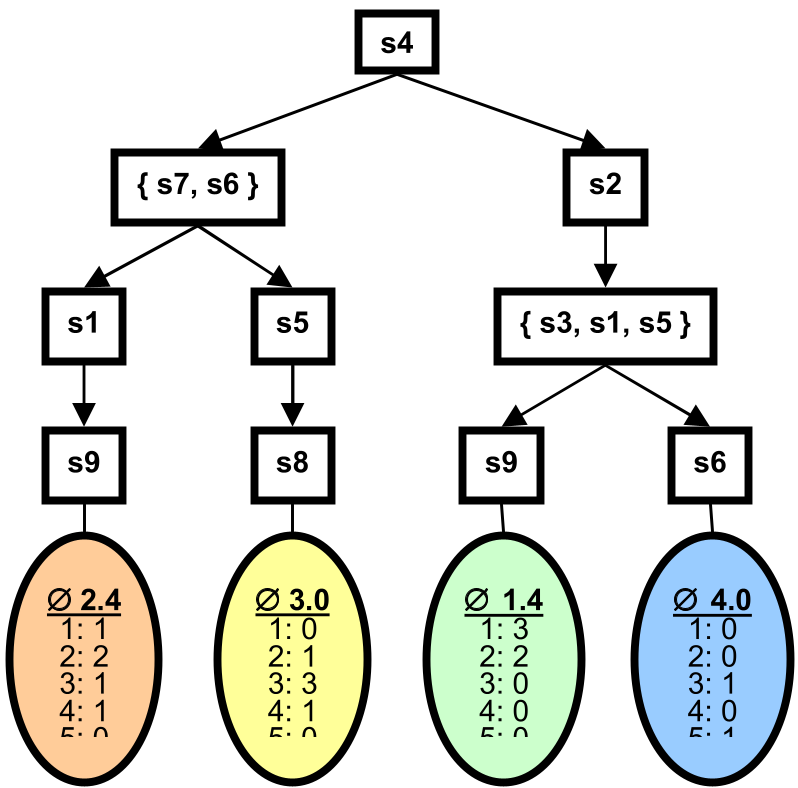 Figure 1: Decision Tree derived from course sequences where si denotes specific learning activities.
2. Personalized Similarity via Cosine Coefficient
Instead of using the entire database, the system calculates the Cosine Similarity between the current student and historical data. A profile is treated as a high-dimensional vector including:
- Intellectual Traits: 8 dimensions based on Gardner’s Multiple Intelligences (Linguistic, Logic, Musical, etc.).
- Vocational Ambitions: Up to 9 dimensions based on career preferences.
- Academic History: Every previously completed subject.
The decision tree is then reconstructed exclusively from the most similar peers, making the success estimation truly personalized.
Experimental Results
The researchers tested their model using 188 individual paths from students between 2005 and 2009. Using a "Leave-One-Out" cross-validation method, they compared the predicted GPA against the actual GPA.
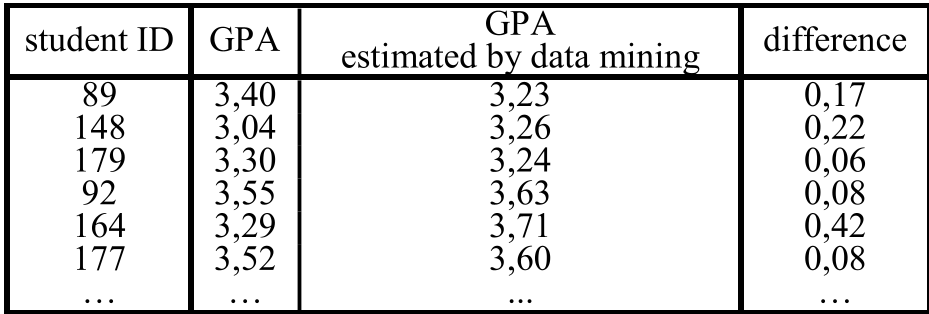 Table 1: Comparison between actual GPA and GPA estimated by the data mining technology.
Key Findings:
- Predictive Accuracy: The mean difference between estimated and actual GPA was only 0.43.
- Dynamic Updating: The authors emphasize that profiling must be dynamic; every new semester's grades are fed back into the profile to refine future predictions.
Critical Insight & Conclusion
The true value of this work lies in its holistic view of the learner. By converting qualitative self-reflection into quantitative vectors, the system bridges the gap between psychological theory (Gardner) and hard data science (Decision Trees/Cosine Similarity).
Limitations: The reliance on self-estimation is a double-edged sword. While it captures a student's confidence and interest, it is subject to personal bias or lack of self-awareness. Future iterations could benefit from blending these self-reports with objective aptitude tests.
Takeaway for the Future: Educational institutions of the future will likely move away from "static" degree plans toward "dynamic" paths that evolve as the student discovers their own strengths.