
Summarizing Social Activity: Bridging People, Actions, and Concepts in Dynamic Networks
Summarization of Social Activity over Time: People, Actions and Concepts in Dynamic Networks
The paper introduces a unified temporal multi-graph framework for automatically summarizing social group activity (Who, What, How, When) using Non-negative Matrix Factorization (NMF). By extracting "activity themes" from interrelated latent spaces of users and concepts, it achieves state-of-the-art performance in summarizing dynamic interactions on platforms like Flickr.
TL;DR
This research presents a novel framework for summarizing collective social activity by extracting Activity Themes—structured snapshots of "Who did What to What and When." By leveraging Non-negative Matrix Factorization (NMF) on a multi-graph that links users, actions, and concepts, the authors move beyond simple tag clouds to provide a deep, temporal understanding of community evolution.
Background & Motivation: The Heterogeneity Problem
Most early social network analysis treated interactions as simple, homogeneous links (e.g., User A follows User B). However, real-world platforms like Flickr or Facebook are heterogeneous: a user posts a photo (action 1), another user comments (action 2), and both use tags (concepts).
The authors argue that existing methods like Latent Semantic Indexing (LSI) fail because they don't adequately account for the temporal co-occurrence of these different action types. To truly summarize a group, we need to solve the "Why" and "How" behind the data, not just the "What."
Methodology: The Unified Multi-Graph Framework
1. The Activity Triple
The core unit of analysis is a triple: (User, Concept, Action). By defining activities this way, the model captures the semantics of the interaction.
2. Joint Matrix Factorization
The paper constructs four primary matrices:
- User-Photo & User-Comment (The "Who" and "How")
- Photo-Tag & Comment-Tag (The "What")
Instead of analyzing these in isolation, the authors use NMF to derive two interrelated latent spaces. This ensures that the latent representation of a "User" is mathematically informed by both their posts and their comments, tied together by the concepts they engage with.
3. Temporal Regularization
The model uses "time indicators" as regularizers. This forces the factorization to prioritize activities that happen within the same time window, ensuring that the extracted themes are temporally representative.
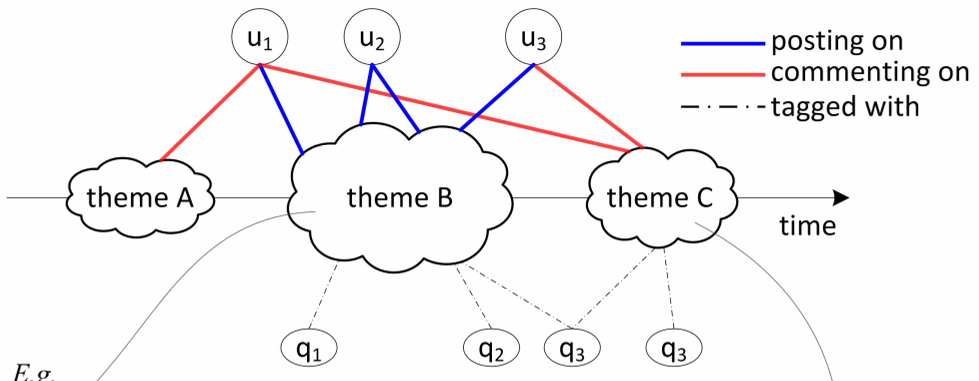 Figure 1: The framework identifies the intersection of Users, Concepts, and Actions across time to form a coherent Activity Theme.
Experiments: Performance on Flickr
The researchers tested their approach on 191 public Flickr groups. They focused on two metrics: Coverage (how much of the total group activity is captured) and Coherence (how well the extracted items relate to each other).
- Coverage Gain: Their NMF-based method reached 38-70% concept coverage, whereas baselines often languished at 23-64%.
- Evolution Tracking: By measuring the cosine similarity between latent space axes at Time and Time , the framework can visualize how a community shifts from one topic to another.
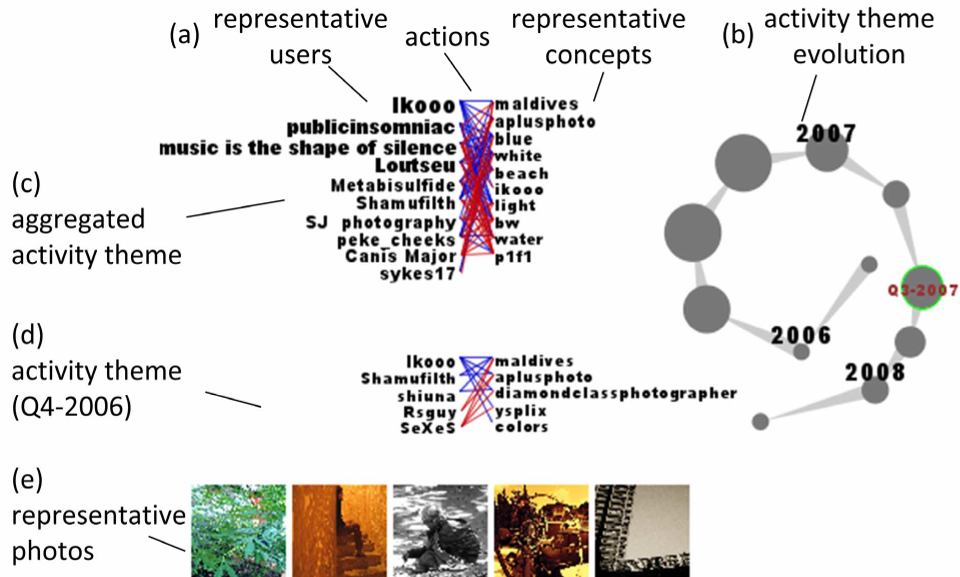 Figure 2: The Spiral Map (b) shows how themes evolve. The bipartite graph (a) visualizes the specific connections between users and tags for a chosen timeframe.
Critical Insight: Why it Works
The brilliance of this work lies in its Inductive Bias. Most summarization tools assume the most frequent tags are the most important. This framework assumes that interconnectedness is the true marker of importance. A user who comments on many diverse photos related to a specific theme is more "representative" than a user who simply posts many unrelated photos.
Conclusion & Future Directions
The paper successfully demonstrates that social activity is a multi-dimensional story. By using NMF to fuse heterogeneous data, we can move from "counting bits" to "narrating behavior."
While this 2008 work utilized Flickr, the methodology is a precursor to modern Neural Graph Collaborative Filtering and Temporal Graph Networks (TGNs). The next step for this lineage of research involves scaling these multi-graph factorizations to the billion-edge regimes of modern social media using distributed computing and deep latent variable models.