
SUPAR: Transforming Smartphones into Ubiquitous Healthcare Gateways via Cloud-Integrated Sensing
SUPAR: Smartphone as a ubiquitous physical activity recognizer for u-healthcare services
This paper introduces SUPAR, a ubiquitous physical activity recognition system that leverages smartphone-embedded triaxial accelerometers and cloud computing for cost-effective u-healthcare. By combining statistical feature extraction with a Support Vector Machine (SVM) classifier, the system achieves a state-of-the-art average recognition accuracy of 97.69% across daily activities.
TL;DR
The SUPAR (Smartphone as a Ubiquitous Physical Activity Recognizer) framework demonstrates a high-precision, low-cost approach to health monitoring. By streaming triaxial accelerometer data from a standard smartphone to a cloud-based SVM classifier, the system identifies activities like walking, running, and cycling with a staggering 97.69% average accuracy, effectively replacing specialized medical wearables with everyday consumer tech.
Background: The Shift from Obtrusive Wearables
In the domain of u-healthcare (ubiquitous healthcare), the primary barrier to adoption has been the "obtrusiveness" of hardware. Requiring patients—especially those with chronic conditions like obesity or insomnia—to wear specialized belts or ankle sensors leads to poor compliance. The author's insight is simple: the most ubiquitous sensor is already in the user's pocket. By repurposing the smartphone's triaxial accelerometer (originally intended for screen rotation and gaming), we can monitor health without requiring the user to change their behavior.
Methodology: Signal Intelligence & Cloud Offloading
1. The Architecture
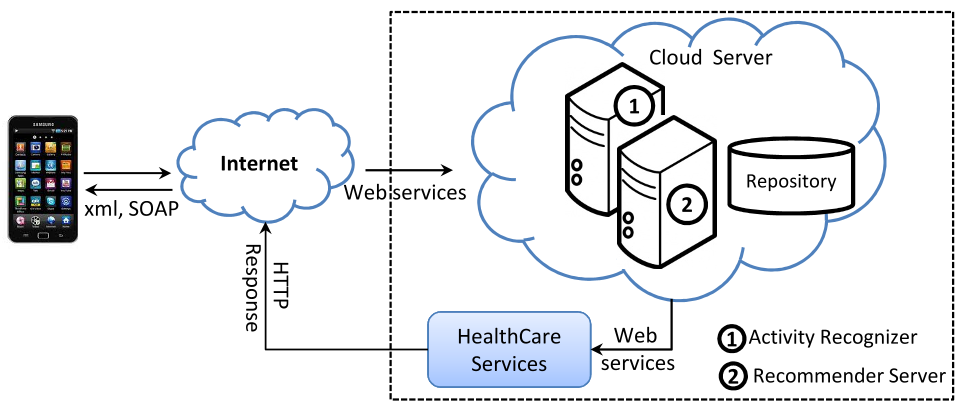
The SUPAR model splits the workload between a Client (Android Smartphone) and a Private Cloud (SC3).
- Data Collection: Signals are sampled at 50Hz, a frequency the authors identified as the "sweet spot" for capturing human motion dynamics without overwhelming the bandwidth.
- Communication: Use of XML serialization and SOAP messages ensures that the sensor logs are transmitted securely to the database server.
2. Feature Engineering
Raw accelerometer data is notoriously "noisy." To make sense of the oscillations, the authors calculate four critical feature types over a 3-second sliding window:
- Time-Domain: RMS (Central tendency) and Variance (Signal spread).
- Relational: Correlation between axes (distinguishes linear gait from complex 3D movement).
- Frequency-Domain: FFT-based Energy (captures the "stress" or intensity of the movement).
Evaluation: Why SVM Wins
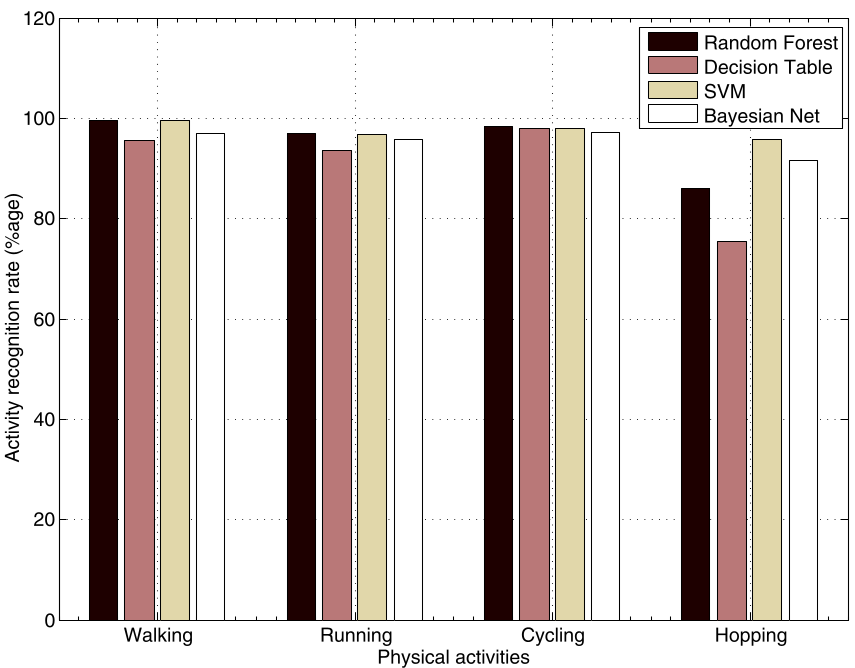
The researchers compared four heavyweights in machine learning: Random Forest, Decision Table, Bayesian Networks, and Support Vector Machines (SVM).
While all models performed admirably for basic gait (walking/running), the SVM with Sequential Minimal Optimization (SMO) showed superior robustness. The confusion matrix revealed that "Hopping" was the most difficult activity to classify, yet the SVM maintained its edge by effectively handling the high-dimensional feature space.
Key Results
- Average Accuracy: 97.69% across 5 subjects.
- Walking Accuracy: Successfully reached ~100% in multiple trials.
- Practical Utility: The system doesn't just "recognize"; it powers a Recommender Server that calculates calorie burn and tracks medication adherence based on the detected activity intensity.
Critical Analysis & Future Outlook
The beauty of SUPAR lies in its Inductive Bias—the choice of the front pants pocket as the sensor location provides a stable reference point for lower-body kinematics.
Limitations:
- Placement Sensitivity: The model assumes the phone is in the pocket. Performance might degrade if the phone is held in hand or placed in a backpack.
- Latency: The reliance on cloud-offloading introduces a dependency on network stability (3G/LTE/WiFi).
Conclusion: SUPAR is a prime example of how "Cloud-Sensor Fusion" can democratize healthcare. By offloading the heavy lifting of SVM training and signal processing to an IaaS environment, the researchers have created a blueprint for cost-effective, real-time patient monitoring that leverages existing consumer infrastructure.