
SIRA: How LLM "Superintelligence" Can Resurrect Lexical Retrieval
Superintelligent Retrieval Agent: The Next Frontier of Information Retrieval
SIRA (SuperIntelligent Retrieval Agent) is a retrieval-centric agentic framework that transforms Multi-round exploratory search into a single, expert-level lexical action. By utilizing a frozen LLM to perform corpus-aware vocabulary enrichment and weighted BM25 execution, it achieves new SOTA performance on the BEIR benchmark, outperforming supervised dense retrievers (E5) and learned sparse models (SPLADE).
TL;DR
Information retrieval (IR) has transitioned from "keyword matching" to "vector similarity," but at a cost of transparency and control. SuperIntelligent Retrieval Agent (SIRA) argues that we don't need more complex embeddings or 10-round agentic loops; we need expert-level lexical actions. By using an LLM to "program" a BM25 engine with corpus-aware statistics, SIRA achieves SIRA-level performance (pun intended) across 10 BEIR benchmarks without any fine-tuning or vector databases.
The "Newcomer" vs. "Expert" Search Dilemma
Current agentic search systems (like ReAct or Search-R1) act like newcomers in a library: they wander from shelf to shelf, reading bits of books, and slowly learning the local terminology to refine their next query. This retrieval-context advantage is inefficient—it relies on long-context LLMs to digest "near misses" and costs significant latency.
SIRA shifts this paradigm. An expert researcher doesn't just guess; they know the specific jargon that distinguishes a relevant paper from millions of distractors. SIRA formalizes this as Corpus-Discriminative Retrieval: the ability to compress a multi-turn conversation into a single, high-precision BM25 call.
Methodology: Programming the Inverted Index
The core philosophy of SIRA is that BM25 is a programmable interface. SIRA controls it through two mechanisms:
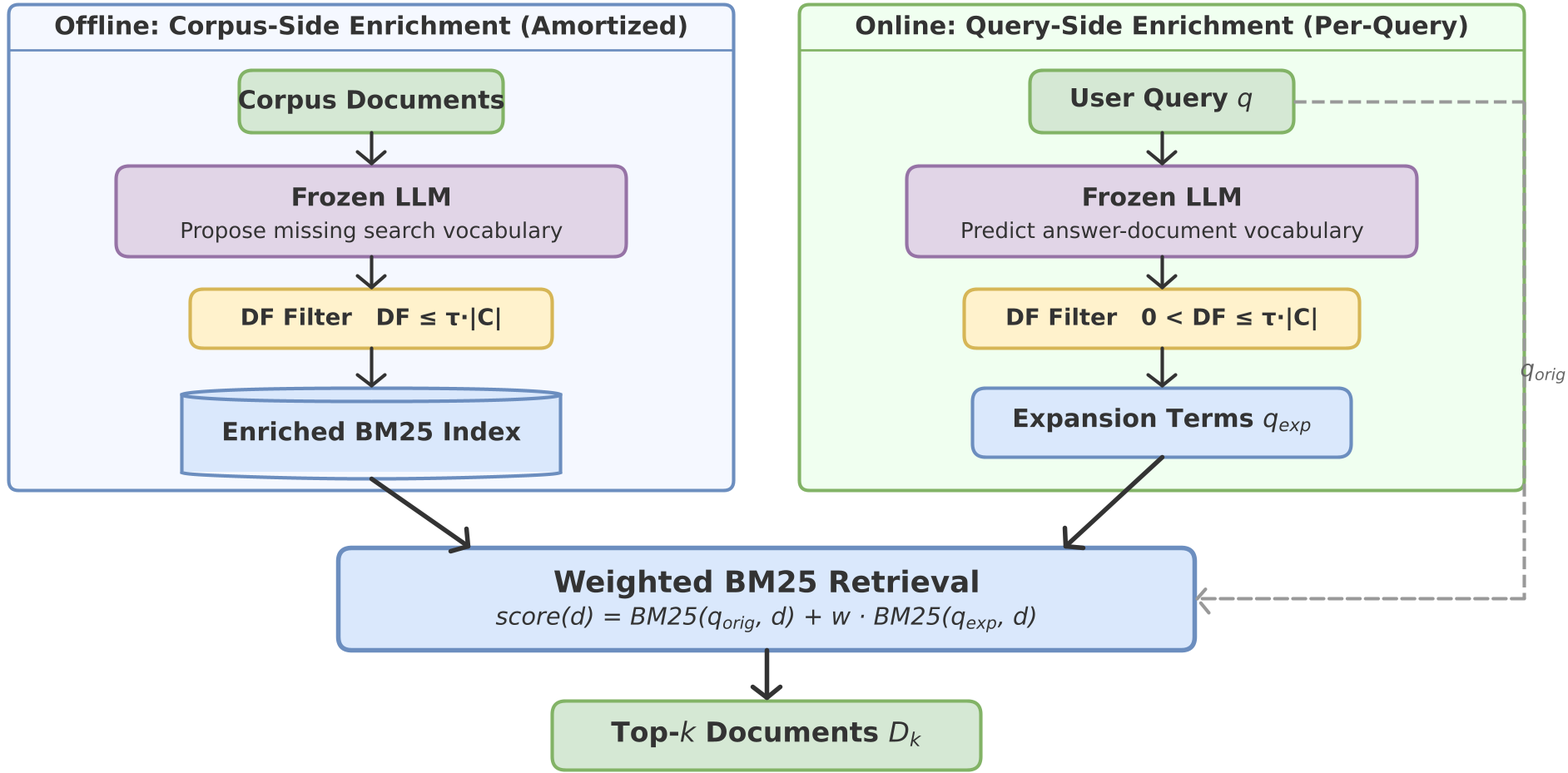
1. Dual-Sided Vocabulary Enrichment
- Offline (Corpus Side): The LLM "reads" documents and asks: "If a user were searching for this but didn't have the exact text, what domain-specific aliases or synonyms would they use?" These are injected as n-grams into the index.
- Online (Query Side): The LLM generates an "Expected-Response Sketch"—a hallucination of what the evidence should look like, capturing entities and relations missing from the original query.
2. The Document Frequency (DF) Filter
This is SIRA's secret sauce for grounding. An agent can propose a "smart-sounding" term, but if it's not in the corpus or appears in every document, it’s useless noise. SIRA checks the Document Frequency (an index-visible signal) to prune terms that are either absent (DF=0) or too common (DF > threshold), ensuring the final query has a high retrieval margin.
Experimental Showdown
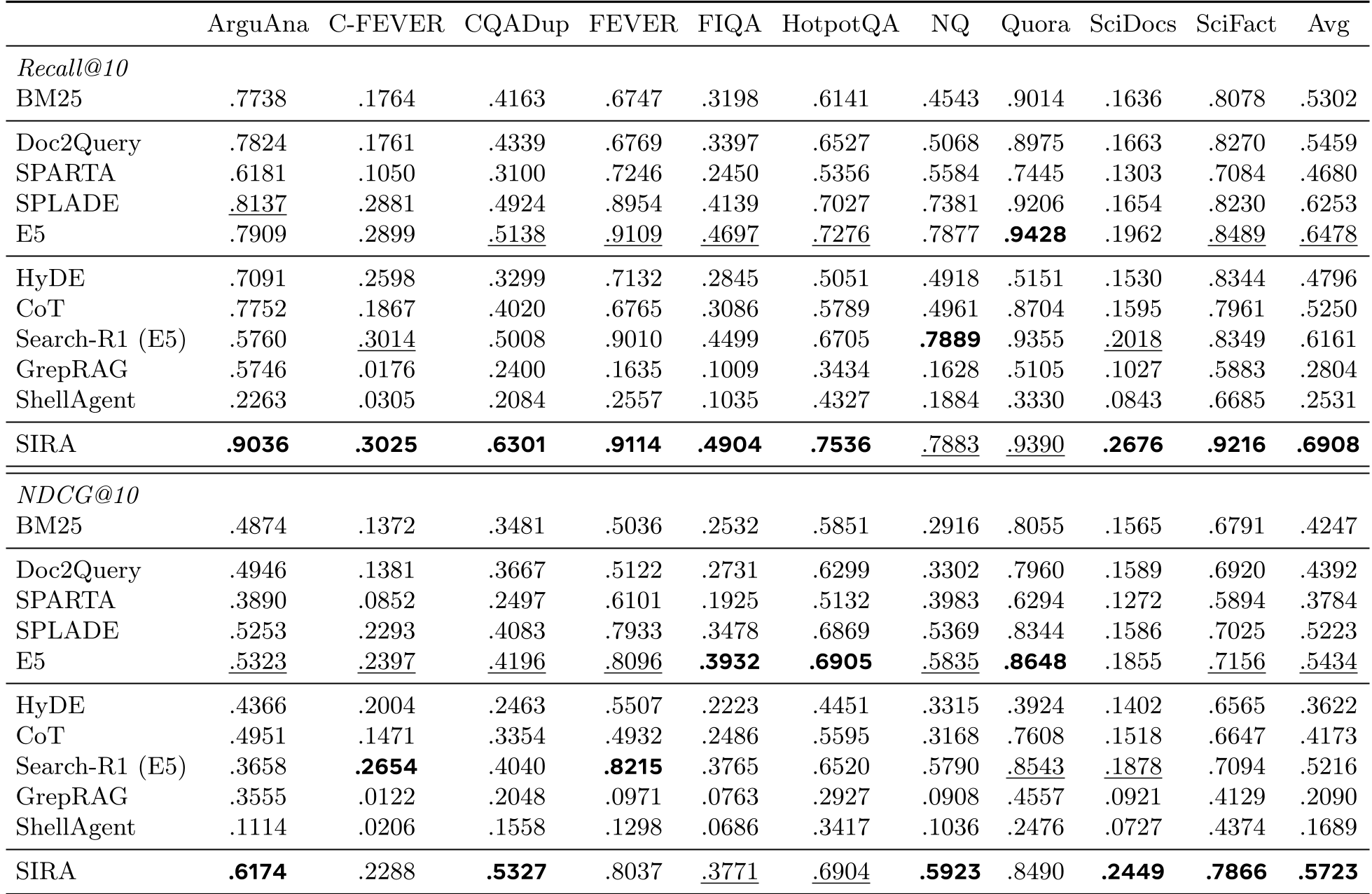
SIRA was tested against heavyweights in the IR field:
- Dense Retrievers: E5 (Supervised bi-encoder).
- Learned Sparse: SPLADE (learned term importance).
- Agentic Baselines: Search-R1 (RL-trained), GrepRAG (tool-use).
Key Findings:
- Superiority over Dense: SIRA outperformed E5 on 8 out of 10 BEIR datasets. In cases like SciDocs (+36%), where specialized terminology is king, SIRA’s lexical precision crushed the "fuzzy" similarity of embeddings.
- Zero-Shot Power: Unlike SPLADE or E5, SIRA requires zero training labels. It leverages the pre-trained knowledge of the LLM to understand the value of words.
Downstream QA: Better Evidence > More Reasoning
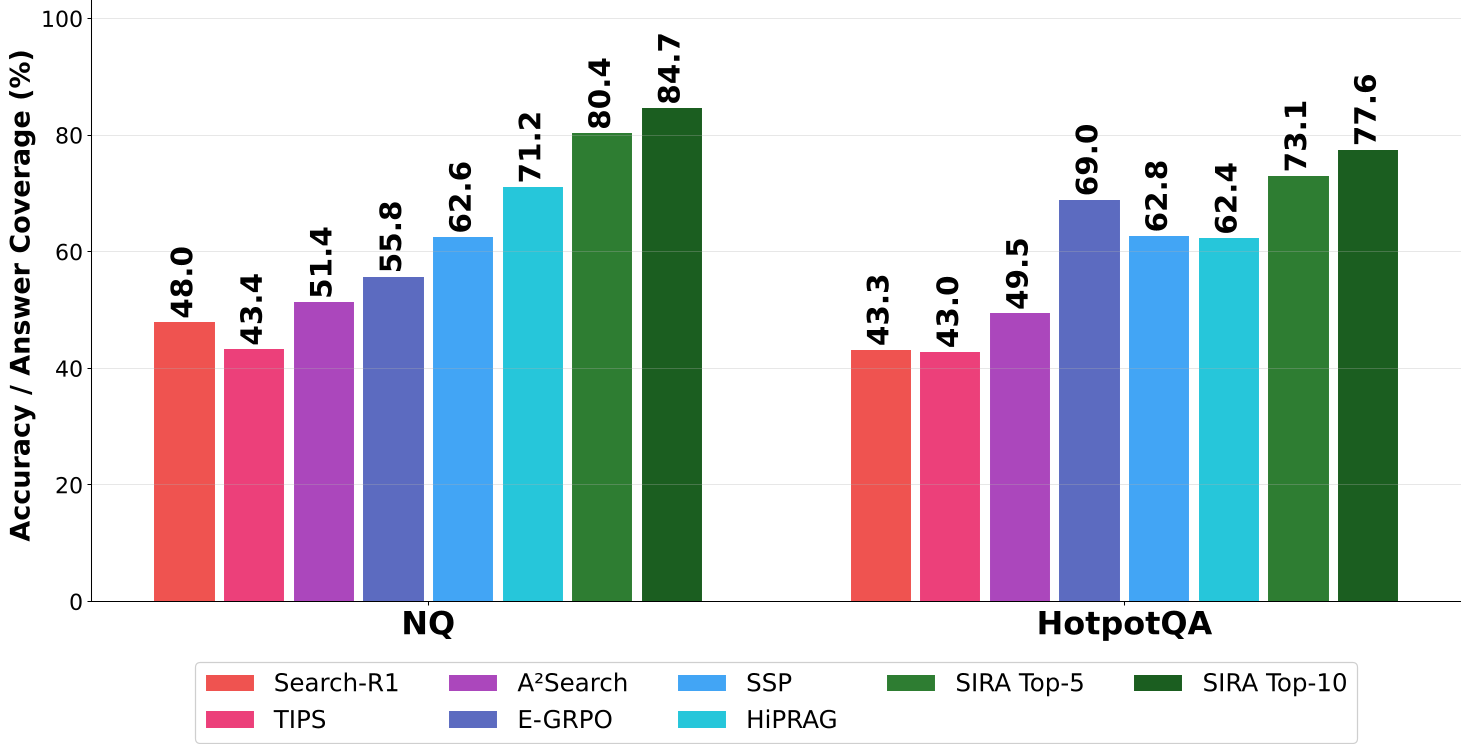
Does better retrieval help the agent answer questions? The researchers compared SIRA's answer coverage (does the gold answer exist in the top-k results?) against RL-trained agents that generate full answers.
Surprisingly, SIRA’s top-10 coverage (84.7%) beat the generated accuracy of all specialized RL agents on Natural Questions (NQ). This proves a vital point for the RAG industry: If your retrieval is "superintelligent," your reader model's job becomes trivial.
Critical Insight: Why This Matters
SIRA is a "return to form" for Information Retrieval. It acknowledges that the Inverted Index—the same technology behind 1990s search—is actually more controllable and efficient for LLM agents than modern vector databases.
The bottleneck hasn't been the BM25 algorithm; it was the Vocabulary Gap. By using the LLM as a "bridge builder" that understands corpus statistics, we can build RAG systems that are faster, cheaper (training-free), and fully interpretable.
Limitations: The system relies on the LLM having some prior knowledge of the topic. For "top-secret" or highly niche internal corpora, SIRA might need a "warm-up" phase of corpus adaptation.
Conclusion
The SIRA paper demonstrates that we don't need agents that "reason" through 20 retrieval calls. We need agents that understand the physics of the corpus. One well-formed, weighted lexical query is worth more than a dozen fuzzy embedding searches.