
Logic of the Crowd: Can We Ever Truly Detect Supermajority Sentiments?
Supermajority sentiment detection with external influence in large social networks
This paper investigates the asymptotic accuracy of supermajority sentiment detection in large social networks modeled as Ising Markov Random Fields (MRF). By introducing a "naive" detector for noisy sentiment measurements, the authors establish theoretical bounds on error probability, demonstrating how network topology and external influence (h) dictate whether detection becomes perfectly accurate as the network size (n) grows to infinity.
TL;DR
Even in an era of "Big Data," polling more people doesn't always lead to the truth. This paper explores Supermajority Sentiment Detection through the lens of statistical physics, using the Ising Model to show that network structure and external "fields" (influence) can make sentiment detection either perfectly accurate or fundamentally limited, depending on whether the population's average opinion "concentrates" away from the decision threshold.
Background: Beyond the i.i.d. Assumption
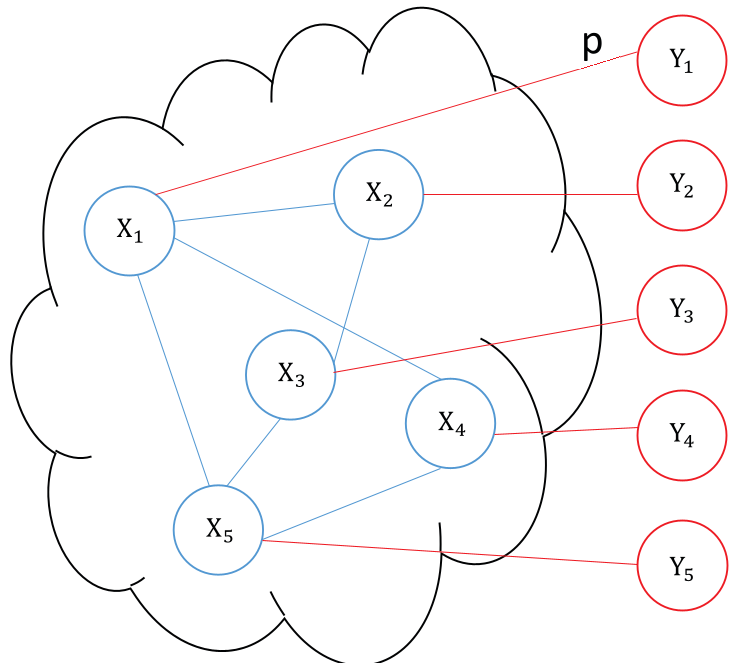
In classical statistics, we often assume that every person’s opinion is independent. But in social networks, we influence our neighbors. This paper treats a social network like a piece of iron in a magnetic field:
- Nodes: People.
- Edges: Friendships/Follower relations.
- (Inverse Temperature): The strength of social pressure to conform.
- (External Influence): Media bias or societal trends.
The authors ask: If we need a 2/3 supermajority to pass a law, can we accurately detect if the network supports it by looking at noisy data (like Tweets)?
The "Naive" Detector and the Ising Prior
The authors model the network's sentiment using an Ising Markov Random Field (MRF):
They propose a detector that simply looks at the noisy average of measured sentiments. The core challenge is the Curse of Dimensionality; calculating the true Maximum Aposteriori (MAP) estimate is nearly impossible for millions of users, so they analyze if this simple detector reaches a "Ground Truth" as the network size .
Methodology: The Geometry of Error
The paper’s most profound insight is the relationship between Asymptotic Distribution and Detection Accuracy.
- Concentration is Key: If the average sentiment of the network members () concentrates at a value far from the threshold , the noise in our measurements eventually washes out, and error goes to zero.
- The Dead Zone: If the average sentiment is exactly , the error probability converges to a positive constant: This suggests that in a perfectly split society (Majority , Bias ), no amount of polling can guarantee a correct prediction.
Network Examples & Phase Transitions
The authors analyze several topologies, but the most interesting are the Complete Graph (everyone knows everyone) and the 2D Lattice (grid-like local influence).
- Star & Wheel Graphs: A "celebrity" center node can pull the entire network toward their sentiment, effectively shifting the "safe zone" for detection.
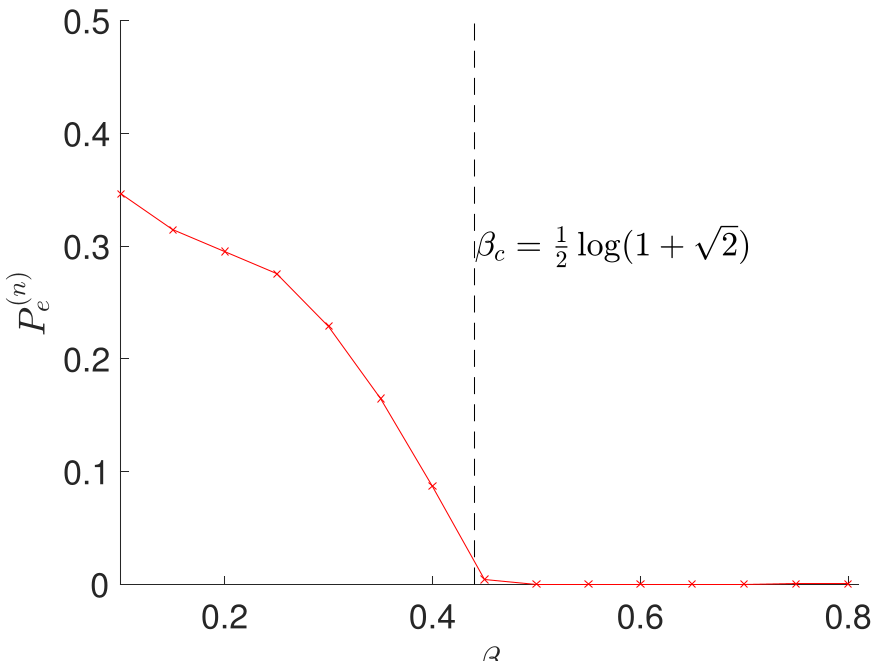
- Lattice Phase Transitions: In a grid network, there is a critical connection strength . Below this, people are too independent, and sentiments are noisy. Above , the network "crystallizes" into a consensus, making detection much easier.
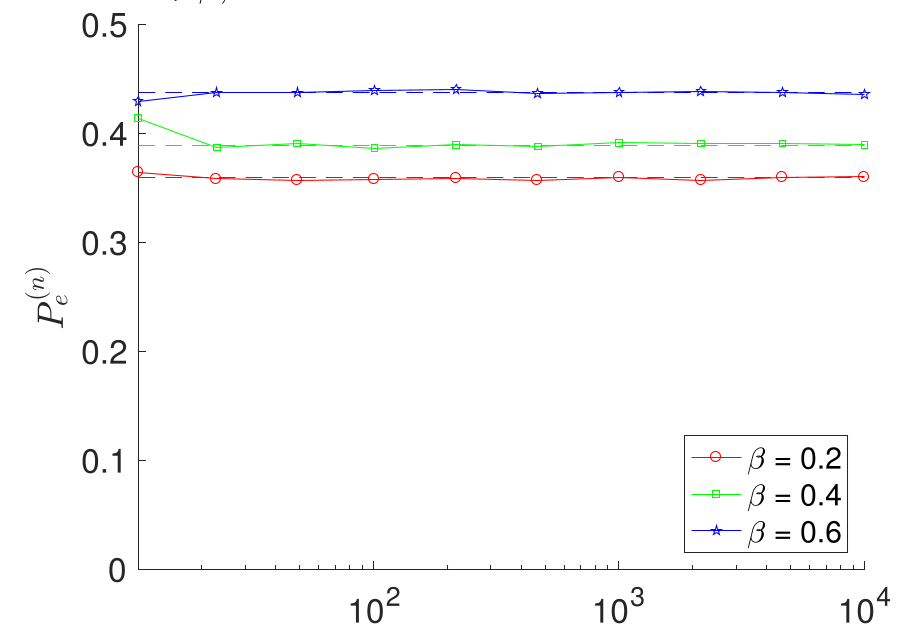 In the Wheel graph (Part b), when and , the distribution concentrates around two modes (), allowing the error to drop to zero because the threshold sits in the "gap" between opinions.
Experimental Validation
Numerical results confirm the theory. In the Lattice Graph (Fig 7), we see a sharp drop in error probability once exceeds the critical threshold . This is a "Phase Transition" in information accuracy.
Critical Insights
- The Power of Bias: External influence acts as a "tie-breaker." Even a small societal bias makes sentiment detection significantly more accurate by pushing the average sentiment away from the ambiguous threshold .
- Network Importance: The same group of people with the same opinions can be "unpredictable" if they are sparsely connected, but "predictable" if they form a close-knit community.
Conclusion
This work highlights that sentiment detection is not just a "counting" problem—it is a "physics" problem. The accuracy of our social barometers (like Twitter sentiment analysis) is fundamentally limited by the underlying connectivity of the people they measure. For pollsters and sociologists, the takeaway is clear: understanding the structure of the network is just as important as the individual responses of its members.