
SDOI: Bridging the Gap Between Technical Documents and Domain Ontologies
10542_Supervised identification and linking of concept mentions to a domain-specific ontology.
This paper introduces SDOI, a supervised learning pipeline designed to identify concept mentions in text and link them to domain-specific ontologies. It utilizes sequential tagging for identification and an iterative classifier for linking, significantly outperforming baselines like the Milne & Witten (2008) algorithm on specialized datasets such as KDD and ICDM conference abstracts.
TL;DR
Integrating unstructured documents with structured knowledge bases (ontologies) is a cornerstone of "strategic reading" and advanced retrieval. In this classic CIKM paper, researchers propose SDOI (Supervised Document to Ontology Interlinking), a robust pipeline that uses sequential tagging and iterative classification. It achieves over 2x the linking accuracy of previous Wikipedia-centric methods in technical domains and reduces human annotation effort by almost half.
Problem & Motivation: Why Domain-Specific Linking is Hard
Existing entity linking research often focuses on Wikipedia, where high-quality link data and broad context are abundant. However, in scientific or technical fields—like Data Mining—the challenges are unique:
- Novel Mentions: Concepts are often mentioned before they are officially added to an ontology.
- Ambiguity: Technical terms may have overlapping anchor text but distinct meanings within a niche taxonomy.
- Manual Bottleneck: Experts spent excessive time identifying and linking concepts manually, hindering the growth of interlinked knowledge.
The authors' insight was to treat the task as a two-stage supervised learning problem: first, "finding" the concepts using language patterns (sequential tagging), and second, "linking" them by leveraging the internal structure of the ontology.
Methodology: The SDOI Pipeline
The SDOI approach decomposes the challenge into two distinct machine learning tasks:
1. Concept Mention Identification
Instead of simple dictionary matching—which misses any term not already in the database—SDOI uses a Conditional Random Field (CRF). It looks at the Part-of-Speech (POS) tags, capitalization, and surrounding token windows to identify "concept-like" phrases even if they are new to the domain.
2. Candidacy and Iterative Linking
Once a mention is identified, SDOI generates a set of candidate concepts from the ontology. To refine the selection, it uses an Iterative Set-Based Classifier. The core innovation here is the handling of collective features: the identity of one mention in a document often helps resolve another. The algorithm iteratively "seeds" certainties and uses them to refine the remaining ambiguous links.
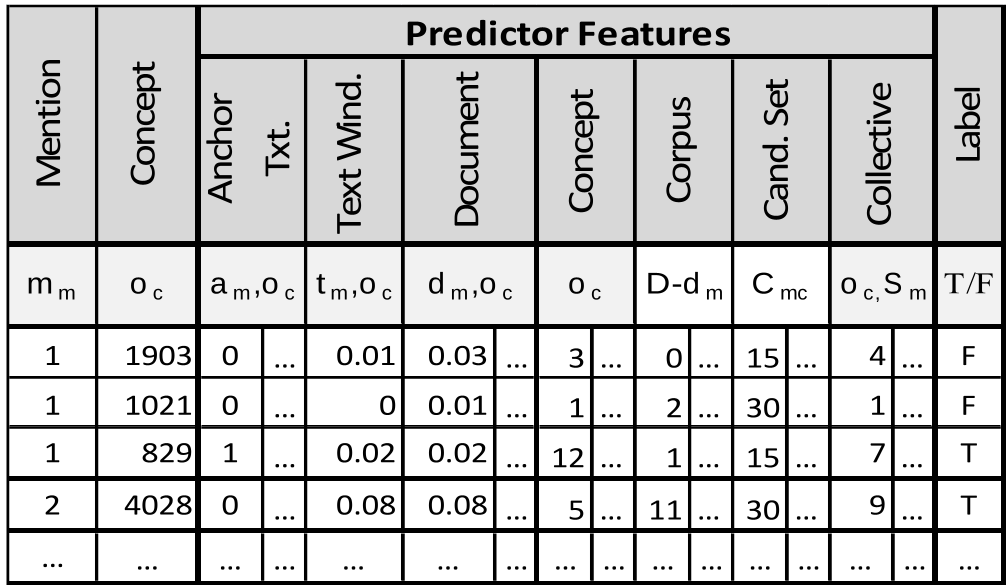 The feature vector includes anchor text similarity, document context, concept attributes, and collective features.
Experiments & Results: Proving Real-World Value
The system was benchmarked against the Milne & Witten (MW08) algorithm, which was a SOTA approach for Wikipedia-based linking at the time.
Performance Gains
In the specialized Data Mining domain (KDD-2009 abstracts), SDOI crushed the baseline:
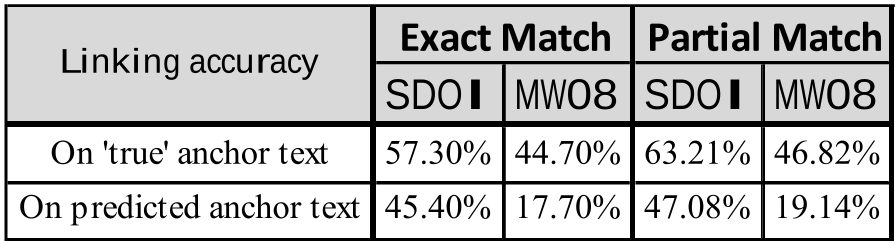
- Contextual Linking: On true anchor text, SDOI achieved 57.3% accuracy vs. MW08's 44.7%.
- End-to-End Task: On predicted anchor text (the harder task), SDOI achieved 45.4% vs. MW08's a mere 17.7%.
Human-in-the-Loop Value
Perhaps the most compelling result is the Time Savings Evaluation. By providing domain experts with SDOI's pre-annotations, the time required to annotate a technical abstract dropped from 33.6 minutes to 18.9 minutes. This proves that the model is not just an academic exercise but a functional tool for accelerating knowledge engineering.
Critical Analysis & Conclusion
Takeaway: SDOI demonstrates that sequential tagging plus iterative, context-aware classification is the winning formula for domain-specific knowledge extraction. It moves beyond simple "keyword matching" to a more "semantic" understanding of how concepts appear in natural language.
Limitations:
- The accuracy for "partial matches" suggests that multi-word technical terms remain a challenge for precise boundary detection.
- The reliance on a specific domain ontology (KDDO1) means the system requires a baseline knowledge graph to exist before it can add value.
Future Outlook: In the modern era of LLMs, the SDOI pipeline offers a blueprint for "Retrieval Augmented Generation" (RAG) and automated ontology population. By combining the linguistic flexibility of tagging with the structural rigor of ontologies, we can eventually automate the creation of a "Web of Concepts" that spans all scientific literature.