
Forecasting Social Evolution: A Multi-Scale Approach to Dynamic Interaction Prediction
A supervised approach for intra-/inter-community interaction prediction in dynamic social networks
This paper introduces a supervised learning framework for the "Interaction Prediction" task in dynamic social networks, utilizing time-aware topological features and community discovery. By integrating time series forecasting with structural, topological, and community-level measures, the method achieves high accuracy (up to 98% AUC in specific scenarios) for both intra-community and inter-community link prediction.
TL;DR
Predicting future interactions in a social network is more than just finding "friends of friends." This paper proposes a sophisticated supervised pipeline that treats network evolution as a series of time-stamped snapshots. By leveraging Community Discovery to prune the search space and Time Series Forecasting to model the trajectory of node behaviors, the authors achieve SOTA performance in predicting both "strong ties" within communities and "weak bridges" between them.
The Core Insight: Communities as Filters and Features
Most link prediction algorithms struggle with the "needle in the haystack" problem: in a network of 10,000 nodes, there are nearly 50 million possible pairings, yet only a tiny fraction will actually form a link.
The authors' pivot is twofold:
- Search Pruning: Use communities (clusters of densely connected nodes) to focus the prediction on pairs that already share a social context.
- Feature Forecasting: Instead of using the current state of the network to predict the future, they use the history of the network to forecast what the topological features (like Jaccard Coefficient or PageRank) will look like at the moment of prediction.
Methodology: The Four-Step Workflow
The methodology bridges the gap between graph theory and time-series analysis.
1. Snapshot Discretization & Community Detection
The dynamic network is divided into time windows (e.g., months for Facebook, years for DBLP). In each window, algorithms like DEMON (overlapping) or Infomap identify the modular structure.
2. Multi-Family Feature Extraction
For every pair of nodes within a community, three types of features are extracted:
- Structural: Local overlaps like Adamic-Adar and Common Neighbors.
- Global: Node-level importance metrics like PageRank and Degree Centrality.
- Community-based: Metrics specific to the module, such as Community Density and Transitivity.
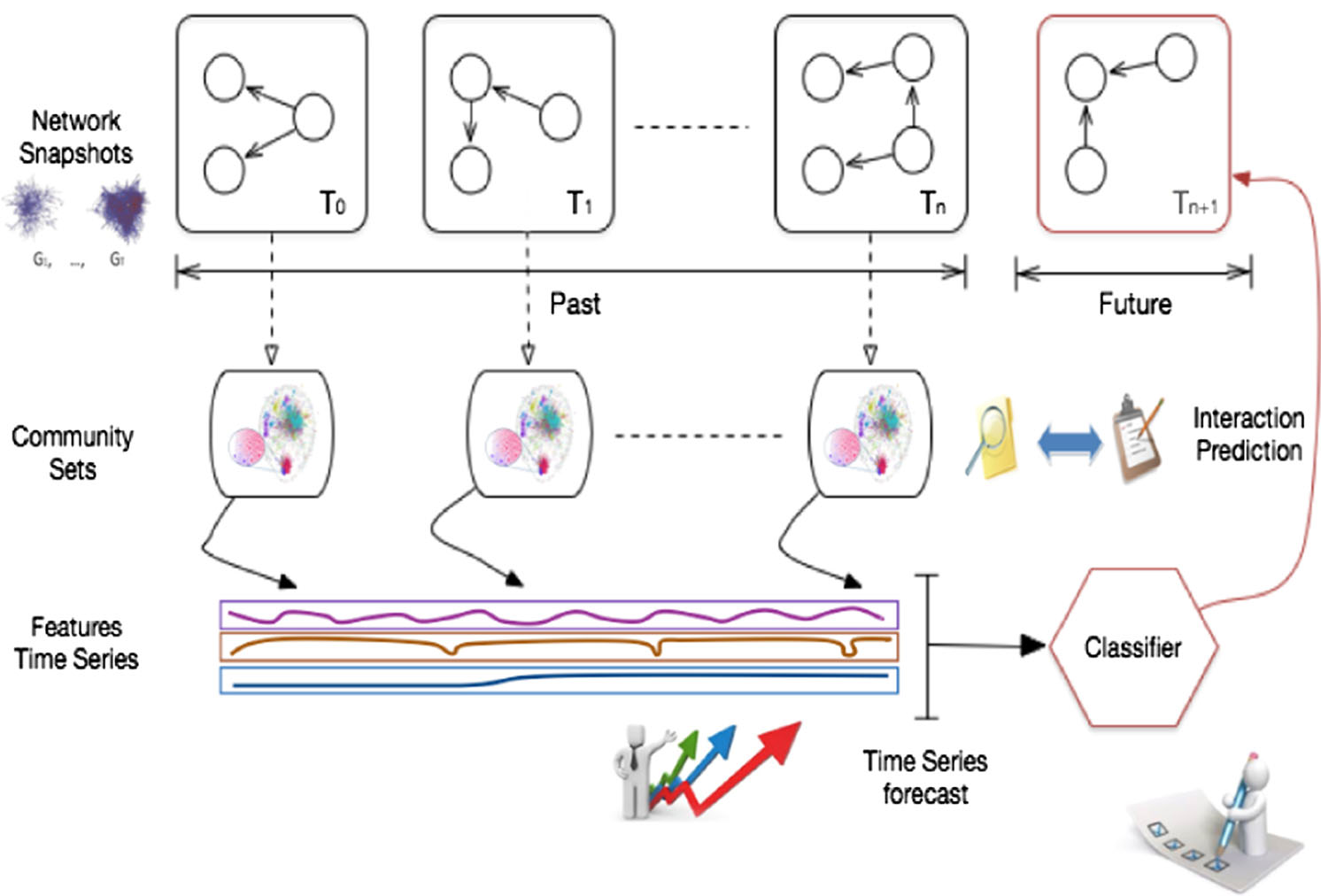
3. Time Series Forecasting
This is where the "temporal" aspect shines. For every node pair , the history of their features is treated as a time series. The model uses Moving Averages (Ma) and Linear Regression (LR) to estimate the expected value of these features for the next time step ().
4. Supervised Classification
These forecasted values are fed into an ensemble of classifiers (Random Forest, SVM, etc.) to produce the final "link" or "no-link" prediction.
Experimental Battleground: Social Media vs. Academic Co-authorship
The researchers tested their approach on two distinct datasets:
- Social (UC Irvine Students): Highly dynamic, direct messaging.
- DBLP (Academic Collaborations): Slower evolution, high clustering coefficient (collaborations involve cliques/papers).
Performance in Balanced and Unbalanced Scenarios
In balanced scenarios, the DEMON algorithm combined with a Moving Average forecast provided the best results for the Social network (AUC 0.98), while Louvain performed best for the DBLP network.

The paper also addresses the "Unbalanced" scenario, which is the real-world standard. In the Social dataset, where only ~4% of pairs form links, the model achieved a precision of 95.6%, effectively eliminating almost all false positives.
Beyond the Bubble: Inter-Community Predictions
A standout feature of this work is the Inter-community interaction prediction. To predict bridges between different modules, the authors build an Induced Graph where each node is a community. They track the "meta-links" between these communities over time.
While predicting specific people-to-people weak ties is volatile, the "community-to-community" model provides a robust macro-level view of how different social clusters gravitate toward each other.
Critical Insight & Conclusion
The study proves that Social Context Matters. By using community discovery, we aren't just saving computation; we are incorporating the "sociological" truth that human edges are constrained by their groups.
Key Takeaways for Practitioners:
- Forecasting > Snapshots: Always model the trend of a feature rather than its last known value.
- Algorithm Matters: For overlapping social contexts, use local-first algorithms like DEMON; for hierarchical organizations, use Infohiermap.
- Precision is King: In link prediction, accuracy is a vanity metric due to sparsity; focus on Lift Charts and Positive Predictive Value (PPV).
This work provides a blueprint for any researcher moving from static graph analysis to the "living," breathing reality of dynamic social networks.