
Unmasking Bitcoin's Dark Side: A Multi-Class Supervised Learning Approach to Blockchain Forensics
Supervised learning model for identifying illegal activities in Bitcoin
This paper presents a supervised learning framework using an ensemble of decision trees to identify illegal activities within the Bitcoin network. By engineering nine discriminative features from a decade of Blockchain data (2009-2020) and categorizing 1216 entities into 16 distinct licit and illicit classes, the model achieves a SOTA classification accuracy of 0.91.
TL;DR
Since 2009, Bitcoin has been a double-edged sword: a revolution in decentralized finance and a fortress for illicit actors. This paper introduces a supervised learning model based on an ensemble of decision trees that moves beyond niche detection. By analyzing over 10 years of blockchain data and a new dataset of 1,216 entities, the authors achieved an accuracy of 0.91 in classifying users into 16 different legal and illegal categories.
Positioning: This work is a significant step toward a generalized forensic tool for Bitcoin, shifting the focus from specific "siloed" threats to a comprehensive categorical classification.
The Forensics Bottleneck: Why Catching Crypto-Criminals is Hard
Existing blockchain security research typically faces a "narrow-vision" problem. Most models are built to detect one specific thing—like a Ponzi scheme or a botnet. However, the Bitcoin ecosystem is diverse, ranging from legitimate exchanges and mining pools to darknet markets and sophisticated money-laundering mixers.
The primary challenges include:
- Anonymity: Users can create infinite hash addresses to mask their trail.
- Data Scarcity: There is a lack of public, high-quality, ground-truth labeled datasets.
- Scale: The raw blockchain grew to nearly 300GB by 2020, making feature extraction a massive computational task.
Methodology: From Raw Blocks to Ensemble Insight
The researchers developed a comprehensive pipeline (Fig. 1) to transform raw blockchain data into actionable intelligence.
1. Address Clustering (Deanonymization)
A single entity usually controls many addresses. The authors used multi-input heuristics to cluster related addresses, treating the cluster as a single "entity" or "wallet" for feature extraction.
2. Feature Engineering
Instead of complex graph embeddings that are computationally expensive, the study focused on 9 high-impact features derived from entity behavior, including:
- Tx: Total transactions.
- L: Total active life of the wallet.
- R: Address reuse ratio (Crucial for identifying automated services).
- Av: Average incoming transactions per address.
3. The Ensemble Model
The core of the system is a Gradient Boosting Tree model. Unlike simple decision trees, this ensemble uses additive functions and a regularized objective to minimize loss and prevent overfitting.
 Fig 1: The standard pipeline for Bitcoin Machine Learning Forensics.
Experimental Battleground: SOTA vs. Baselines
The researchers compared their model against popular benchmarks: SVM, Logistic Regression, Random Forest, and XGBOOST.
Performance Metrics
The proposed model stood out with a 91% accuracy rate. In classes with sufficient data, like "Wallets" (legitimate) and "Darkmarkets" (illicit), the model showed high specificity and sensitivity.
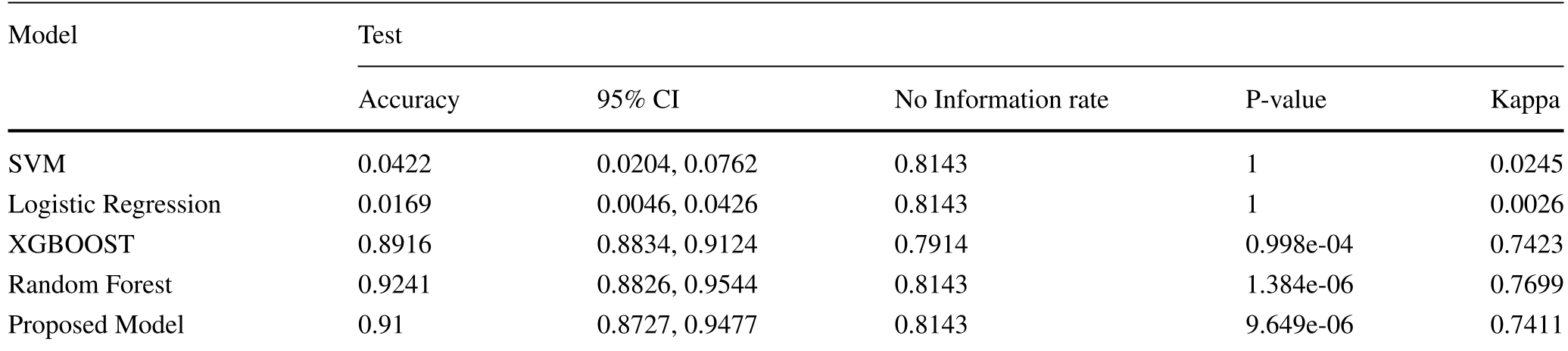 Table: The proposed model shows superior Accuracy and Kappa values compared to traditional SVM and Logistic Regression.
The Resource Trade-off
Higher accuracy isn't free. The authors monitored CPU and RAM utilization and found that the proposed model used 30-45% more RAM than its counterparts. This highlights a critical reality in real-world deployment: high-fidelity forensics requires robust hardware.
Critical Insight & Conclusion
While the 0.91 accuracy is impressive, the study candidly admits the limitations of the "Data Hunger" inherent in supervised learning. Some rare illegal activities were misclassified as legitimate businesses because the model hadn't seen enough examples (the "class imbalance" problem).
Takeaway: This paper provides a foundational public dataset and a reliable ensemble method for the research community. For future forensics, the path forward involves combining these ensemble methods with Zero-shot learning to identify novel crimes without needing thousands of prior examples.
Future Outlook: As Bitcoin evolves (with protocols like Taproot or the Lightning Network), the heuristics for address clustering (Fig. 2) will need constant updates, making this an ongoing arms race between regulators and cyber-criminals.
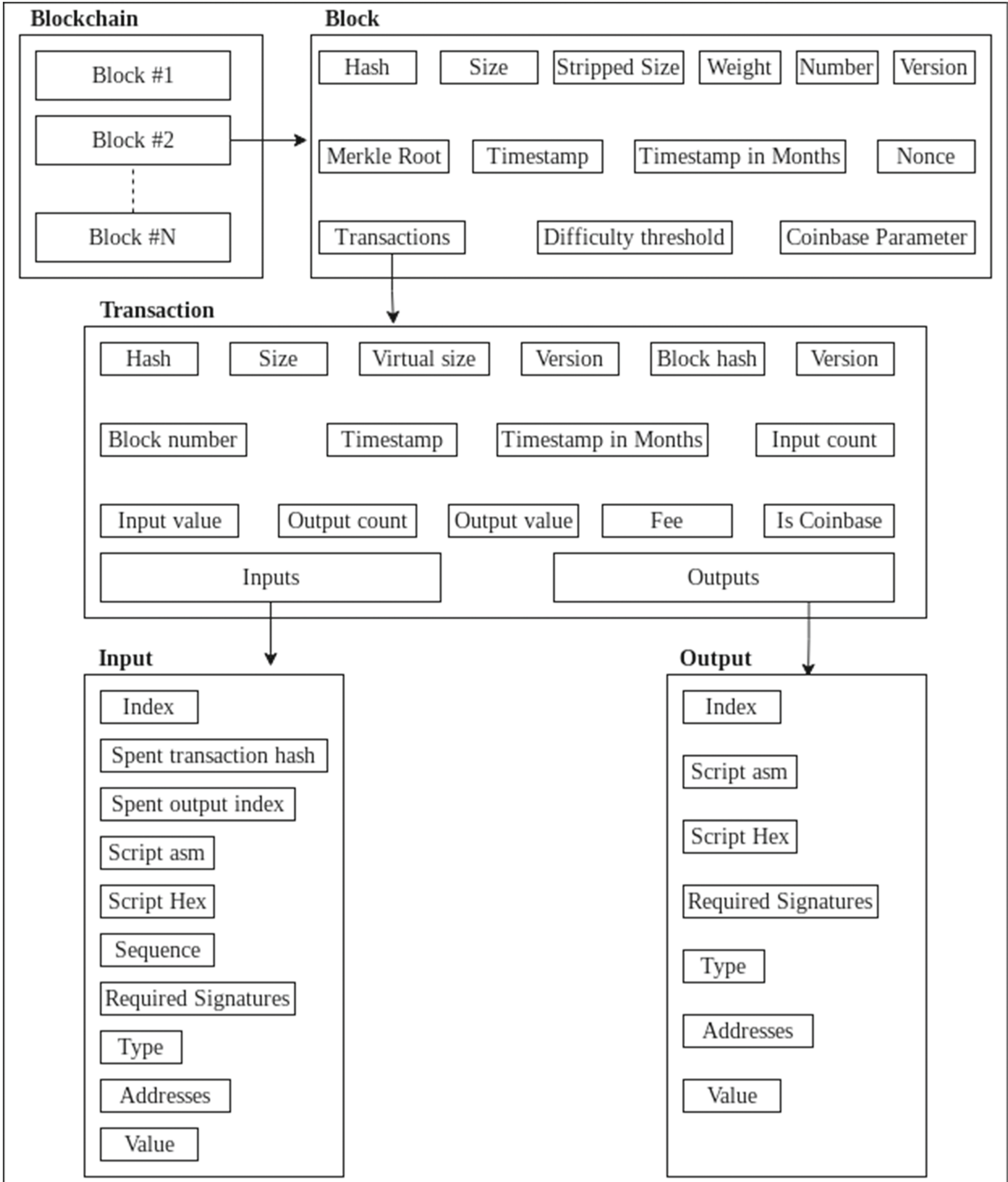 Fig 2: The complex metadata structure of Bitcoin providing the surface area for feature engineering.