
APFEL: Mastering Ontology Alignment via Supervised Learning
Supervised Learning of an Ontology Alignment Process.
This paper introduces APFEL (Alignment Process Feature Estimation and Learning), a supervised machine learning approach for automating and optimizing ontology alignment. By leveraging user validations of initial alignments, APFEL learns an optimal weighting scheme for diverse intensional and extensional features, outperforming existing manual methods like QOM.
TL;DR
The alignment of heterogeneous ontologies is a bottleneck in semantic interoperability. APFEL (Alignment Process Feature Estimation and Learning) shifts the burden from human experts to machine learning. By analyzing user-validated samples, it automatically selects and weights the best "rules" (like label similarity or hierarchy overlap), significantly outperforming manually tuned systems in both accuracy and speed.
Background: The Alignment Paradox
In the Semantic Web, or any multi-agent system, different entities use different schemas. Aligning "Telephone Number" in one ontology to "Phone_No" in another is easy for a human but hard to automate at scale.
Existing tools fall into two camps:
- Hard-coded Heuristics: Experts define rules (e.g., "if labels match, they are the same"). These fail in niche domains or complex structures.
- Instance-based Learning: These rely on having thousands of shared data points (instances), which are often unavailable in real-world schemas.
APFEL bridges this gap by viewing alignment as a Parameterizable Alignment Method (PAM) that can be optimized through supervised learning using very few initial examples.
Methodology: The APFEL Pipeline
APFEL decomposes the alignment task into a structured workflow:
- Initial Bootstrapping: It generates a "first guess" alignment using a standard method (like QOM).
- User Validation: A human looks at a small subset and clicks "Correct" or "Incorrect."
- Feature Hypothesis Generation: APFEL creates hundreds of potential similarity rules by combining features (URIs, labels, sub-concepts, super-properties) with comparison metrics (String distance, Equality, Set inclusion).
- ML Training: It uses the validated samples to train a classifier. The Decision Tree (C4.5) proves most effective here because it implicitly performs Feature Selection, discarding useless rules and keeping only the high-impact ones.
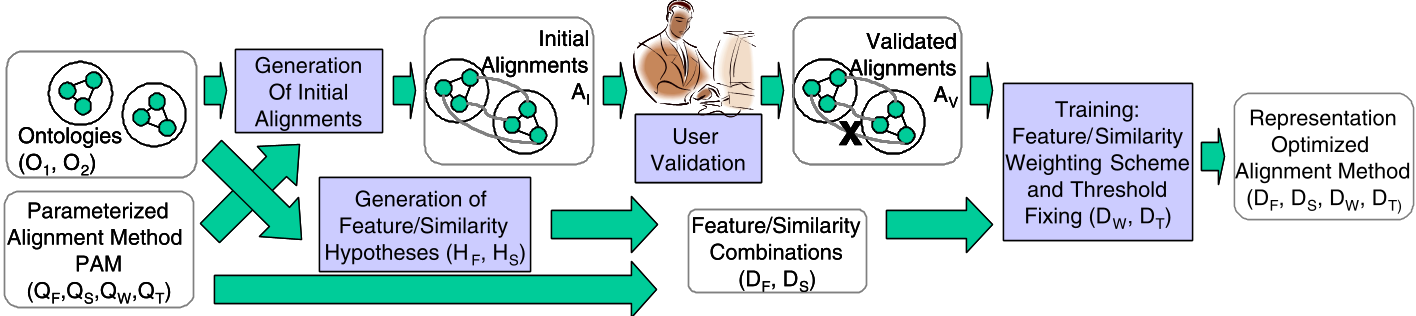 Figure 1: The APFEL process flow, showing the transition from raw ontologies to an optimized alignment method.
Why it Works: Beyond Simple Labels
Ontologies are richer than just names. APFEL exploits the Similarity Stack. It looks at:
- Extensional Data: Shared instances or data values.
- Intensional Structure: Do these two concepts share the same parent? Do they have the same sibling counts?
By aggregating these via a weighted sum (), the model learns exactly how much to trust the "label" versus the "hierarchy" for a specific pair of ontologies.
Results: Efficiency Through Pruning
In the "Russia Travel" and "Bibliographic" benchmarks, the results were clear. While the manual QOM used 25 features to get an F-Measure of 0.667, APFEL's Decision Tree used only 7 high-quality features to achieve 0.733.
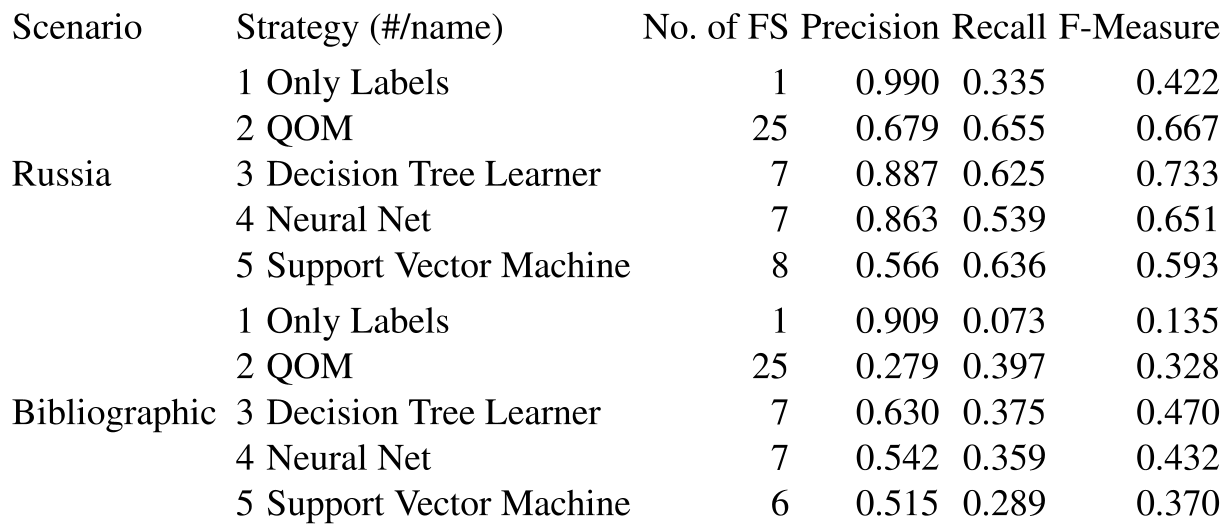 Table 1: Performance comparison showing APFEL (Decision Tree) outperforming QOM and other ML models.
Key Insight: More features aren't always better. The "Labels Only" strategy has high precision but terrible recall. APFEL finds the "Goldilocks" zone—the minimal set of semantic features that maximizes coverage without introducing noise.
Critical Analysis & Conclusion
APFEL represents a significant leap from "hand-crafted" alignment to "learned" alignment. Its choice of Decision Trees is particularly clever because it provides a human-readable set of rules, allowing knowledge engineers to understand why the system thinks two entities match.
Limitations:
- Bootstrapping Dependency: The quality of the final model still depends on the quality of the "initial guess" and the user's patience in validating it.
- One-to-One Bias: The current implementation focuses on 1:1 mappings, leaving complex transformations (e.g., merging "First Name" and "Last Name") for future work.
Future Outlook: In an era of LLMs, the "features" used in APFEL could be significantly expanded to include vector embeddings. However, the core philosophy of APFEL—tuning the process based on specific ontology pairs—remains the gold standard for high-precision semantic integration.