
FWSVM: Transforming Social Graph Data into Smart Advertising Insights
Applying supervised learning algorithms on information derived from Social Network to enhance recommender systems
The paper introduces a "Smart Advertising" framework by applying a Weighted Feature Support Vector Machine (FWSVM) to social network data. By extracting user attributes via the Facebook Graph API and applying importance weights, it transforms raw social profiles into precise predictive models for targeted marketing.
TL;DR
The research proposes a paradigm shift in digital marketing by moving from reactive "cookie-based" ads to proactive "Smart Advertising." By utilizing Feature Weighted Support Vector Machines (FWSVM) on Facebook Graph data, the authors achieved an impressive 92.9% prediction accuracy in determining user behaviors, outperforming standard SVMs by prioritizing high-value user attributes.
Context & Motivation: Why Browsing History Isn't Enough
In the early 2010s, advertising was largely reactive. If you searched for a gym, you saw gym ads. However, this "cookie-chasing" method often fails because it doesn't understand the user's broader intent or context. The authors identify a critical gap: indiscriminate feature evaluation.
Standard Machine Learning models often treat every data point (Age, Gender, Location) as equally important. In reality, your income level might be a far better predictor of your "international travel habits" than your gender. This paper addresses this by introducing a weighting mechanism to help the machine "focus" on what matters.
Methodology: The Core of Weighted Classification
The authors break their workflow into three distinct phases:
- Data Harvesting: Utilizing the HTTP-based Facebook Graph API to retrieve structured quantitative data (nodes and edges) from users.
- Feature Weighting via Pairwise Comparison: Instead of arbitrary weights, the study uses the law of comparative judgment to establish relationships between features, assigning higher weights to variables with stronger predictive correlations.
- The FWSVM Classifier: A modified version of Vapnik’s original SVM that incorporates these weights into the learning process to handle non-linear, high-dimensional social data.
Model Architecture Concept
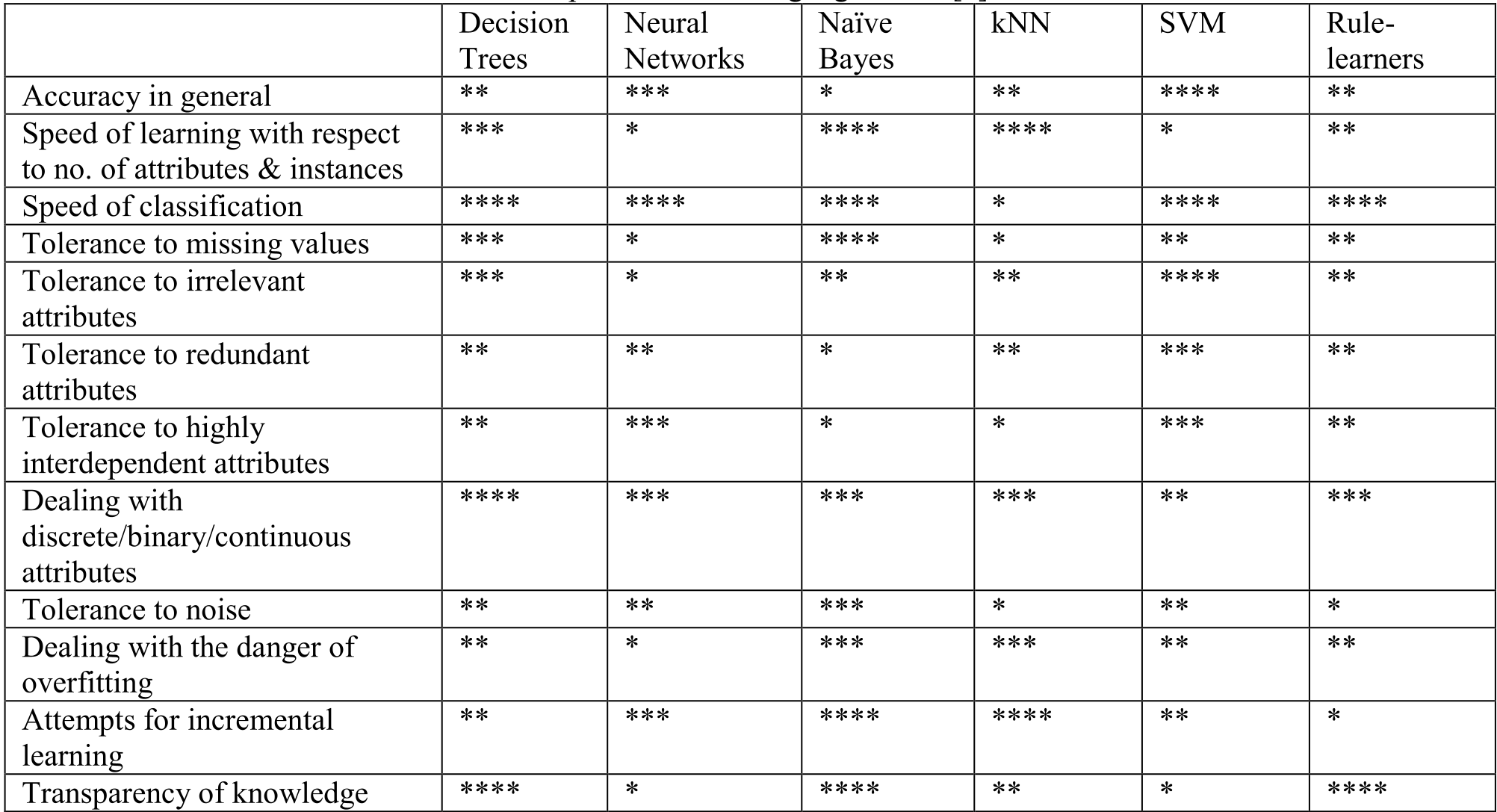 The table above highlights why SVM was chosen: its superior tolerance to irrelevant/redundant attributes and high general accuracy compared to Decision Trees or Neural Networks (in the 2014 context).
Experimental Battle: SVM vs. FWSVM
The researchers tested their approach on three datasets: a custom Facebook pool, the Iris dataset, and a vertebral dataset. The focus was on predicting whether a user would travel in the following year based on seven specific features.
Quantitative Results
The difference weights make is undeniable. As the training set size increased, the gap between standard SVM and Weighted SVM widened:
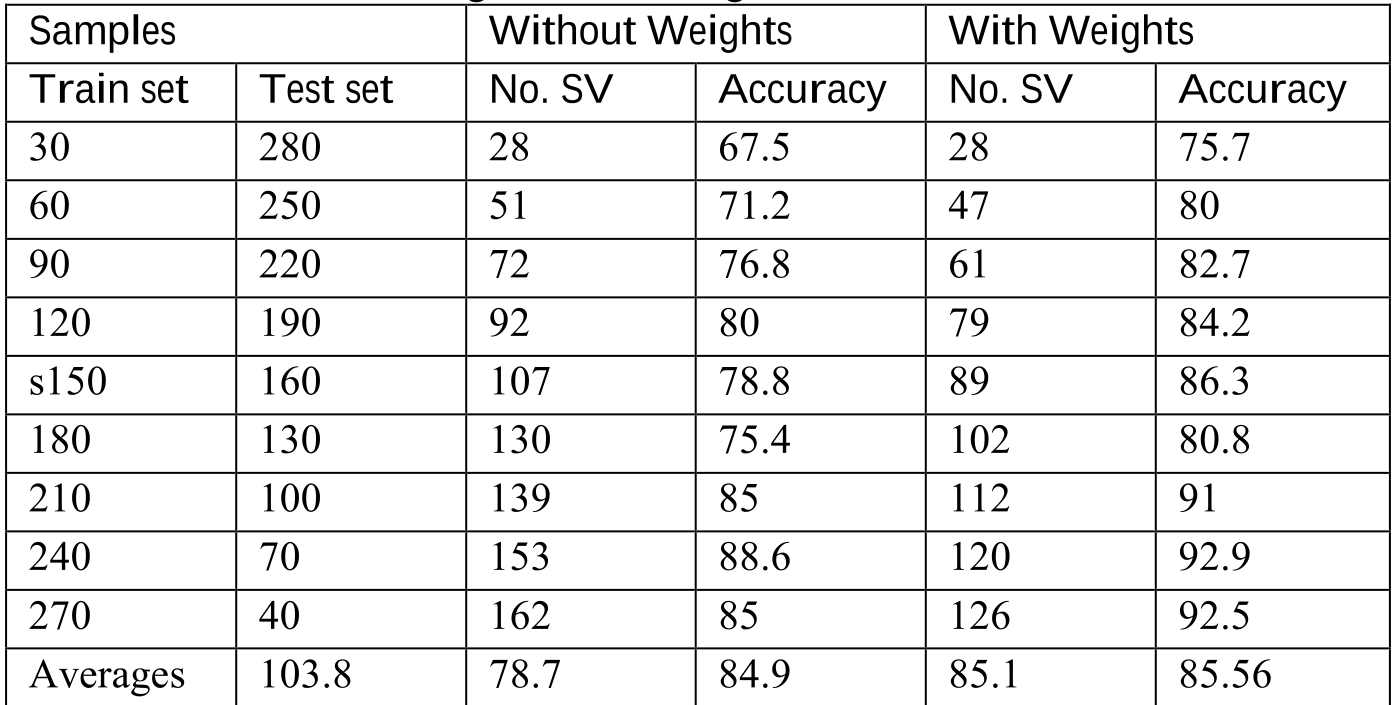
- Maximum Accuracy: FWSVM (92.9%) vs. SVM (88.6%).
- Efficiency: FWSVM required fewer Support Vectors (120 vs. 153), meaning the model is less prone to overfitting and faster during the inference phase.
- Trend: Even with small training samples, the weighted model consistently provided a ~7-8% accuracy boost.
Critical Insight: Data Finding Users
The ultimate takeaway of this paper is the concept of "Data Finding Users." By analyzing historical data (2005–2012), the system doesn't wait for a user to search for a flight; it predicts the need before it arises.
Limitations & Future Directions
While the results are strong, the paper relies on manually assigned weights via Pairwise Comparison, which may introduce human bias. The authors suggest that future work should focus on automated feature extraction—potentially using the recommender system to not just predict if someone travels, but where they should go based on their friends' reviews.
Conclusion
This research highlights that in the era of Big Data, the "Quantity" of information is secondary to the "Weight" of human-centric insights. By adding a simple yet mathematical weighting layer to the SVM architecture, social networks can transform from simple communication hubs into hyper-accurate marketing engines.
Key Terminology:
- FWSVM: Feature Weighted Support Vector Machine.
- SOTA: At the time of publication, this represented a highly efficient approach to social classification.
- Support Vectors: The data points that define the maximum margin between classes.