
Leveraging Bipartite Duality: A Supervised Approach to Link Prediction
Supervised Machine Learning Applied to Link Prediction in Bipartite Social Networks
This paper proposes a supervised learning framework for link prediction in bipartite social networks and their projections. It introduces "indirect topological attributes" that leverage the dual-mode nature of graphs to enhance prediction models, achieving state-of-the-art performance in academic collaboration and e-commerce recommendation tasks.
TL;DR
Predicting future connections in social networks is often handicapped by looking at only one dimension of the data. This paper demonstrates that by treating networks as bipartite graphs (e.g., Authors-Papers or Customers-Products) and extracting indirect topological features from dual projections, we can significantly boost the precision of recommendation systems using standard supervised learning techniques like AdaBoost.
Contextual Positioning
In the landscape of Social Network Analysis (SNA), link prediction is a foundational problem. While most SOTA methods focus on unimodal graphs (node linked to node ), this work recognizes that many networks are actually projections of bipartite structures. This paper moves the needle by shifting the feature engineering process from simple direct neighbors to cross-domain aggregate similarity.
The "Projection" Problem: Why We Lose Information
Most academic collaboration studies use a Co-authorship Graph. In this graph, two authors are connected if they wrote a paper together. However, this is a projection. The original reality is a bipartite graph where Authors link to Papers.
When we project this into a simple author-only network:
- We lose the specific context of the papers (the dual nodes).
- We ignore the similarity between the papers themselves in a "Paper-Paper" projection.
The authors argue that the likelihood of two authors collaborating in the future depends heavily on how similar their publications are, a feature that is invisible to traditional "Common Neighbors" metrics in the author-only graph.
Methodology: The Power of Indirect Attributes
The core innovation is the Indirect Topological Attribute. Instead of just looking at the neighborhood of node and in the target graph, the method looks at the neighbors in the original bipartite graph and computes their similarity in the dual projection.
Architecture Shift
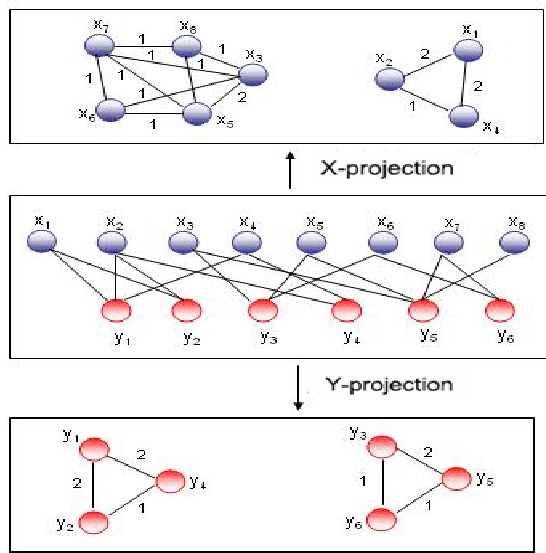 Fig 1: The process of projecting a bipartite graph G into two unimodal graphs GX and GY.
The formulation follows a supervised learning pipeline:
- Direct Attributes: Common Neighbors, Jaccard Coefficient, Adamic Adar computed on Graph .
- Indirect Attributes: For authors and , calculate the similarity between all papers (authored by ) and (authored by ) in the Paper-Paper projection , then take the maximum.
By combining these features, the machine learning model (J48 Decision Tree with AdaBoost) gains a "multidimensional view" of the potential link.
Experimental Results
The authors validated their approach on two distinct domains:
- DBLP (Academic): Predicting new co-authorships.
- Mondomix (E-commerce): Recommending songs to customers.
Performance Gains
In both cases, introducing indirect attributes resulted in a substantial "spike" in precision.
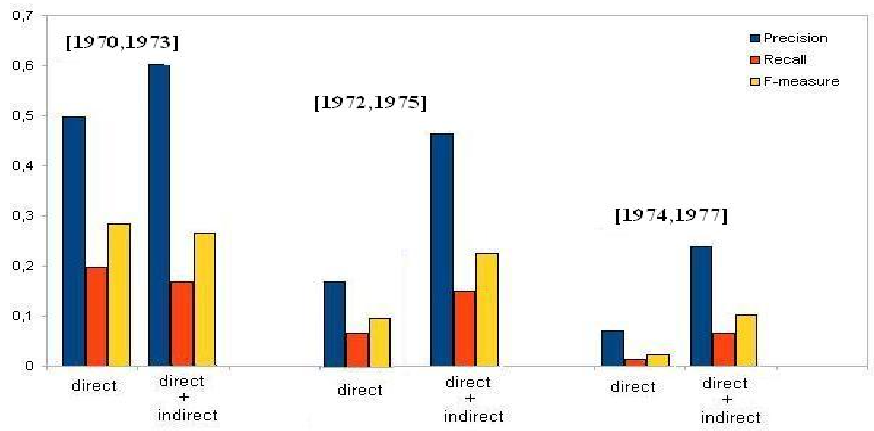 Fig 2: Performance comparison on DBLP shows that adding indirect features (blue/green vs red bars) consistently improves F-Measure and Precision.
The "skewed" nature of the data (where very few potential links actually become real links) makes precision the most critical metric. The indirect attributes help the model filter out "false positives"—pairs of nodes that look similar in one projection but have no affinity in the dual space.
Critical Insight & Conclusion
The takeaway for data scientists and researchers is clear: Don't flatten your data too early. If your data has a natural bipartite structure (Users-Items, Genes-Diseases, Speakers-Events), using that structure to build features will almost always outperform models that operate on a simple flattened projection.
Limitations & Future Work
- Weighting: The current work ignores edge weights (e.g., how many times a customer bought a product).
- Temporality: The model treats a link from 5 years ago the same as a link from yesterday.
- Complexity: Higher computational cost for calculating indirect metrics in dual projections.
This paper provides a robust blueprint for improving recommendation engines by honoring the complex topology of the underlying bipartite networks.