
Scaling Human Capital: Predicting Talent Substitutability via Machine Learning
Prediction of suitable human resource for replacement in skilled job positions using Supervised Machine Learning
This paper presents a supervised machine learning framework for predicting suitable human resource replacements in skilled positions, using a case study of professional football player transfers. By evaluating eleven different classification algorithms on the FIFA 2017 dataset, the study identifies Linear Discriminant Analysis (LDA) as the superior method for high-dimensional, multi-class skill gap analysis.
TL;DR
When a highly skilled worker leaves, the cost of a "bad hire" replacement is astronomical. This paper leverages the FIFA 2017 dataset to simulate a high-stakes HR scenario: finding a football player who can perfectly fill the shoes of a transferred star. The researchers found that while popular algorithms like SVM dominate simple binary tasks, Linear Discriminant Analysis (LDA) is the true workhorse for the complex, multi-class reality of professional skill matching, maintaining ~87% accuracy even as data complexity scales.
The "Hiring Headache": Why Intuition Fails
In specialized industries—be it data science or professional football—skills are not just binary ("skilled" vs "unskilled"). They are a spectrum of dozens of quantitative attributes like vision, aggression, and ball control. Prior work often struggles because:
- High Dimensionality: Assessing a candidate across 50+ metrics simultaneously is cognitively impossible for human recruiters.
- Class Explosions: Predicting a specific "Rating" (e.g., a score of 82 vs 83) transforms the problem from a simple "Yes/No" into a 50-class classification challenge where most standard models lose their predictive edge.
Methodology: The FIFA 2017 Sandbox
The researchers treated the FIFA 2017 player database as a proxy for corporate talent pools. The workflow involved:
- Categorization: Sorting 17,588 players into functional groups (Forward, Midfield, etc.) to reduce noise.
- Feature Engineering: Using Pearson Correlation to identify "Rating" drivers.
- Stress Testing: Evaluating 11 algorithms—including AdaBoost, Random Forest, MLP, and LDA—under varying conditions of feature count and class density.
 Eq 1: The Accuracy Metric - A standard ratio of correctly predicted skill levels to total instances.
The LDA Breakthrough
The most striking insight from the study is the divergence in performance between "Binary" and "Multi-class" environments.
The Binary Fallacy
When the model only had to distinguish between two ratings (e.g., 69 and 70), almost every algorithm (SVM, Logistic Regression, Random Forest) reached near 100% accuracy. However, these results are deceptive. In real HR scenarios, we need to distinguish between dozens of tiered skill levels.
The Multi-class Reality
As the number of classes increased to ~40:
- SVM and Logistic Regression collapsed, with accuracy dropping to near zero.
- KNN and Random Forest degraded significantly due to the increased computational complexity and decision tree branching.
- LDA (Linear Discriminant Analysis) emerged as the winner, maintaining an accuracy of 86-87%.
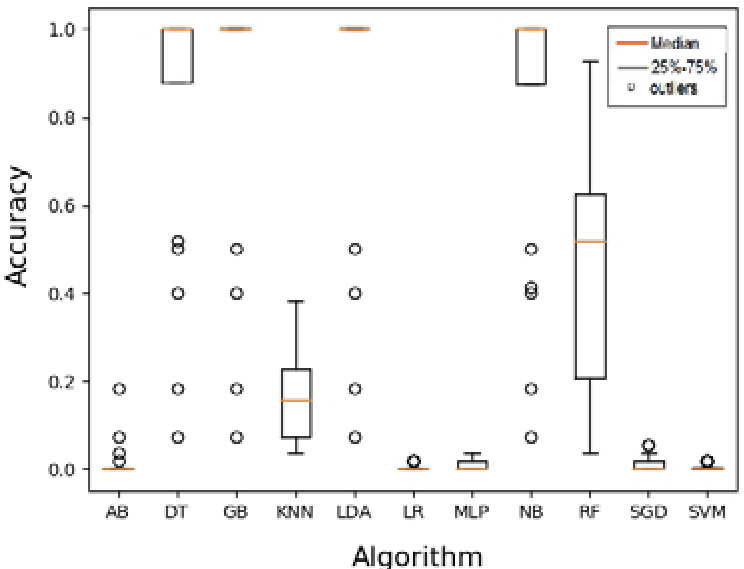 Fig 1f: Comparative box plots showing LDA's stability across 40+ features and classes compared to the volatility of other classifiers.
Key Takeaways for Tech Leaders
- LDA for High-Dim Talent Data: Unlike models that attempt to find complex non-linear boundaries (which often overfit or fail in many-class settings), LDA's use of linear combinations is remarkably robust for skill-based ranking.
- Context Matters: A model that looks like a "SOTA" performer on a simple dataset (like SVM on binary tasks) may be utterly useless in the nuanced world of professional grading.
- Feature selection is paramount: The study proves that while adding features usually helps, only certain algorithms can handle the "noise" created by 50+ attributes without specialized pruning.
Critical Analysis & Future Work
While the paper successfully identifies LDA as a top performer for discrete classification, it leaves the door open for Regression techniques. In the future, predicting a continuous "Value" or "Performance Index" rather than discrete ratings could provide even more granular HR insights. Additionally, integrating Precision and Recall metrics would be vital for understanding the "Cost of False Positives" in a hiring context—where hiring a mediocre player for a star's salary is a catastrophic failure.