
Optimized Random Forest: Strengthening the Shield Against Malicious URLs in Social Networks
Using supervised machine learning algorithms to detect suspicious URLs in online social networks
This paper presents a supervised machine learning model focused on detecting malicious URLs within Online Social Networks (OSNs), specifically Twitter. By utilizing a Random Forest (RF) classifier with multisource features—including tweet metadata, account info, domain WHOIS data, and webpage content—the authors achieved a state-of-the-art recall of 0.92 after systematic parameter tuning and feature selection.
TL;DR
Social networks are prime targets for drive-by downloads and phishing. While blacklists are the standard defense, they are too slow for modern "burst" spam campaigns. This research presents a highly optimized Random Forest model that leverages multisource features (Twitter API, WHOIS data, and Web content) to detect suspicious URLs with 92% recall and 96% precision, significantly outperforming traditional blacklists and baseline ML classifiers.
The "Time Gap" Problem: Why Blacklists Fail
In the world of cybersecurity, blacklists like PhishTank and Google Safebrowsing are essential but reactive. Spammers have mastered the art of "short-lived" attacks:
- Evasion: Using URL shorteners and fresh domains to avoid historical tracking.
- Speed: Most spam campaigns hit 80% of their target audience within the first 24 hours.
- Lag: There is a critical window between the launch of a URL and its detection by security communities.
To bridge this gap, we need classifiers that can look at the DNA of a tweet and its destination URL in real-time, rather than relying on a database of "known criminals."
Methodology: The Power of Multisource Features
The core insight of this paper is that spammers can easily fake one aspect of their identity (like follower counts) but find it much harder to fake multiple dimensions simultaneously. The authors extracted 36 features across three categories:
- Lightweight Metadata: Account age, follower/friend ratios, and tweet frequency.
- Domain Information: The "Domain Age" from WHOIS records (one of the strongest predictors).
- Content Analysis: Redirection patterns, the number of input forms on the landing page, and even the presence of ad-blocked links.
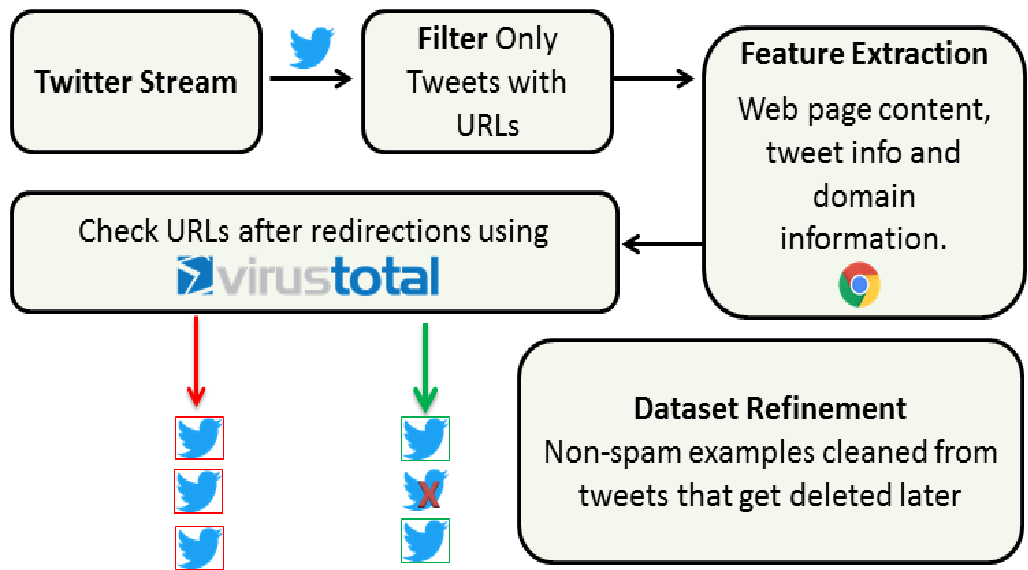 Figure 1: The data collection pipeline utilizing the Twitter API and VirusTotal for ground-truth labeling.
Engineering Efficiency: Parameter Tuning and Feature Selection
The research moves beyond "off-the-shelf" implementation. By using Grid Search, the team identified that after 9 trees, performance gains in the Random Forest diminish, but Max Tree Depth (optimal at 24) and Leaf Size are critical for preventing overfitting.
Furthermore, they applied the Mean Decrease Accuracy (MDA) wrapper method. Unlike simple filters, MDA evaluates the impact of removing a feature on the overall model performance.
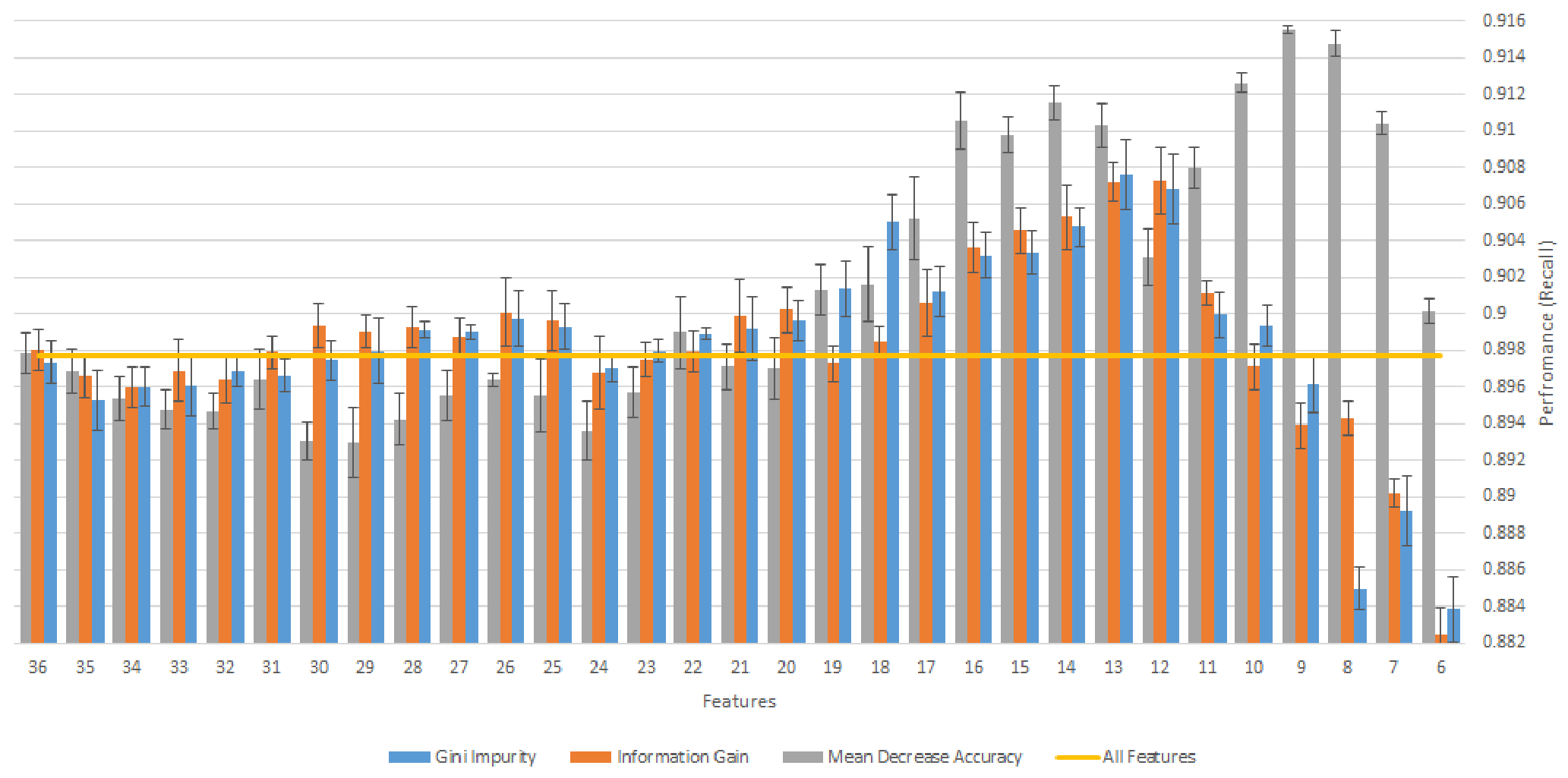 Figure 2: Performance improvement as lower-ranked features are removed.
The results revealed a surprising efficiency: by narrowing the focus from 36 features down to the top 9 (led by Domain Age and Link Digit Count), the classifier actually became more accurate, reaching a Recall of 0.92.
Experimental Showdown: Random Forest vs. The Field
The study compared the optimized RF against common industry baselines. As shown in the data, RF's ability to handle non-linear relationships and its inherent ensemble robustness made it the clear winner:
| Model | AUC | F1-Score | Precision | Recall |
|---|---|---|---|---|
| Random Forest (RF) | 0.92 | 0.92 | 0.96 | 0.89 (Initial) |
| k-NN | 0.80 | 0.78 | 0.79 | 0.76 |
| Logistic Regression | 0.67 | 0.63 | 0.67 | 0.60 |
| Naive Bayes | 0.58 | 0.62 | 0.51 | 0.78 |
Critical Insight & Future Outlook
This paper proves that Information Gain and Gini Index are useful, but "Domain Age" remains the ultimate "Inductive Bias" for spam detection. Spammers can change their account names, but they cannot legally forge the registration date of a domain at scale without significant cost.
Limitations: The model relies on WHOIS and webpage crawling, which are "heavyweight" and more resource-intensive than simple metadata analysis. Future research should explore "Medium-weight" features that balance speed and accuracy, perhaps using newer architectures like XGBoost or Transformers to analyze the temporal patterns of tweet bursts.
Conclusion: By combining rigorous statistical parameter tuning with multisource feature engineering, this approach provides a reproducible blueprint for building resilient social network security systems.