
SVM-Powered Instagram: Reclaiming User Control in the Era of Algorithmic Feeds
Support Vector Machine Algorithm to Classify Instagram Users’ Accounts Based on Users’ Interests
This paper proposes a framework to classify Instagram user accounts and rank posts based on user-defined interests using Support Vector Machines (SVM). By introducing an "account type" system and content-based recommendation via the ID3 decision tree algorithm, the study achieves a structured following list and a personalized feed that prioritizes user control over passive algorithmic sorting.
TL;DR
In response to the growing frustration with "black-box" social media algorithms, researchers from the University of Jeddah have proposed a novel framework that uses Support Vector Machines (SVM) and Content-Based Recommendation to categorize Instagram accounts. Unlike current systems that guess what you like, this method allows users to explicitly define account types, reducing search time and increasing feed relevance through a structured ID3 decision tree logic.
The Motivation: When More Following Means More Frustration
Instagram transitioned from a chronological feed to a personalized one in 2016, a move that sparked the "#RIPINSTAGRAM" movement. While the platform claimed this improved relevance, users often feel "oppressed" by a hegemony of hidden weights.
The authors identify two core pain points:
- Inefficient Search: Navigating a following list of hundreds of accounts is time-consuming without categorization.
- Lack of Agency: Users have little say in how they are profiled, leading to a "rich-get-richer" phenomenon where only high-engagement posts surface, regardless of the user's current topical interest.
Methodology: The Hybrid Intelligence Model
To solve this, the paper introduces a system architecture that places the user at the center of the training loop.
1. Classification via SVM
The system adds a new "Account Type" feature in settings. The user selects a category for followed accounts from eight predefined classes (derived from Hu et al.'s seminal 2014 study): Friends, Self-portraits, Activities, Fashion, Food, Captions, Gadgets, and Pets.
The Support Vector Machine (SVM) acts as the core engine here. It uses a hyperplane to separate these features in a high-dimensional space, ensuring that once a type is assigned, the system can distinguish between "similar" and "dissimilar" account types.
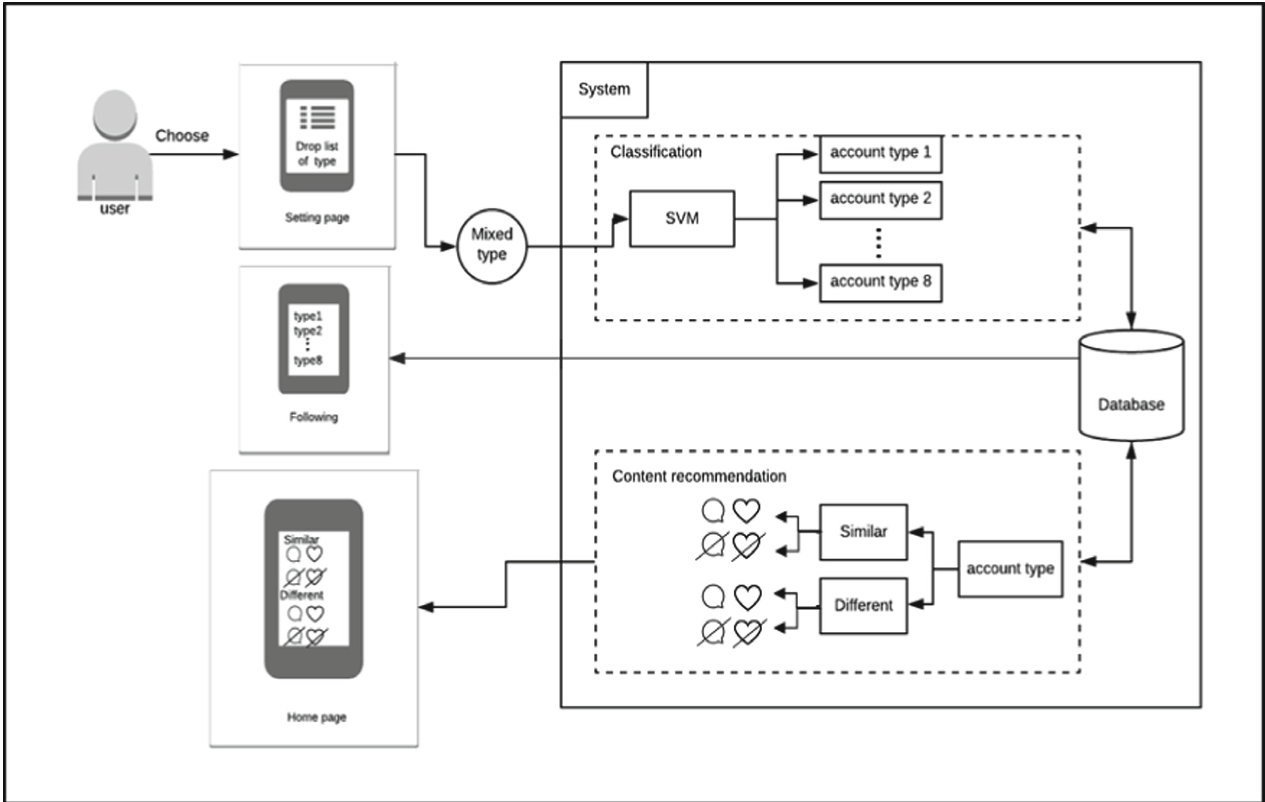
2. Post Ranking via ID3 Decision Tree
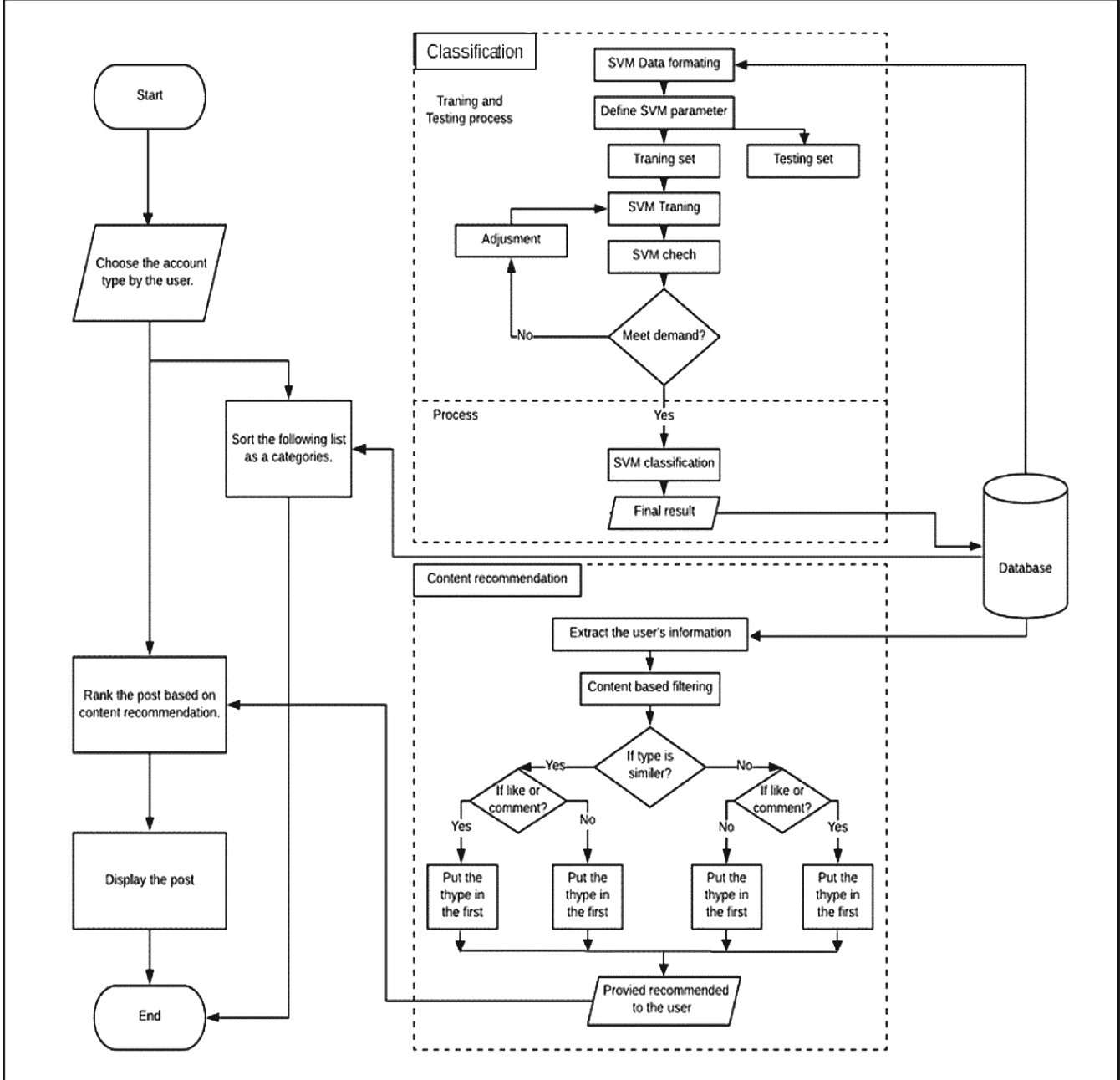
Once classified, the posts aren't just dumped into a list. The authors use a Content-Based Recommendation system driven by the ID3 (Iterative Dichotomiser 3) Algorithm. This algorithm calculates the Entropy (E) of the user's interactions (Likes/Comments).
The decision logic follows a specific hierarchy summarized in the table below:
| Type | Similarity | Practice (Like/Comment) | Result Ranking |
|---|---|---|---|
| Type X | Yes | Yes | First |
| Type X | Yes | No | Second |
| Type X | No | Yes | Third |
| Type X | No | No | Last |
Experiments & Results: User-Centric Validation
The researchers built a prototype to demonstrate the workflow—from selecting an "Account Type" (e.g., Captioned Photo) to seeing the reorganized "Following List" and "Ranked Posts."
Key Findings:
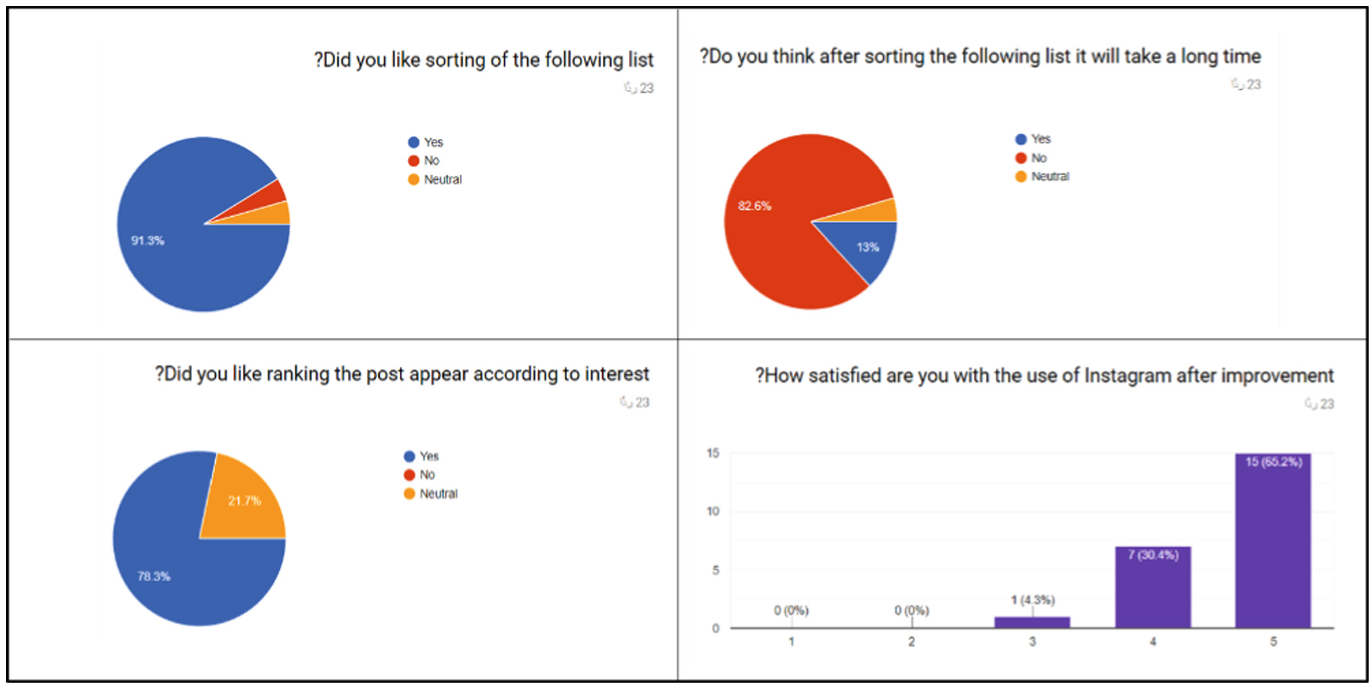
- Time Saving: 87% of surveyed users reported that finding a specific account was difficult in the standard UI. The prototype's categorical sorting directly addressed this.
- Satisfaction Rate: 91% of participants preferred the sorted following list over the traditional "continuous list."
- User Agency: The questionnaire results (shown in the histograms below) confirm a high satisfaction rating (ranging from 4 to 5) for the proposed sorting method.
Critical Insights: Why This Matters
This work highlights a critical shift from passive recommendation (the system decides for you) to active classification (the user guides the system).
Strengths:
- Logic over Heuristics: By using SVM and ID3, the system moves away from purely engagement-driven metrics ("The Rich Get Richer") towards thematic relevance.
- Flexibility: The "Account Type" setting makes the application feel more like a productivity tool and less like a slot machine.
Limitations & Future Work: While SVM is effective for linear classification, modern Instagram content is multi-modal (Reels, Stories). Future iterations would likely need to incorporate Convolutional Neural Networks (CNNs) or Transformers to automatically suggest these categories to the user to reduce the manual effort of tagging every followed account.
Conclusion
The study proves that "sorting efforts" shouldn't be hidden from the user. By combining the statistical rigor of SVM with a transparent decision-tree recommendation, social platforms can become more enjoyable, efficient, and ultimately, more respectful of the user's time.