
iDPS: Bridging the Gap Between Deliberative AI and Hard Real-Time Constraints
Supporting Deliberative Real-Time AI Systems: A Fixed Priority Scheduling Approach
This paper introduces iDPS (imprecise Dual Priority Scheduling), a novel scheduling framework designed for deliberative AI systems. It utilizes a Prologue-Optional-Epilogue (P-O-E) task model to manage the high execution-time variance of AI algorithms while providing worst-case hard real-time guarantees for mandatory components.
TL;DR
Deliberative AI (like planning and reasoning) is notoriously unpredictable in its execution time, making it a "bad citizen" in hard real-time systems that demand strict worst-case guarantees. This paper introduces iDPS (imprecise Dual Priority Scheduling), a framework that uses a Prologue-Optional-Epilogue structure to guarantee a minimum level of AI performance while allowing the system to use every spare microsecond to refine AI results. In tests, it boosted resource utilization from a mediocre 50% to nearly 100%.
The "Real-Time AI" Paradox
In the world of Real-Time Systems (RTS), safety is paramount. We schedule tasks based on their Worst-Case Execution Time (WCET). However, AI algorithms—especially deliberative ones used in robotics—have a massive variance in execution time. If you reserve enough time for the "worst case," the CPU sits idle 99% of the time. If you don't, the system might crash when the AI encounters a complex scenario.
The authors identify a critical gap: existing solutions are often restricted to Soft Real-Time (GPOS) or use simplistic scheduling (Cyclic Executives) that waste the potential of modern Fixed Priority Scheduling (FPS).
Methodology: The P-O-E Model and iDPS
The core innovation lies in rethinking how an AI task is structured and scheduled.
1. The P-O-E Task Model
Instead of one big "Black Box" task, the authors split an AI computation into three parts:
- Prologue (Mandatory): Initial processing and setting up a "minimum acceptable" plan.
- Optional (Anytime): The "deliberation" phase that improves the plan quality as long as time allows.
- Epilogue (Mandatory): Finalizing the action, sending commands to actuators, or network I/O.
2. Dual Priority Promotion Logic
Standard Dual Priority Scheduling (DPS) uses three priority bands. iDPS optimizes this for AI:
- Prologue is promoted to the high-priority band immediately to ensure the AI starts working ASAP.
- Epilogue is promoted as late as possible (calculated using response-time analysis).
- The gap between them creates a "buffer" where the Optional anytime algorithm can run at a mid-priority level, soaking up all available slack.
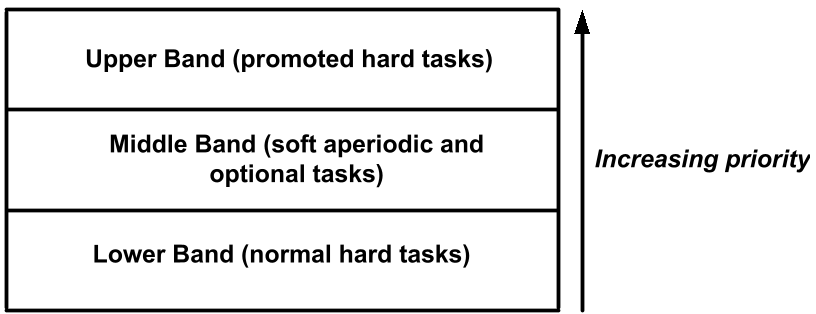 The strategy shifts the epilogue (Ck) to the latest possible execution window, maximizing the space for optional computation.
Mathematically Guarded: Schedulability Analysis
The paper doesn't just "hope" the tasks finish. It provides a tractable schedulability test. Since calculating exact response times with task offsets is NP-Hard (intractable as the number of tasks grows), the authors utilize a "Sufficient but Not Exact" approach. This allows the system to verify—at design time—that even if the AI takes its absolute maximum time to finish the Prologue and Epilogue, no deadlines will ever be missed.
Experimental Results: The RoboCup Case Study
The authors simulated a RoboCup scenario (11 agents needing to make decisions every 10ms).
- Traditional Scheduling: Failed to utilize the machine effectively because it had to reserve massive blocks of time for the worst-case scenario.
- iDPS: Successfully reclaimed "slack" time. Even when the "guaranteed" portion was only 20% of the total requirement, iDPS allowed agents to use nearly 100% of the CPU capacity by dynamically expanding the optional execution window.
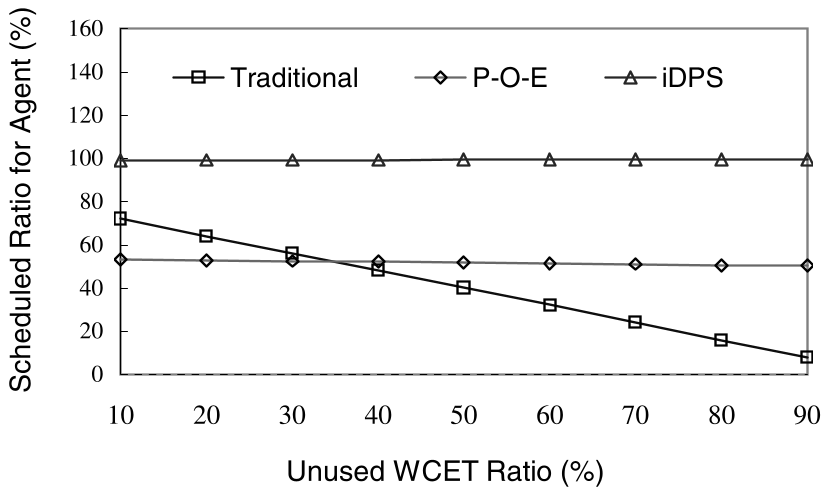 As the agents' utilization requirements increase, iDPS (top line) consistently maintains near-perfect resource usage compared to the dwindling efficiency of traditional methods.
Critical Insight & Conclusion
The beauty of iDPS is its compatibility. Most industrial Real-Time Operating Systems (RTOS) are based on Fixed Priority Scheduling. Unlike complex EDF (Earliest Deadline First) schemes, iDPS requires minimal changes to the OS kernel—it primarily needs a timer-based priority promotion mechanism.
The Takeaway: For developers building autonomous drones or robotic soccer players, this work provides the mathematical permission to use a "sophisticated but slow" AI algorithm alongside "fast and mandatory" safety logic, knowing the scheduler will always give the AI the maximum possible time to think without ever missing a hard deadline.
Limitations
- WCET Accuracy: The system relies on accurate WCET for the Prologue/Epilogue. If these are wrong, the "late promotion" of the Epilogue could lead to a deadline miss.
- Context Switching: While noted as "low overhead," the frequent context switching between many agents in shorter periods (10ms) could impact actual performance on lower-end hardware.