
LDBC SNB Evolution: Bridging the Gap in Dynamic Graph Benchmarking
940_Supporting Dynamic Graphs and Temporal Entity Deletions in the LDBC Social Network Benchmark's Data Generator.
This paper introduces an extension to the LDBC Social Network Benchmark (SNB) data generator to support dynamic graphs through temporal entity deletions. It defines a formal framework for "lifespan attributes" (creation and deletion dates) for nodes and edges, ensuring structural and semantic integrity in synthetic datasets.
TL;DR
The LDBC Social Network Benchmark (SNB) is the industry gold standard for graph processing, but until recently, it lacked a mechanism for complex, semantic deletions. This paper introduces lifespan attributes to the SNB Data Generator, allowing for the creation of truly dynamic graphs where entities (users, posts, friendships) are not just born but also "die" (deleted) according to strict temporal and semantic constraints.
The "Deletions" Problem in Graph Systems
In a post-GDPR world, graph databases can no longer treat "deletions" as an afterthought. Deleting a node in a highly connected graph isn't just about removing a record; it involves managing dangling edges, maintaining consistency across distributed nodes, and ensuring that the historical sequence of events makes sense (e.g., you cannot like a post that hasn't been created yet, or a post that has already been deleted).
Prior benchmarks either ignored deletions or used "point deletions" that lacked the cascading complexity found in real-world social networks. The author's insight was that to test a system's true performance under pressure, the benchmark itself must generate valid, interdependent lifespans across the entire graph schema.
Methodology: The Math of Entity Lifespan
The core of the paper is a set of formal constraints that govern the creation () and deletion () dates of any entity .
1. Referential Integrity
For any edge between nodes and , the edge's lifespan must be a subset of the overlap of its endpoints' lifespans. Mathematically, the edge cannot exist before both its endpoints are created, and it must be gone by the time the first endpoint is deleted.
 Figure 1: The dynamic part of the LDBC schema focuses on Persons, Forums, and Messages.
2. Semantic Constraints
The generator doesn't just pick random dates. It follows domain-specific logic. For example:
- Knows Relationships: Two people can only be "friends" while both are active members of the network.
- Message Trees: A "Comment" is dependent on its parent "Post." If a parent post is deleted, the entire tree of comments must logically cease to be accessible or be deleted in a specific order.
Visualizing Temporal Validating
The beauty of this system lies in its interval-based selection. As shown in the provided diagrams, the generator calculates a "valid window" for every action based on existing entities.
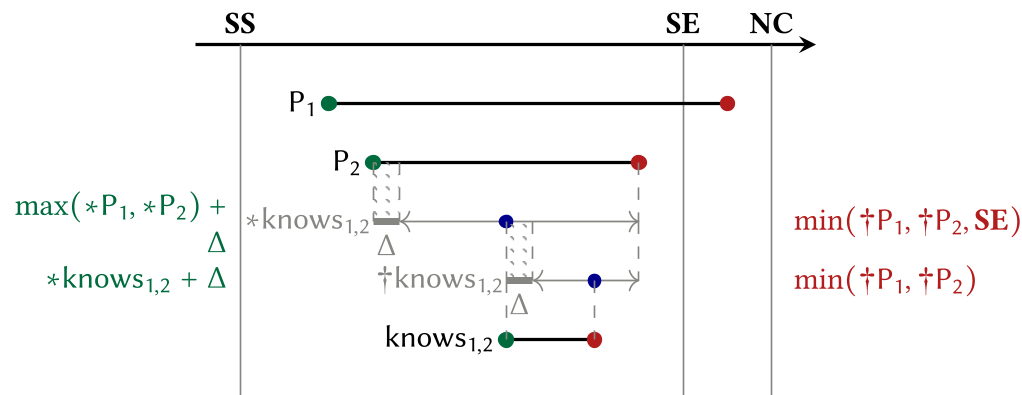 Figure 2: Thick black lines represent the actual lifespan, while thin grey lines show the mathematically valid intervals for selection.
Experiments and Scale
While this is a short paper focused on the validity of the generation, the significance lies in its implementation. By embedding these rules into the LDBC Datagen (which uses Spark/Hadoop for distributed generation), the authors ensure that these temporal rules can be applied to graphs with billions of edges.
In an ablation-style analysis of the rules, the authors demonstrate how specific parameters like (minimum time between operations) and (comment window) prevent "impossible" states in the data, such as messages appearing 10 years after a forum closed.
Critical Insight: Why This Matters
Most graph researchers focus on Query performance. This paper argues that Update performance—specifically deletions—is an equally important, yet neglected, dimension of system maturity.
Limitations: Currently, the paper focuses on "validity" (correctness). The next frontier is realism. Real social networks don't delete data linearly; they have spikes (bursty dynamics) during major global events. Adding "Flashmob" posts was a great first step, but more work is needed to match the statistical distributions of platforms like Twitter or Facebook.
Conclusion
By introducing lifespans to the LDBC SNB, we move closer to a benchmark that truly mimics the "living, breathing" nature of data. For developers of graph databases, this means the bar for "SOTA performance" just got higher: it's no longer enough to be fast at reading; you must now be fast at forgetting, without breaking the world.