
HCOME-3O & Semantic Wikis: Democratizing Collaborative Ontology Argumentation
On Supporting HCOME-3O Ontology Argumentation Using Semantic Wiki Technology
This position paper proposes integrating Semantic Wiki technology into the HCOME-3O framework to support collaborative ontology argumentation. It introduces a decentralized, web-driven approach for communities to discuss, track, and rationalize changes in evolving ontologies using tools like HCONE and Cicero.
TL;DR
This paper explores a vital evolution in knowledge engineering: moving from rigid, standalone tools to "living" ontologies driven by community-led discussion. By integrating the HCOME-3O framework with Semantic Wiki technology, the author provides a blueprint for an open environment where users can debate and track the rationale behind every modification to a shared ontology.
Background Location: This is a position paper that bridges the gap between structured Knowledge Engineering (HCOME) and Social Web technologies (Wikis), focusing specifically on the negotiation phase (argumentation) of the ontology lifecycle.
The Gap: Why "Closed" Ontology Tools Fail
Ontologies are not static; they are evolving artifacts. However, the logic behind why a class was changed often disappears into the void of undocumented emails or meetings. Existing tools like the early HCONE prototype were platform-independent but lacked the openness of the Web. Conversely, current Wikis are great for discussion (collective intelligence) but terrible at maintaining the formal relationships between a debate and a specific version of a semantic triple.
The author argues that for an ontology to be truly common and "living," it must be escorted by meta-information: the dialogue, the rationale, and the history of decisions.
Methodology: Mapping Dialogue to Logic
The core contribution is an architecture that allows a Semantic Wiki (HCOMEasWiki) to serve as the shared space for Ontology Argumentation.
The Hybrid Architecture
The system splits the environment into two distinct spaces:
- Personal Space: Where intensive editing and private conceptualization occur.
- Shared Space (The Wiki): Where the community performs "Exploitation" and "Inspecting"—reviewing, criticizing, and arguing over proposed versions.
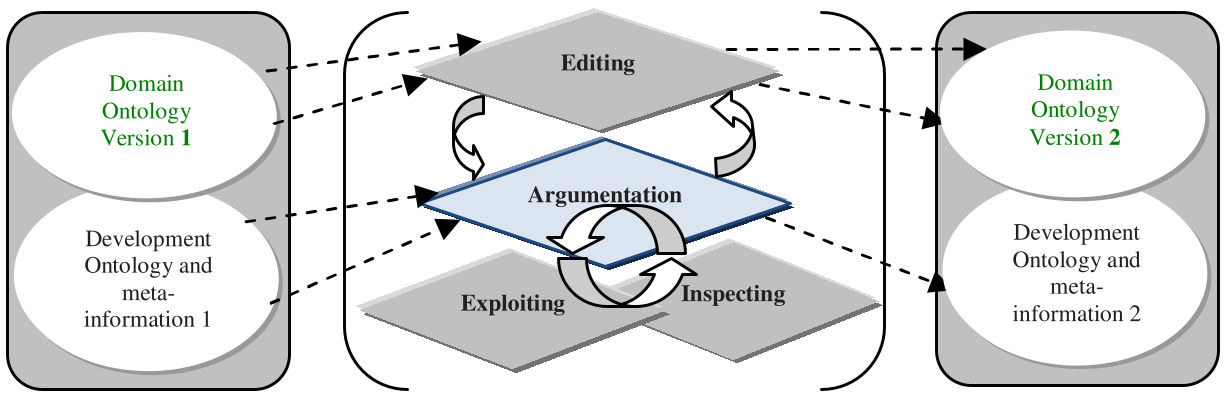
The Integration Mechanism
To make this work, the author identifies a mapping between the Argumentation Ontology and Wiki properties. For example, a "Category" in the Wiki might map to an "Issue" class in the meta-ontology, ensuring that every user-generated comment remains machine-readable and logically linked to an ontology element.
Experiments: HCOMEasWiki
The author implemented a prototype using MediaWiki, Semantic MediaWiki, and the Cicero API. Cicero allows for asynchronous discussions based on the IBIS (Issue-Based Information System) framework, where:
- An Issue is raised.
- Positions are proposed (often different versions of an ontology).
- Arguments are made for or against those positions.
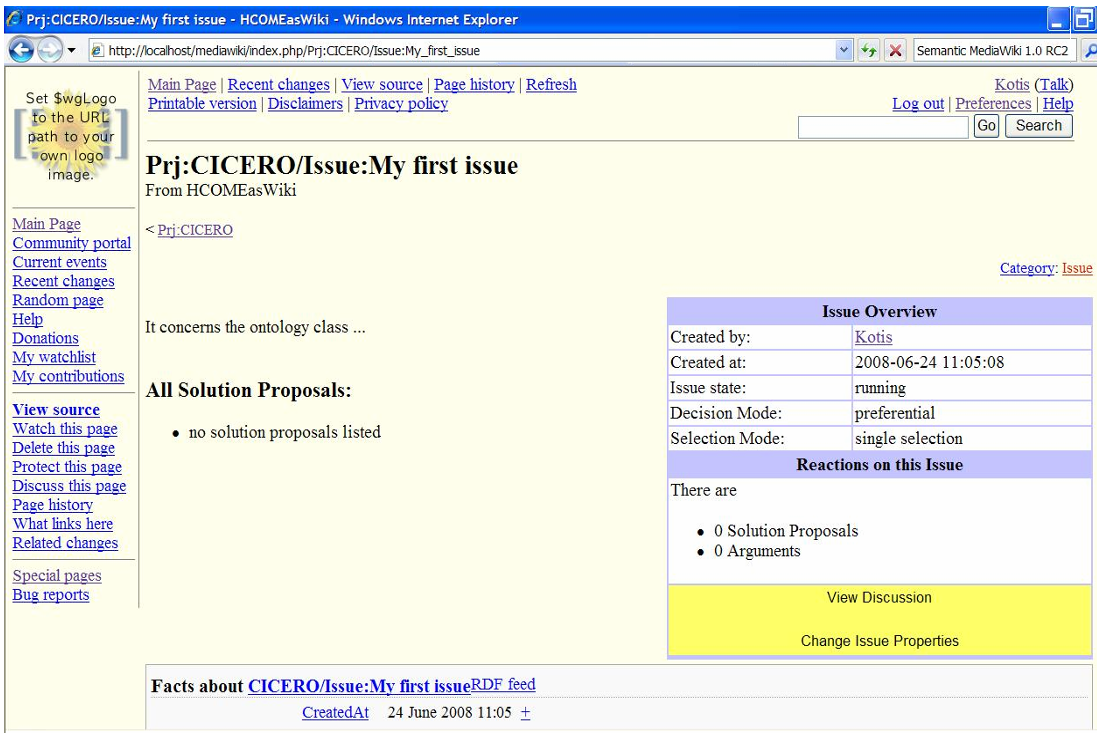
| HCOMEasWiki (Wiki Property) | Action | HCONE Tool (Meta-Ontology) |
|---|---|---|
| "Discussed_Element-Class" | Map | "Class" (Administrative Ontology) |
| "Issue" Category | Map | "Issue" Class (Argumentation Ontology) |
Critical Insight: Balancing Top-Down and Bottom-Up
The paper concludes with a profound observation on the future of Knowledge Management. We are seeing a collision of three approaches:
- Top-Down: Expert-driven, high quality, slow.
- Bottom-Up (Wiki-style): Self-organizing, rapid, often chaotic.
- Middle-Out: Community members rendering perspectives on a grounded core.
The author posits that the HCOME-3O framework provides the structure necessary to balance these forces, using the Wiki as a "socialization" layer to capture the human interaction that precedes formal semantic modeling.
Future Outlook
While the prototype is promising, the move towards Collective Intelligence requires overcoming the learning curve of structured argumentation (like IBIS). Future systems may need more sophisticated AI assistants to help users categorize their arguments correctly, ensuring that the "meta-information" remains clean and actionable for the engineering lifecycle.
Takeaway: True collaborative engineering isn't just about sharing files; it's about sharing the arguments that created them.