
Social Discovery in the Fog of Big Data: A Key-Value Approach to Uncertain Networks
Supporting Social Information Discovery from Big Uncertain Social Key-Value Data via Graph-Like Metaphors
This paper introduces a cognitive-based system for social network analysis (SNA) that handles big, uncertain social data using graph-like metaphors. By representing directional (follow/subscribe) and undirectional (mutual friendship) relationships as key-value pairs with existential probabilities, the system achieves significant scalability on cloud environments like Amazon EC2.
TL;DR
As social networks grow, the data we collect becomes increasingly "fuzzy" due to privacy and identity ambiguity. This paper presents a cognitive-based system that uses Key-Value pairs and Existential Probabilities to map out social patterns. By leveraging cloud-based MapReduce, the system identifies popular users and deep social connections (k-th degree) even when the relationships are not 100% certain.
Background & Motivation: The Veracity Gap
In the world of Big Data, we often talk about the 5V's: Volume, Velocity, Variety, Value, and Veracity. While most social network analysis (SNA) tools focus on Volume, they often ignore Veracity. Real-life social links are rarely binary (0 or 1). For example, because of name ambiguity (multiple "John Does") or restricted privacy settings, we might only be 60% sure that User A follows User B.
The authors argue that traditional data management approaches fail here because they treat social links as absolute. To solve this, they propose a "Cognitive Computing" perspective—capturing the perceived likelihood of linkages.
Methodology: Graph-Like Metaphors in Key-Value Stores
The core innovation lies in the data representation. Instead of a rigid adjacency matrix, the system uses a flexible Key-Value structure:
- Key: The Follower or Social Entity.
- Value: A list of
{Target: Probability}pairs.
This structure allows the system to handle two major types of social dynamics:
- Directional Relationships: Follow/Subscribe patterns (common in Twitter/Weibo).
- Undirectional Relationships: Mutual friendships (common in Facebook/LinkedIn).
Algorithmic Intuition
To find the "Most Popular User" or "Active Follower," the system doesn't just count entries. It applies a probabilistic product:

For deeper connections (Friends-of-Friends), the system uses a modified Dijkstra-like logic to find the shortest path, where the "strength" of the connection is the product of the probabilities along the path.
Architecture & Scalability
The system is built on Apache Hadoop, allowing it to partition massive social graphs across a distributed cluster.
 (Conceptual Framework: Transforming raw social data into cognitive discovery)
Experimental Validation
The authors tested the system using the SNAP (Stanford Network Analysis Project) datasets for Twitter and Facebook.
- Twitter Dataset: ~81k entities, 1.7M relationships.
- Facebook Dataset: ~4k entities, 88k mutual friendships.
Key Results:
- Performance: On Amazon EC2, the system achieved a 6x speedup for Twitter data and up to 8x speedup for Facebook data compared to a high-end standalone machine.
- Insight: The system confirmed the "Six Degrees of Separation" theory even within uncertain data, finding that almost all users were connected within six steps, albeit with varying degrees of probability.
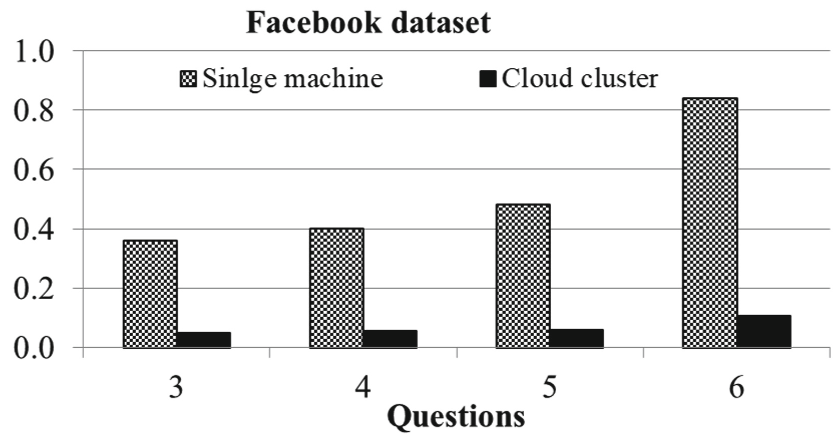 (Performance benchmarking: Significant runtime reduction using Cloud Cluster vs. Standalone)
Critical Insight & Conclusion
The brilliance of this work is not just in the speed of the MapReduce implementation, but in the probabilistic handling of social distance. By quantifying "isolation" and "popularity" as probabilities rather than hard facts, it provides a more nuanced—and ultimately more accurate—view of social dynamics in the era of Big Data.
Future Outlook: The authors plan to integrate privacy-preservation techniques (like k-anonymity) directly into this probabilistic framework, which could make this system a standard for ethical and robust social data mining.