
The Social Architecture of Innovation: Beyond the Lone Genius
Supporting Social Network-Based Knowledge Creation
This paper explores the synthesis of Social Network Theory and Knowledge Management, proposing a framework for knowledge creation within organizations. It maps the tension between "Social Closure" and "Structural Hole" theories, positing that knowledge synergy is a product of social capital and dyadic interaction.
TL;DR
Knowledge isn't just "found" or "processed"—it is created in the friction between people. This paper argues that organizational innovation relies on social networks, specifically balancing the trust found in tight-knit groups (Social Closure) with the fresh perspectives gained from bridging diverse teams (Structural Holes). The result is "Knowledge Embeddedness," where the network itself becomes smarter than its members.
Problem & Motivation: The Silo Trap
In the modern knowledge economy, organizations often treat knowledge as a static asset to be "collected" or "stored" (the Cognitivist view). However, this overlooks the social mechanism of innovation. Most breakthroughs don't happen in isolation; they happen through synergy. The problem is that many companies rely on formal hierarchies that stifle the self-organizing social networks where real tacit knowledge exchange occurs.
The author seeks to answer: How do social relationships actually transform individual ideas into organizational knowledge?
Methodology: Reconciling Two Titan Theories
The paper bridges a long-standing debate in network sociology between two core theories of Social Capital:
- Social Closure (Coleman): Focuses on dense, cohesive networks. High density fosters Trust and shared norms, essential for transfering complex, "sticky" tacit knowledge.
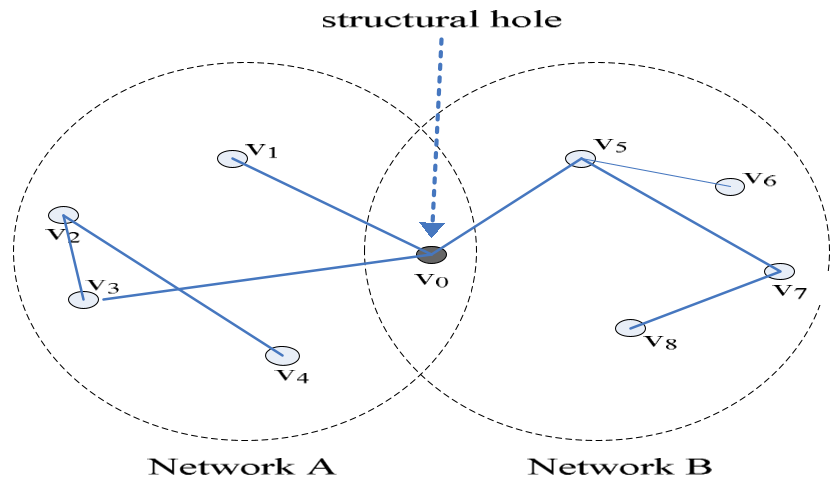
- Structural Holes (Burt): Focuses on sparse networks with "bridges" to other groups. These bridges provide Non-redundant Information, preventing groupthink and sparking radical innovation.
The Ego Network Concept
The methodology centers on the Ego Network, where an individual (the ego) connects with various "alters."
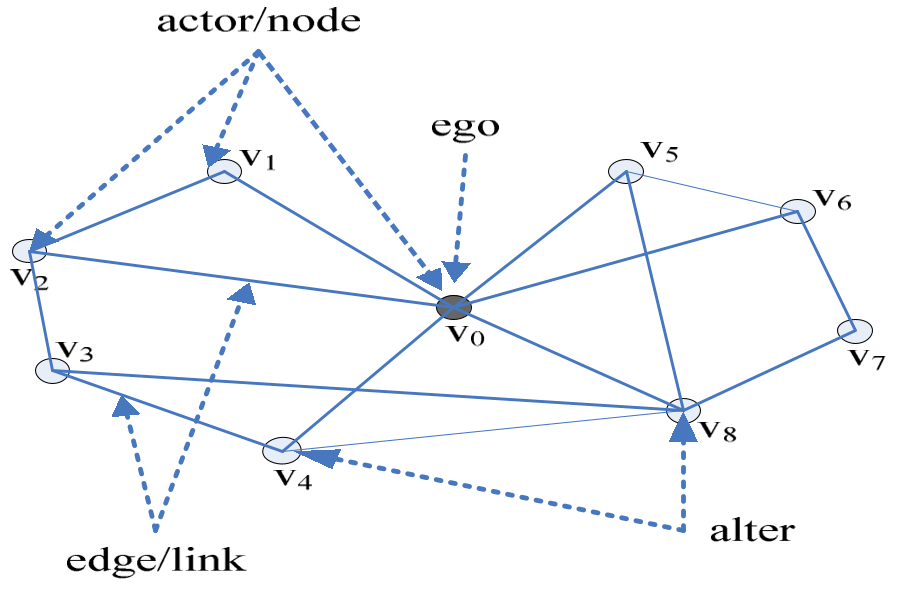
The author suggests that for knowledge creation, a worker needs both: a dense "home" network for support and a sparse "reach" into other domains to find new resources. This creates a Structural Hole that acts as a gateway for innovation.
Core Insight: Knowledge Embeddedness
The "Secret Sauce" of the paper is the Model of Dyadic Knowledge Embeddedness. It focuses on the relationship between two actors (A and B).
- Interaction Frequency: The more they talk, the more knowledge is "embedded" in the relationship.
- Trust: Acts as a lubricant for sharing.
- Uncertainty: Acts as a friction that degrades knowledge transfer.
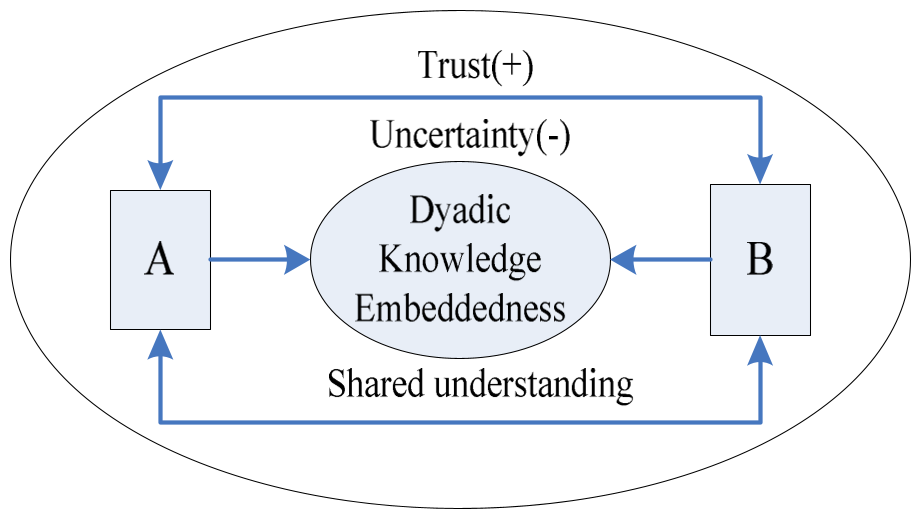
Knowledge creation is thus seen as a Connectionist process—knowledge does not reside in a database, but in the connections themselves.
Analysis & Conclusion
The value of this research lies in its refusal to pick a "winner" between dense and sparse networks. Instead, it argues that:
- Cohesion (Social Closure) is best for refining and sharing existing knowledge through trust.
- Bridging (Structural Holes) is best for discovering and creating radical new ideas.
Takeaway for Organizations: To improve knowledge creation, don't just build a better Wi-Fi or a bigger database. Build a culture that allows for self-organizing "Ba"—environments where workers can freely form alliances across departments, bridging structural holes to create a "synergy of knowledge" that belongs to the whole community.
Limitations: The paper is primarily theoretical/conceptual. Future work would benefit from longitudinal data tracking how specific network changes directly correlate to patent counts or product turnaround times.