
Beyond the Pull: Empowering Social Networks via Event-Driven Mobile Services
Supporting Social Networks by Event-Driven Mobile Notification Services
The paper proposes an event-driven mobile notification framework designed to support and foster social networks. By leveraging a server-push paradigm, it introduces two novel applications—a Virtual Obituary Notice and a Mobile Shopping Recommender—aiming to shift information access from manual client-pull to proactive, context-aware delivery.
TL;DR
This research explores the paradigm shift from "client-pull" to "server-push" in mobile environments. It highlights that the true value of mobile terminals lies not in browsing, but in notifying. By presenting two specific case studies—a Virtual Obituary and a Mobile Shopping Assistant—the paper details how event-driven services can create robust social networks and build "electronic word-of-mouth" trust.
Background: The Mobile Information Paradigm Shift
In a desktop environment, we are "hunters" of information, manually pulling data from the web. However, mobile users are often on the move, making intensive information retrieval tedious. The author argues that mobile users don't want to search; they want to be informed.
This necessitates a shift to the Server-Push Paradigm. Unlike a standard pull query, a push notification requires:
- Importance: It must be critical enough to justify interrupting the user.
- Subscription: It must be opt-in to avoid being perceived as offensive spam.
- Community: It should ideally connect individuals sharing overlapping interests or social ties.
Implementation Case Study 1: The Virtual Obituary
One of the most unique contributions is the concept of a decentralized funeral notice system. The challenge is verifying a death without relying on slow official bureau feeds.
The "Confirm Death" Algorithm
The paper proposes a social verification loop:
- Personal Definition: A user (e.g., John) pre-defines a "Trusted Friends" group.
- Trigger: If John becomes unresponsive, the system queries his circle.
- Consensus: Once > 50% of the trusted group confirms the event, the notification is pushed to all subscribers.
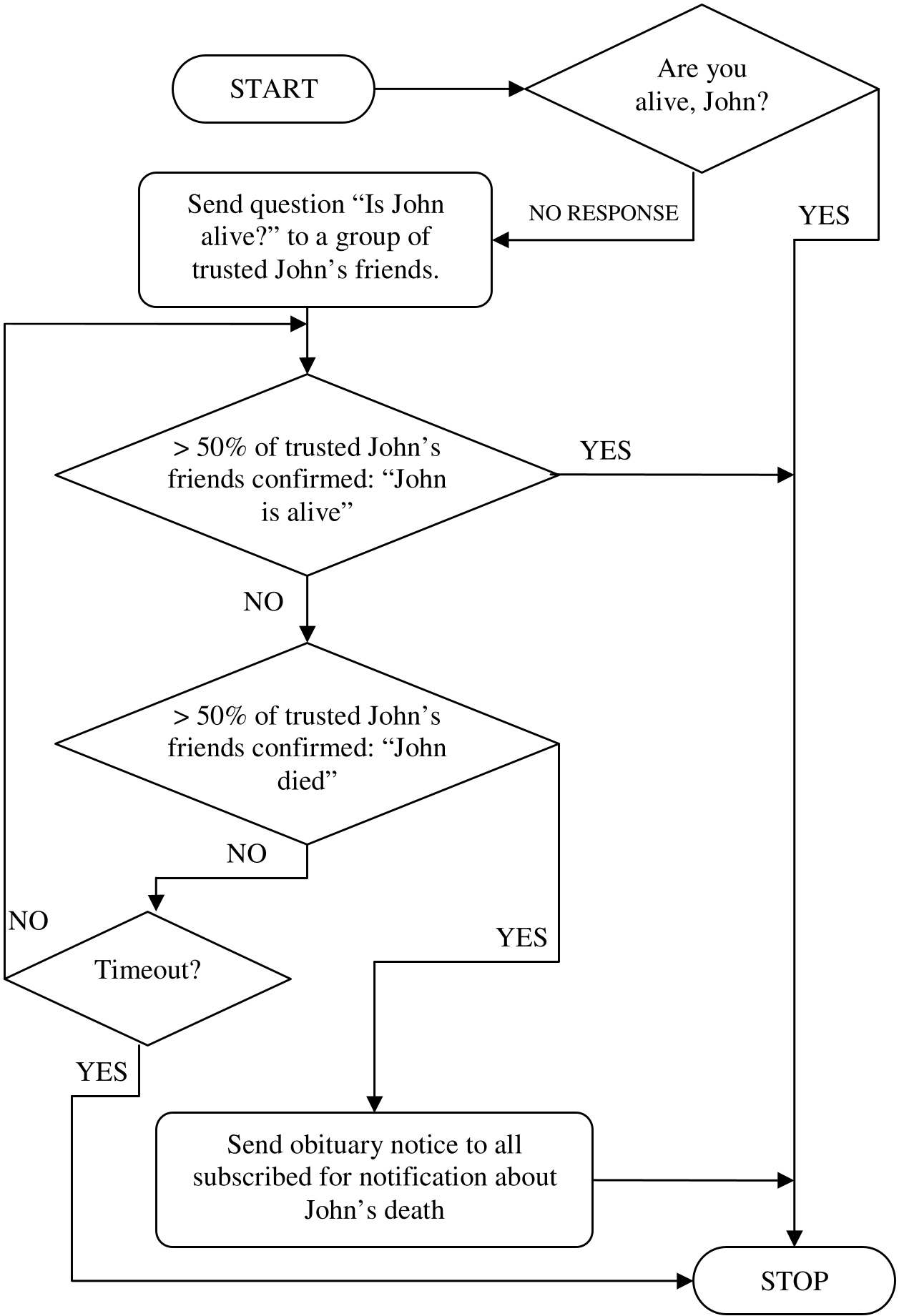
This mechanism uses the social network itself as a validation layer, ensuring information quality through collective trust.
Implementation Case Study 2: Mobile Shopping Recommender
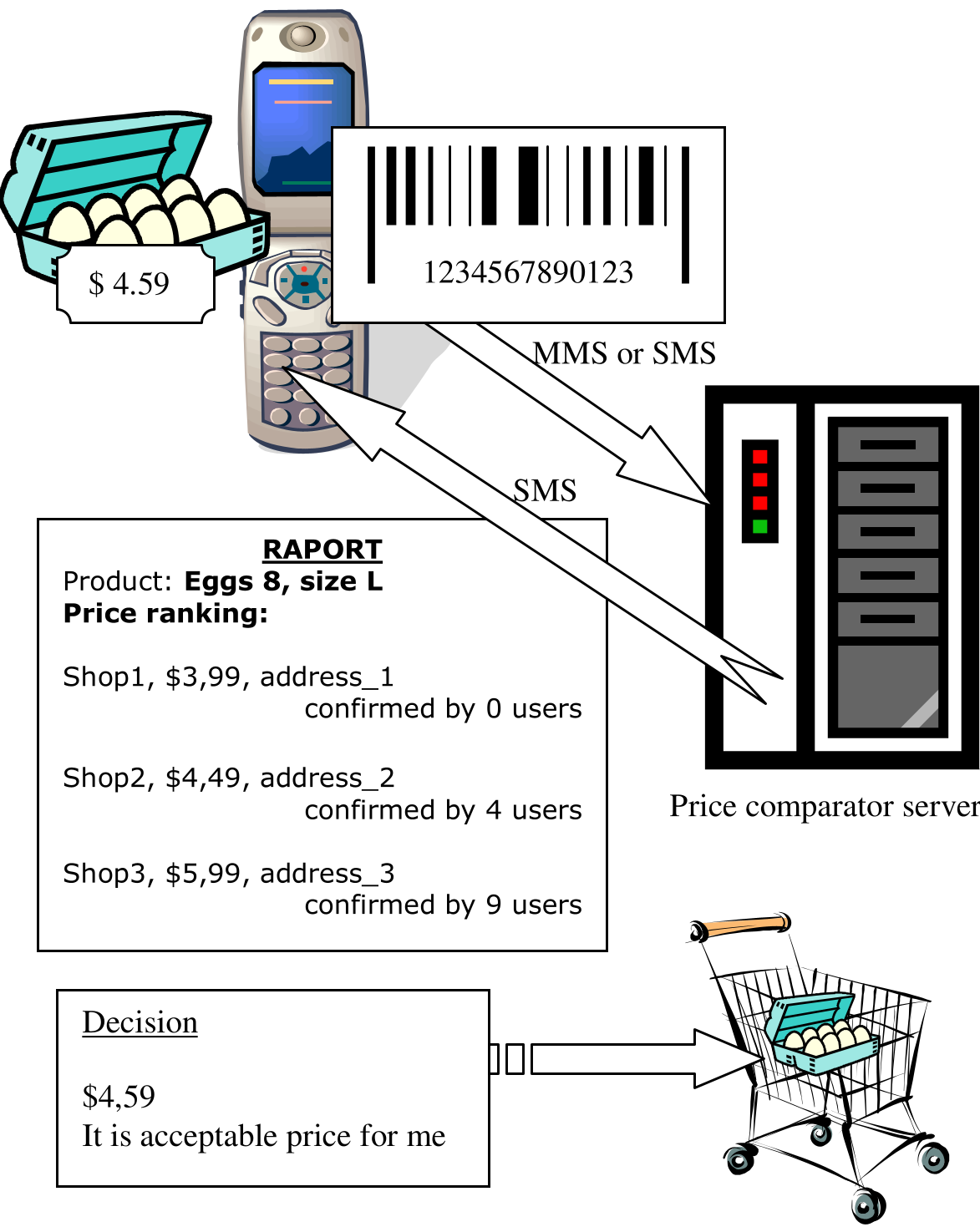
To tackle the disconnect between offline shopping and online price transparency, the author developed a mobile comparator.
Key Technical Insights:
- Physical to Digital: Users take a photo of a barcode.
- OCR over MMS: Sending raw images via MMS often degraded quality, dropping recognition to 50%. By switching to localized OCR of the digit string beneath the barcode, the success rate climbed to 80%.
- Trust through Feedback: Following Web 2.0 principles, the system allows frustrated customers to report "price traps" (false low prices at physical stores), creating an emotional feedback loop that strengthens the community.
Critical Analysis & Conclusion
Takeaway
The core achievement of this work is identifying that a social network is not just a platform for chatting, but a sensor network for meaningful life events. By automating the delivery of "unlikely and rare" events, mobile services can provide utility that transcends traditional search engines.
Limitations
- Sensitivity: The virtual obituary concept faces cultural and emotional resistance ("virtual cemeteries" can be polarizing).
- Image Quality: The reliance on camera performance and lighting remains a bottleneck for barcode-centered interactions.
- Verification Risks: A 51% consensus model among friends could be prone to malicious "jokes" or coordinated misinformation if the trusted circle is compromised.
Future Outlook
As we move deeper into the 2020s, the "Web 2.0" trust paradigm mentioned by Wojciechowski has evolved into modern Social Graphs and Decentralized Identities (DID). Modern implementations of his "Event-Driven" vision can now be seen in everything from Amber Alerts to real-time supply chain notifications, proving his early focus on "Important Events" was prescient.