
Redefining the FLU Mutant: How High-Dose Singlet Oxygen Bypasses the EX1 Sensor
A suppressor screen uncovers flu as a weak mutant and chloroplastic 1O2 triggers EX1-independent stress responses in Arabidopsis.
This study identifies that the widely used Arabidopsis flu1-1 mutant is a weak allele rather than a null mutant. By isolating new suppressor mutants (mut1, mut2), the authors demonstrate that full knockout of the FLU gene triggers excessive singlet oxygen (O) production, which bypasses the standard EX1-mediated pathway and overrides the inhibitory effect of SAFE1 to induce programmed cell death.
TL;DR
A landmark study in New Phytologist reveals that the ubiquitous Arabidopsis flu1-1 mutant is actually a "weak" mutant, not a null. This discovery explains a major mystery in plant retrograde signaling: how high levels of chloroplastic singlet oxygen (O) can bypass the primary sensor (EX1) to trigger cell death, overwhelming the plant's internal safeguards like SAFE1.
Back to Basics: The O Signaling Mystery
In the world of plant biology, the chloroplast is both a powerhouse and a potential "bomb." Under stress, it produces Singlet Oxygen (O), a reactive oxygen species (ROS) that can cause massive damage. For 20 years, the flu1-1 mutant has been the Gold Standard for studying this. The logic was simple: in the dark, the FLU protein should stop chlorophyll precursors (Pchlide) from building up. In flu1-1, this was supposed to be "broken," leading to a Pchlide explosion that turns into O when the lights come on.
Crucially, scientists believed this O signaling required a specific sensor called EXECUTER1 (EX1). If you removed EX1, the plant wouldn't die. But the authors of this study found a "leak" in this theory: some mutants still died even without EX1.
The "Weak" Truth: Why flu1-1 Isn't What We Thought
The researchers conducted an EMS mutagenesis screen on flu1-1/ex1 plants (which are usually healthy) and found two "suppressors" (mut1 and mut2) that suddenly started dying again. The surprising culprit? New mutations in the FLU gene itself.
Structural Insight via AlphaFold3
Using AlphaFold3, the team discovered that the original flu1-1 mutation (A262V) only weakens the binding between FLU and its target, GluTR.
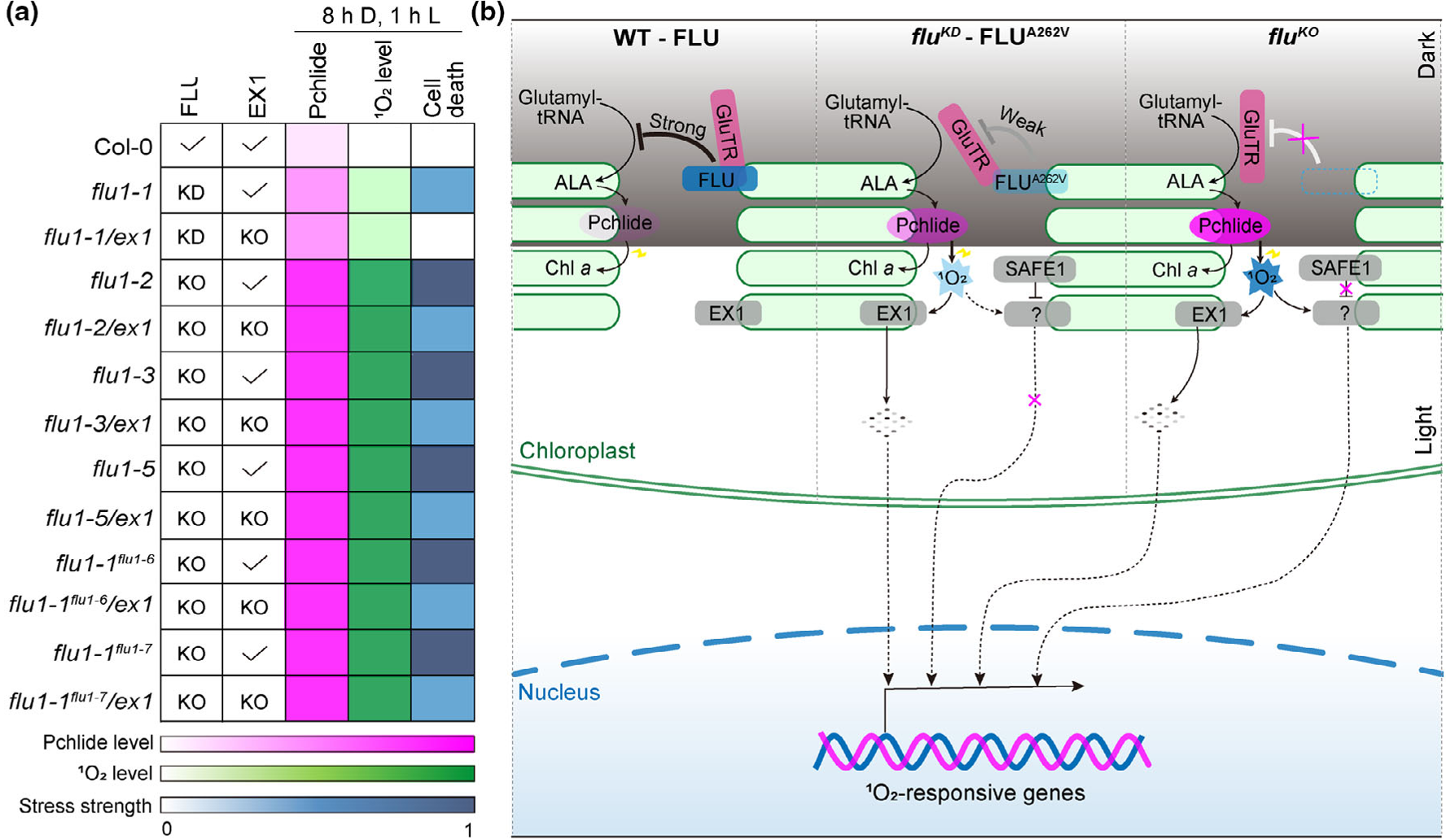
- In Wild-Type: FLU binds GluTR tightly No Pchlide build-up No O burst.
- In flu1-1 (Weak): FLU binds GluTR loosely Moderate Pchlide Moderate O (EX1-dependent).
- In Null Mutants: No FLU binding Massive Pchlide Massive O (Bypasses EX1).
Methodology: Probing the Dose-Response
The study utilized several high-precision techniques to prove this "Dosage Effect":
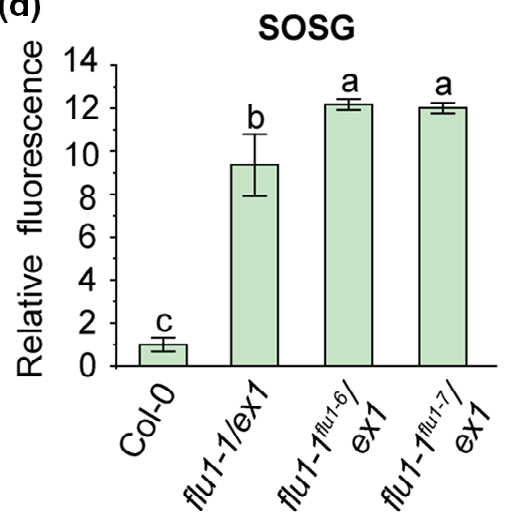
- SOSG Staining: Directly visualized the significantly higher O levels in true knockout mutants vs. the weak flu1-1 allele.
- RNA-Seq & raSORGs: Identified 603 genes (Reactivated Singlet Oxygen-Responsive Genes) that represent a "danger signal" triggered only by high-dose O.
- Lipid Peroxidation (LPO): Proved that high-dose O triggers enzymatic LPO (signaled by 13-HOT and Jasmonic Acid), a hallmark of programmed cell death rather than just random toxic damage.
Overcoming the SAFE1 "Gatekeeper"
The study highlights the role of SAFEGUARD1 (SAFE1). SAFE1 is like a fuse in a circuit—it prevents EX1-independent signaling from firing. However, the researchers demonstrated that the burst of O in true FLU knockouts is so violent that it "blows the fuse," overwhelming SAFE1 and triggering an alternate route to cell death.
By overexpressing SAFE1, the researchers were able to rescue even the true knockout plants, proving that the pathway is a balance between ROS intensity and the concentration of protective proteins.
Conclusion & Future Outlook
This work is a masterclass in re-evaluating established biological "facts." By proving flu1-1 is a weak allele, the authors fixed a 20-year-old oversight and clarified the Dose-Dependent nature of chloroplast signaling.
Key Takeaways for Research:
- Dose Matters: Low-level stress uses specific sensors (EX1); high-level stress uses general oxidative pathways.
- The SAFE1 Limit: There is a threshold beyond which internal plant safeguards fail, but increasing SAFE1 expression can bolster resilience.
- Tool Revision: Future O studies must distinguish between weak and null FLU alleles to accurately interpret results.
Final Thought
The plant's ability to "measure" the intensity of light stress and choose between a regulated signaling response or a rapid "suicide" (PCD) is more nuanced than we imagined. This study provides the blueprint for engineering plants that can withstand higher thresholds of oxidative stress before reaching the "point of no return."