
Data Mining in Agriculture: Transforming Raw Fields into Intelligent Systems
A survey of data mining techniques applied to agriculture
This survey explores the application of fundamental data mining techniques—k-means clustering, k-nearest neighbor (k-NN), Artificial Neural Networks (ANN), and Support Vector Machines (SVM)—to the field of agriculture. It highlights how these algorithms achieve State-of-the-Art results in tasks such as wine fermentation quality prediction, soil parameter estimation, and animal disease detection through sound recognition.
TL;DR
Data mining is no longer just for web search or genomics. This seminal survey identifies how four core algorithms—k-means, k-NN, ANN, and SVM—are being repurposed to solve critical agricultural bottlenecks. From predicting the "death" of wine fermentation to diagnosing pig respiratory diseases via acoustic sensors, data mining is the engine driving the transition from traditional farming to Precision Agriculture.
Problem & Motivation: The Complexity of the Field
Agriculture is inherently noisy and multi-variant. Enologists struggle to predict whether a wine fermentation process will go "stagnant" or "sluggish" until it's too late. Soil scientists face the "Parameter Gap": while soil texture (sand/clay %) is easy to measure, critical hydraulic parameters (like Drained Upper Limit) require expensive, time-consuming experiments.
The authors argue that the industry's reliance on human expertise is its greatest bottleneck. Data mining provides the Inductive Bias necessary to extract "hidden laws" from large-scale sensing data, turning reactive management into proactive optimization.
Methodology: The Core Four
The paper breaks down methodology into two main pillars: Clustering (unsupervised) and Classification (supervised).
1. The Strategy of "Closeness": k-means and k-NN
- k-means (Unsupervised): Used primarily for discovery. By minimizing the sum of squared distances between data points and cluster centers, it groups similar agricultural samples.
- Application: Predicting wine fermentation quality by clustering metabolic profiles from the first 72 hours of the process.
- k-NN (Lazy Learning): Instead of building a complex model, it looks at the most similar historical examples.
- Application: Estimating soil water parameters by finding "neighboring" soil types with known textures.
2. The Learning Machines: ANN and SVM
- Artificial Neural Networks (ANN): Multi-layer perceptrons simulate biological neurons to map complex inputs (like sound waves) to specific outputs (disease types).
- Application: Pig Cough Recognition. Transforming 22kHz audio signals into 64-dimensional vectors to differentiate between a healthy grunt and a disease-indicating cough.
- Support Vector Machines (SVM): Finding the "Optimal Hyperplane" that maximizes the margin between classes.
- Application: Detecting Meat and Bone Meal (MBM) in animal feed. SVMs handle high-dimensional NIR spectra to ensure feed safety with high precision, preventing "false positives" that could ruin a farmer's reputation.
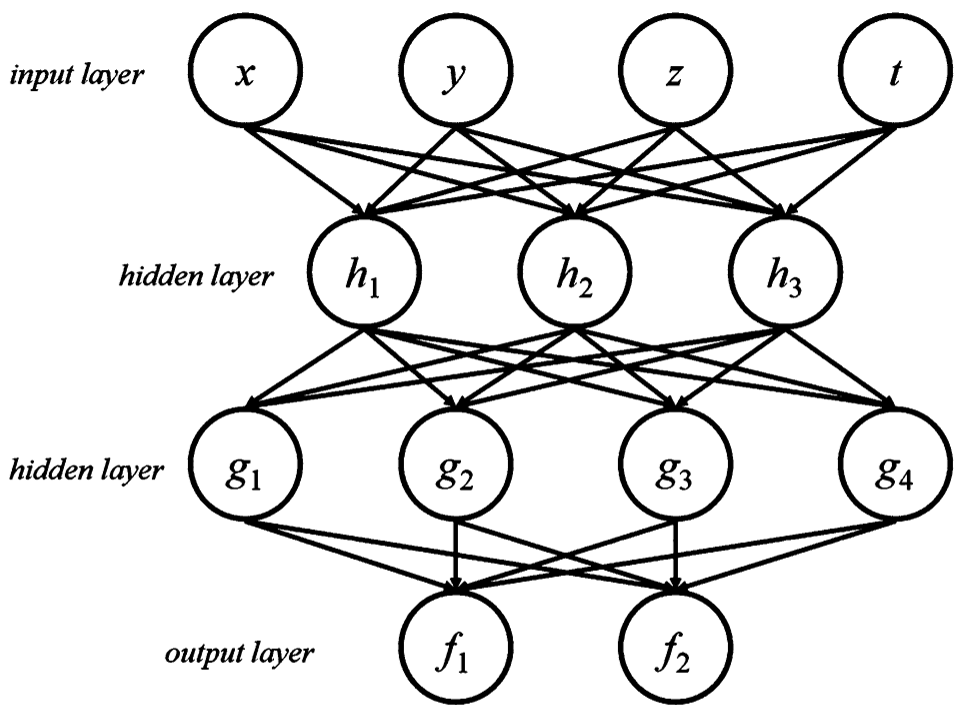 Figure: A typical Multilayer Perceptron architecture used for agricultural signal processing.
Experiments & Results: Quantitative Victories
The survey highlights that these models aren't just theoretical; they outperform traditional methods:
- Acoustic Diagnostic: The ANN model for swine health reached a 90%+ recognition rate, effectively replacing constant human monitoring in high-risk, contagious environments.
- Feed Safety: The SVM approach to NIR spectroscopy processed over 267,000 spectra, proving that automated binary classification is reliable enough for European regulatory standards.
- Soil Metrics: The dynamic k-NN method successfully converted simple texture percentages into highly accurate water retention estimates, bridging the gap for soil dynamic simulators like DSSAT.
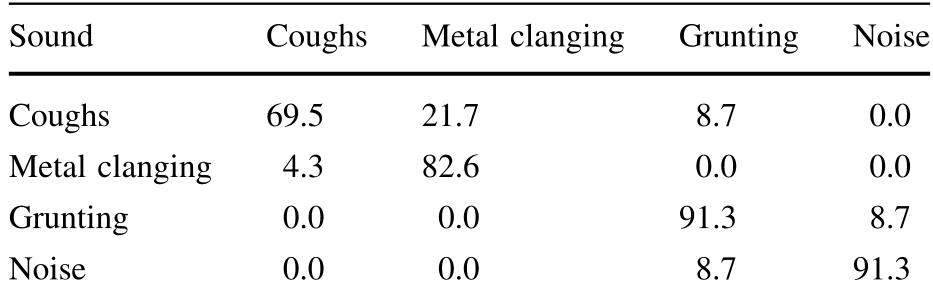 Table: Confusion Matrix showing high recall for pig coughs (90%+) compared to noise.
Critical Analysis & Future Outlook
The Limitations
The authors honestly acknowledge that most agricultural applications still use "vanilla" versions of these algorithms. There is a lack of domain-specific architectures. Furthermore, the computational cost of k-NN (lazy learning) and the risk of Overfitting in ANNs remain significant hurdles for real-time edge deployment on farms.
The Road Ahead: Parallelism and Biclustering
The survey concludes with a call to arms for Multidisciplinary Teams. To move forward, the field must:
- Adopt Biclustering: Not just grouping samples, but finding which specific metabolites or genes are responsible for a cluster (providing "Explainability" to enologists).
- Harness Parallel Computing: Real-time apple grading on high-speed conveyors requires faster-than-sequential processing.
- Object-Oriented Design: Shifting from simple scripts to robust software engineering (e.g., UML-based agricultural systems) to handle the complexity of modern "Smart Farms."
Conclusion: This paper serves as a foundational map, proving that the "dirt" of the field and the "data" of the mining world are a perfect, if unexpected, match.