
Reclaiming Digital Sovereignty: A Deep Dive into Decentralized Social Networks
A survey on decentralized Online Social Networks
This paper provides a comprehensive survey and taxonomy of Decentralized Online Social Networks (DOSNs). It categorizes existing research into P2P, Federated, and Hybrid architectures while evaluating their performance in storage, access control, and interaction signaling to achieve privacy-preserving alternatives to centralized platforms like Facebook.
TL;DR
As centralized social media giants face increasing scrutiny over data privacy and censorship, this survey provides a blueprint for Decentralized Online Social Networks (DOSNs). By deconstructing current research, the paper identifies how P2P mechanisms, federated servers, and hybrid architectures attempt to remove the "omnipotent provider" while highlighting a critical reality: decentralization currently comes at a steep price in performance and functionality.
The Core Tension: Privacy vs. Utility
The fundamental motivation for DOSNs is the "Trust Deficit." In a centralized architecture, the Service Provider (SP) has total visibility into Personal Identifiable Information (PII). While we enjoy "free" services, the economic reality forces providers to monetize user data, often resulting in privacy erosion and susceptibility to governmental censorship.
The authors argue that technical decentralization is the only robust solution to "Authorial Centralization." By distributing resources across peers (P2P) or multiple independent servers (Federation), we theoretically eliminate the gatekeeper.
Deconstructing the DOSN Hierarchy
The paper introduces a structured 3-layer model to analyze these systems:
- Communication Layer: The underlying network.
- DOSN Core: The meat of the system, handling Access Control (ACL vs. Encryption), Storage (DHT, Peer, or Server), and Signaling.
- Extensions: The "User Experience" layer, containing APIs, Search, and Recommenders.
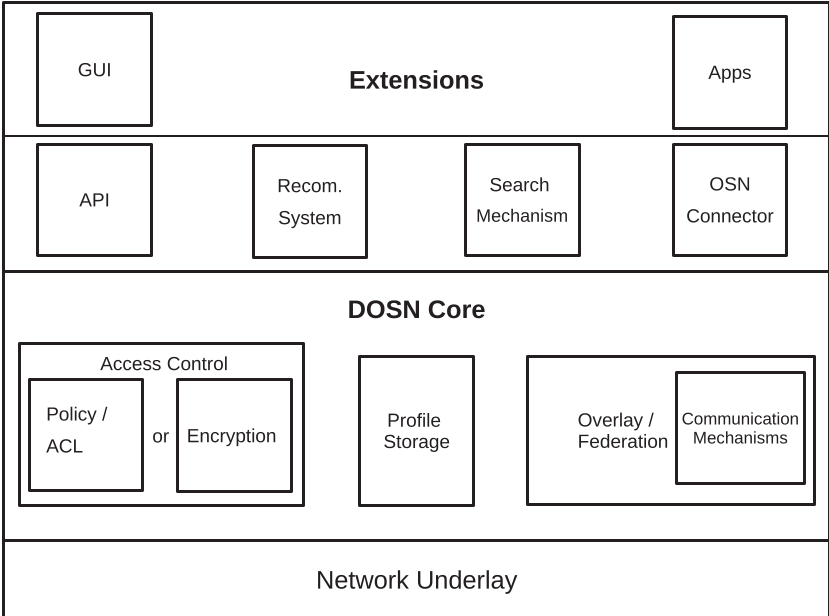 Figure 1: The 3-layer abstraction of the DOSN design space.
The Storage Dilemma: Where does your data live?
- P2P-OSNs (e.g., PeerSoN, Safebook): Data lives on user devices. This offers maximum sovereignty but suffers from Churn—if your friends are offline, your profile disappears.
- F-OSNs (e.g., Diaspora): Data lives on "Pods" or personal servers. It is more reliable but requires users to manage (or pay for) hosting.
- Hybrid Models: Attempting to balance the two by storing sensitive metadata on personal devices and heavy content (photos/videos) on untrusted but reliable clouds.
Technical Deep Dive: Strategies for Access Control
One of the paper's most salient points is that Access Control Lists (ACLs) are insufficient in decentralized settings because they require a trusted authority to enforce them. Consequently, most DOSNs shift toward Cryptographic Access Control:
- Attribute-Based Encryption (ABE): Users can define complex policies (e.g., "only my college friends can see this photo").
- Broadcast Encryption (BE): Efficiently sharing content with a dynamic group without re-encrypting for every individual.
| Approach | Storage | Access Control | Signaling | Unique Key |
|---|---|---|---|---|
| Safebook | Trusted Friends | PKI | DHT | Matryoshka routing for anonymity |
| Diaspora | Hosting Nodes | Server-side ACL | Pod-to-Pod | High usability, 400k+ users |
| DECENT | Random DHT | ABE | DHT | Modular object-oriented design |
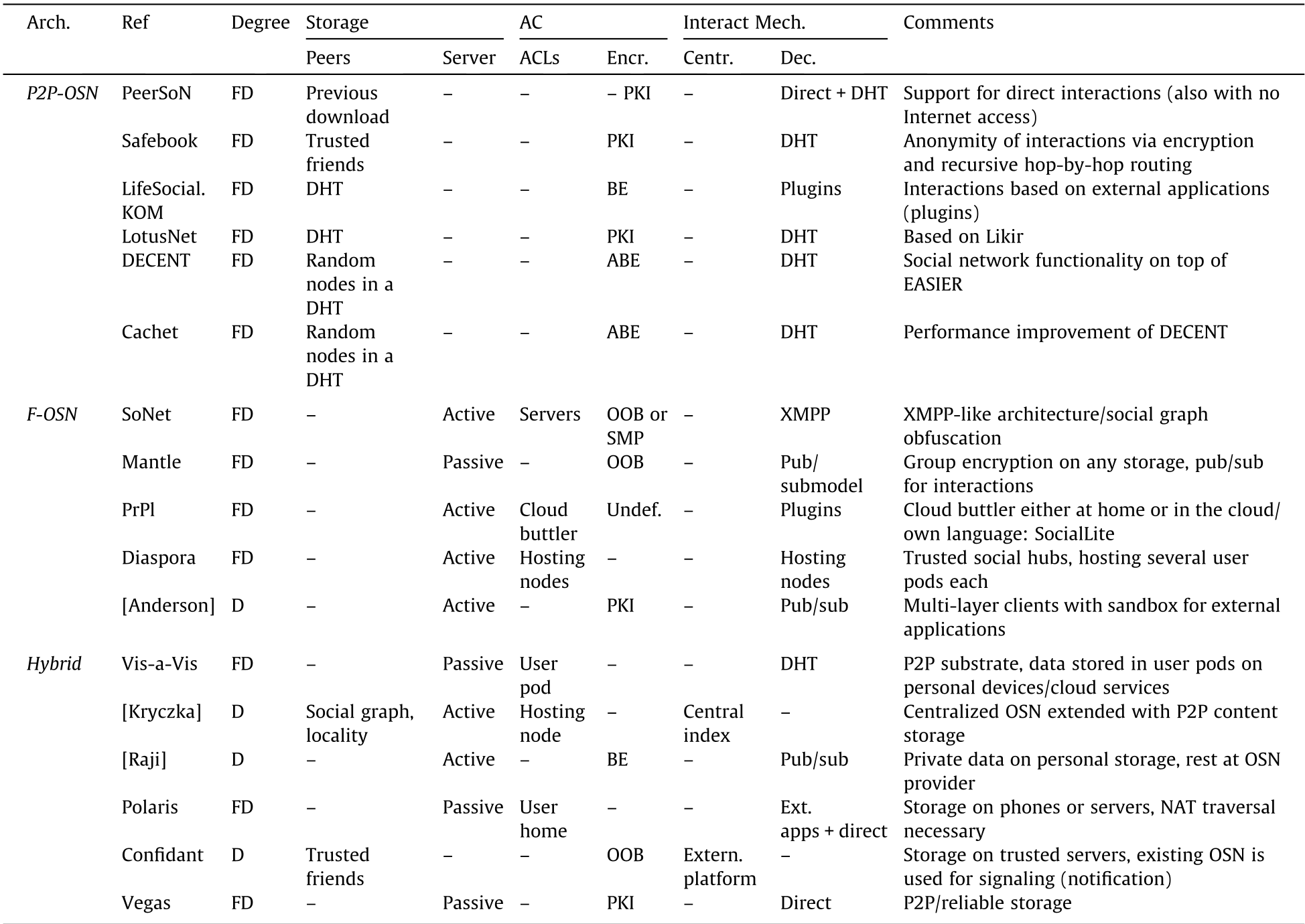 Table 1: Classification of prominent DOSN proposals based on architectural decisions.
The "Functionality Gap": Why we haven't left Facebook yet
The survey concludes with a sobering analysis of user experience. Centralized systems excel at Global Knowledge tasks:
- Discovery: How do you find a friend without a central index?
- Recommendations: "People you may know" requires a global view of the social graph, which is intentionally hidden in DOSNs to protect privacy.
- Performance: P2P lookups can take over 10 seconds, whereas centralized databases respond in milliseconds.
Critical Insights & Future Outlook
The paper highlights a "missing link" in current research: Metadata Privacy. Even if your messages are encrypted, a governmental observer can still see who you are talking to and when. Only a few projects like Safebook tackle this via recursive hop-by-hop routing, but even they are vulnerable to sophisticated traffic analysis.
The Takeaway: For DOSNs to move from academic curiosities to mainstream tools, we must solve the "Social Graph Paradox"—how to provide rich, graph-based features (search, recommendation, viral growth) while maintaining a fragmented, encrypted, and decentralized data structure. The future likely lies in Federated/Hybrid models that provide the UX of a server-based system with the cryptographic guarantees of a peer-to-peer network.
Conclusion
This survey serves as a vital map for the DOSN landscape. It clarifies that decentralization isn't just a technical choice; it's a trade-off between absolute privacy and the interactive features that make social networks "social."