
Identifying the Digital Vanguard: A Survey of Influential User Detection in Social Networks
Survey of Influential User Identification Techniques in Online Social Networks
This survey paper systematically explores techniques for Influential User Identification in Online Social Networks (OSNs). It categorizes prominent methods ranging from classical structural centrality measures to modern content-aware and community-based algorithms, highlighting their roles in viral marketing and industrial applications.
TL;DR
In the era of viral marketing, identifying the "Opinion Leaders" who drive trends is a billion-dollar problem. This paper provides a comprehensive roadmap of techniques—from the mathematical elegance of Centrality Measures to the modern nuance of Content & Opinion Analysis—to find the nodes that move the needle in Online Social Networks (OSNs).
The "Influential" Motivation: Why Degrees Aren't Enough
Since the commercialization of the web, our decision-making has shifted. Statistics show that up to 83% of people trust recommendations from family and friends over traditional ads. In a network graph, these "Influential" nodes act as catalysts for information diffusion.
The core challenge is scalability and depth. It is easy to find someone with many followers (structural influence), but much harder to find someone whose content actually changes the behavior of others (contextual influence).
Methodology: From Topology to Content
The survey categorizes identification techniques into four distinct domains:
1. Structural Measures (The "Where" of Influence)
These methods treat the network as a graph of nodes and edges.
- Degree Centrality: Simple count of direct connections.
- Betweenness Centrality: Identifying the "gatekeepers" or bridges between different social circles.
- PageRank & HITS: Algorithms that recognize that a connection from a high-authority node is worth more than many connections from low-authority nodes.
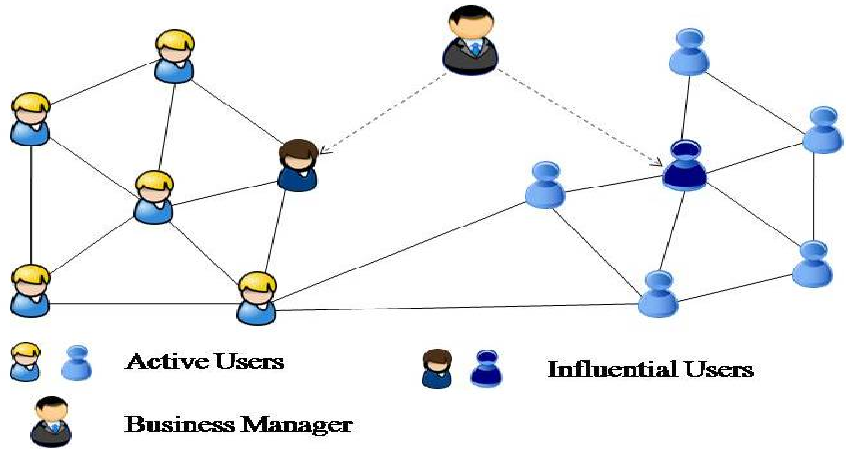 Figure 1: Instead of marketing to everyone, businesses target specific influential nodes to let the information cascade through the network naturally.
2. Diffusion Models (The "How" of Spreading)
How does an idea "infect" a network?
- Linear Threshold Model (LTM): A node is activated if the sum of weights from its active neighbors exceeds a specific threshold.
- Independent Cascade Model (ICM): Each active node has a one-shot probability of activating its neighbors.
3. Content and Community Awareness (The "What" of Influence)
Structural positioning is meaningless if the content doesn't resonate.
- Topic-Level Influence: Some users are influential in "Technology" but ignored in "Politics."
- Opinion Oriented Link Analysis (OOLAM): Differentiates between Positive, Negative, and Controversy personas. This is crucial for brand safety—you don't want a "negative persona" leading your viral marketing campaign.
Critical Comparison of Techniques
The authors summarize a decade of progress in the following comparison table:
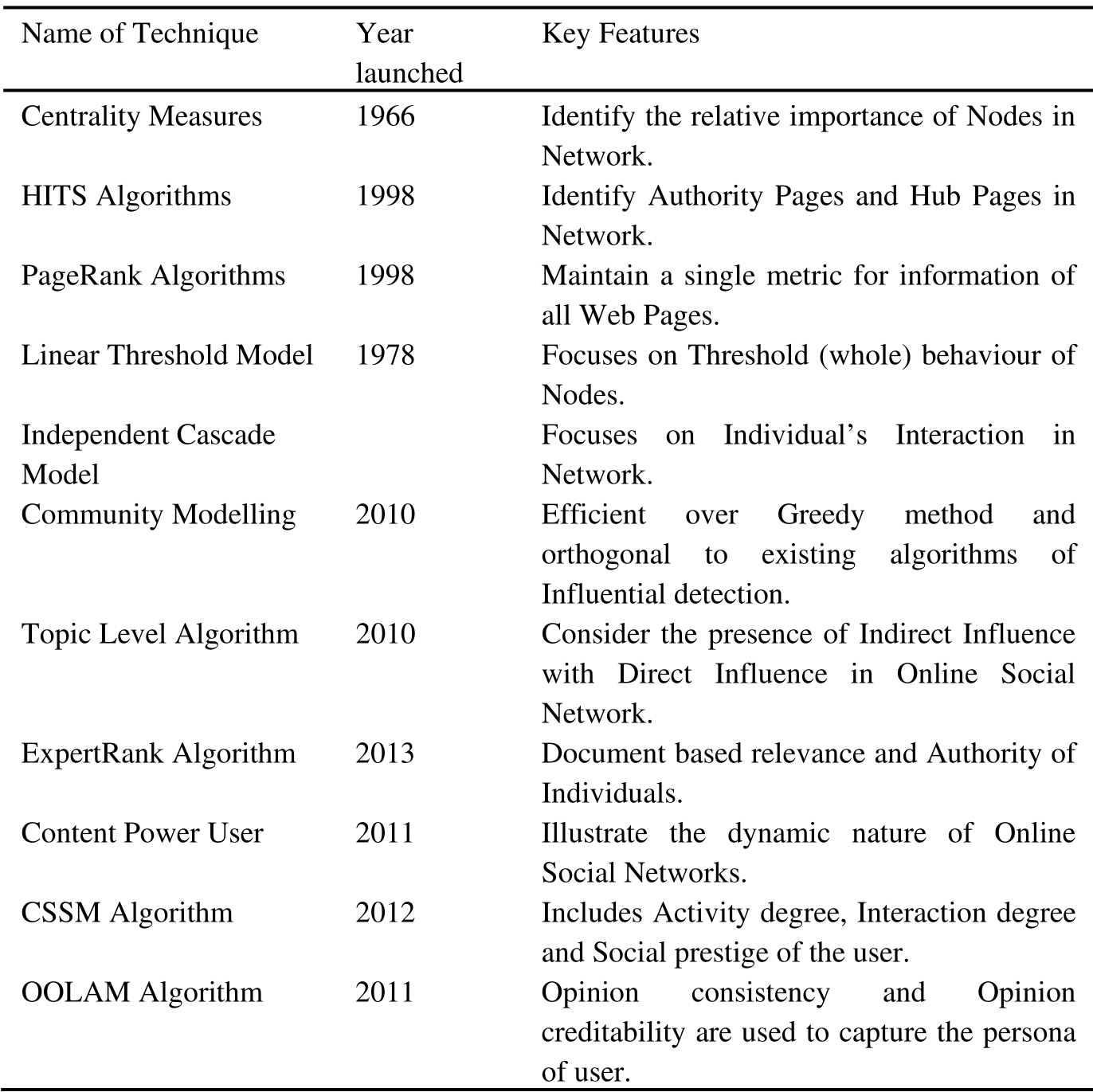
Key takeaways from this comparison include the shift from purely node-based metrics (Centrality) to behavioral attributes (CSSM) such as social prestige and interaction degree.
Future Outlook: The Next Frontier
While graph theory provides the foundation, the authors point toward several emerging dimensions:
- Temporal Dynamics: Influence is not static; it grows and decays over time.
- Location-Based Services: Integrating "where" a user is physically can hyper-personalize marketing efforts.
- Link Polarity: Moving beyond "who follows whom" to "who likes/dislikes whom" to understand the emotional sentiment of the network.
Conclusion
Finding the right user in a sea of billions requires more than just counting followers. The most robust identification systems today are hybrid models that combine the mathematical rigor of Graph Centrality with the semantic richness of Content Power. For researchers, the challenge remains: how to perform these complex calculations in real-time as social networks evolve at the speed of a click.