
Meta-Heuristics in Influence Maximization: Bridging the Gap Between Greedy Accuracy and Heuristic Speed
A survey on meta-heuristic algorithms for the influence maximization problem in the social networks
This survey provides a comprehensive taxonomy and critical analysis of meta-heuristic algorithms for the Influence Maximization Problem (IMP) in social networks. It categorizes existing literature focusing on how meta-heuristics balance influence spread and computational efficiency using novel cost functions like Expected Diffusion Value (EDV) and Local Influence Estimator (LIE).
TL;DR
The Influence Maximization Problem (IMP)—identifying the most influential nodes to maximize information spread—has long been a battleground between slow, accurate Greedy algorithms and fast, suboptimal heuristics. This survey explores the rise of meta-heuristic algorithms (PSO, GA, ACO) as a superior middle ground, utilizing mathematical proxies to bypass expensive simulations while outperforming traditional centrality-based methods.
Background: The Scalability-Accuracy Dilemma
In the era of viral marketing and epidemic control, finding the "super-spreaders" in a network of millions is critical. However, the IMP is NP-hard.
- Greedy Algorithms: Offer a approximation guarantee but rely on Monte Carlo simulations, making them unusable for large-scale graphs (often taking days to compute).
- Heuristic Algorithms: Use simple metrics like "High Degree" or "PageRank." They are nearly instantaneous but fail to account for node overlap and the "Rich Club" phenomenon, leading to mediocre influence spread.
Meta-heuristic algorithms have emerged to fill this void by treating IMP as a sophisticated search problem in a discrete landscape.
The Core Mechanism: How Meta-Heuristics "Cheat" Fairly
To solve the objective function , meta-heuristics employ two primary innovations:
1. Influence Estimation Proxies (The "How")
Instead of simulating thousands of cascades, these algorithms use mathematical estimators:
- EDV (Expected Diffusion Value): Calculates influence based on immediate 1-hop neighbors.
- LIE (Local Influence Estimator): Extends evaluation to 2-hop neighbors, balancing speed and "vision."
- TLCIE: A three-layer evaluation for even higher precision.
2. Topology-Aware Operators
Unlike standard PSO or Genetic Algorithms designed for continuous spaces, IMP meta-heuristics use discretization rules. They often initialize populations using high-centrality nodes and use "Random Walks" within the graph topology to mutate and improve solutions.
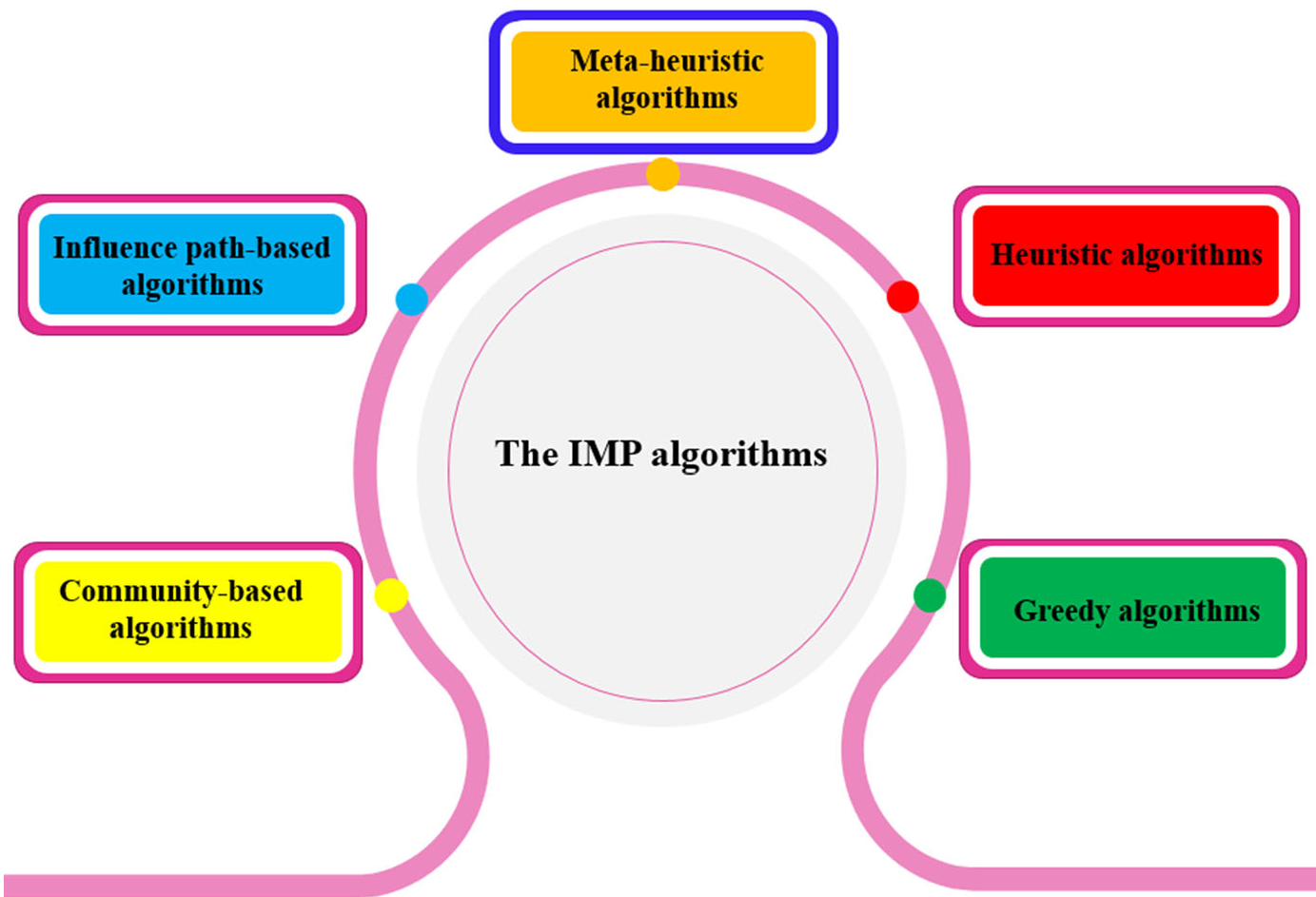 Figure 1: The taxonomy of algorithms, highlighting meta-heuristics as a distinct, evolving branch.
Methodology Deep Dive: Evolutionary Strategies
The survey tracks the evolution from early Simulated Annealing (SA) to recent adaptive methods:
- DPSO (Discrete Particle Swarm Optimization): Replaces velocity vectors with probability-based node swaps.
- DDSE (Degree-Descending Search Evolution): A Memetic algorithm that combines Genetic local search with a strategy that prioritizes high-degree nodes during mutation, ensuring the search stays within "productive" areas of the graph.
- DSFLA (Discrete Shuffled Frog-Leaping Algorithm): Combines memeplexes to facilitate global exploration, preventing the algorithm from getting stuck in local optima—a common failing of simple heuristics.
 Figure 2: The rapid progression of meta-heuristic approaches from 2011 to 2020.
Performance Benchmarks: The Proof in the Data
Evaluation on real-world datasets like PGP and Gr-QC reveals a clear trend: Meta-heuristics like DDSE significantly outperform the SAEDV and standard LIR (Local Influence Ranking) in spread, while remaining orders of magnitude faster than traditional Greedy approaches.
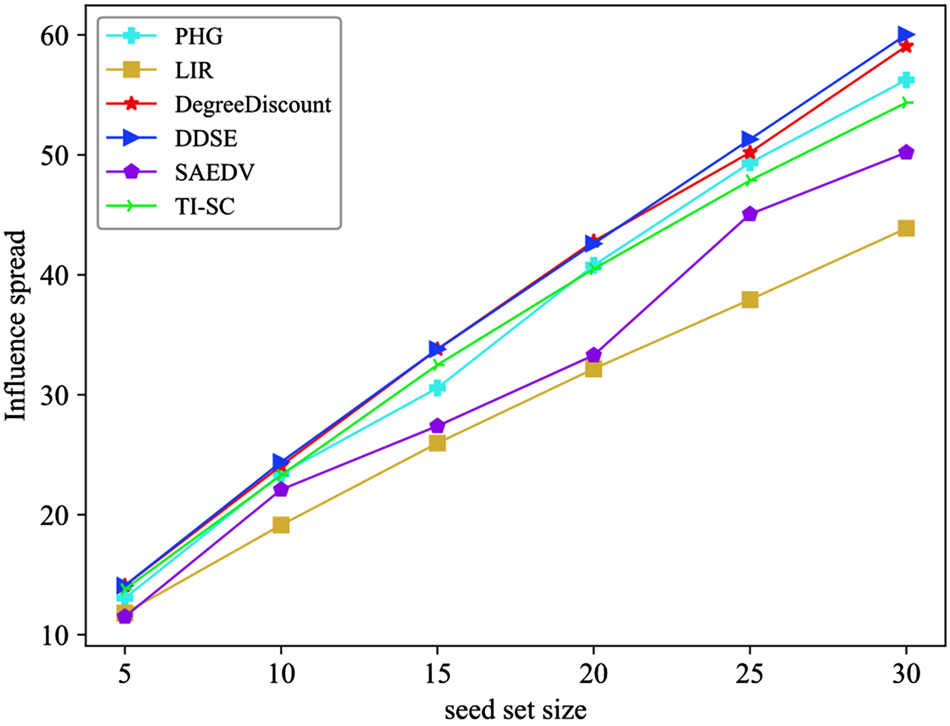 Figure 3: Influence spread results on the PGP dataset. Note how Meta-heuristic DDSE (purple) maintains high performance as the seed set grows.
Critical Insight: Why Meta-Heuristics Win
The true power of these algorithms lies in their Inductive Bias. By incorporating graph theory (centrality) into the search operators while retaining the stochastic exploration of evolutionary computing, they effectively navigate the "influence overlap" problem. They don't just pick the most popular people; they pick the most popular people who don't know each other, maximizing the unique "frontier" of the influence spread.
Future Outlook and Limitations
Despite their success, the survey identifies several frontiers:
- Dynamic Networks: Most current meta-heuristics assume a static graph. Real-world social networks are transient.
- Rich Club Phenomenon: Algorithms still struggle to avoid selecting clusters of highly connected nodes that provide redundant influence.
- Multi-objective Constraints: Future work needs to integrate real-world costs—time, budget, and varying node "weights"—directly into the fitness functions.
Conclusion
This survey cements meta-heuristic algorithms as the robust choice for practitioners. They offer the flexibility to tune the search intensity based on available compute power, making them the most practical tool for viral marketing and information diffusion analysis in the modern, large-scale social web.