
Evolution of Mobile Social Networks: From Centralized Clouds to Opportunistic Edges
A survey on mobile social networks: Applications, platforms, system architectures, and future research directions
This paper provides a comprehensive survey of Mobile Social Networks (MSNs), categorizing them into conventional client-server architectures and future hybrid opportunistic paradigms. It systematically reviews MSN platforms, system architectures, and key technologies such as social behavior analysis and vehicular social networking (VSN).
TL;DR
Mobile Social Networks (MSNs) are evolving from simple mobile versions of Facebook/Twitter into complex, hybrid systems that operate even when the Internet fails. This survey maps the transition from infrastructure-based architectures to opportunistic paradigms where your smartphone becomes a router, a host, and a sensor in a decentralized social web.
Background: Why "Mobile" Changes Everything
While traditional social networks (like early Facebook) were about "Social Browsing" on a desktop, MSNs introduce ubiquity and context-awareness. A mobile device isn't just a screen; it’s a cluster of GPS, accelerometers, and various radios (LTE, WiFi, Bluetooth). This paper argues that the future of MSNs lies in their ability to function over Opportunistic Networks, where nodes connect in an ad-hoc manner without knowing the network topology.
The Core Shift: Conventional vs. Future Architectures
The paper brilliantly dissects the system architecture using three distinct views: Physical, Development, and Logical.
1. Conventional MSN (The Status Quo)
Currently, we rely on a Client-Server model.
- Physical: Your phone (Client) talks to a cloud provider (Server) via the Internet.
- Pain Points: High latency, total reliance on signal coverage, and catastrophic failure during disasters.
2. Future MSN (The Hybrid Leap)
The "Future" architecture proposed is a Hybrid model that integrates the Internet with Opportunistic Networks.
- Innovation: If the Internet is down, devices use Bluetooth or WiFi Direct to share data through a "Store-Carry-Forward" mechanism.
- Physical Intuition: People move according to social patterns. If we know those patterns, we can predict "contacts" and route data through the people most likely to meet the intended recipient.
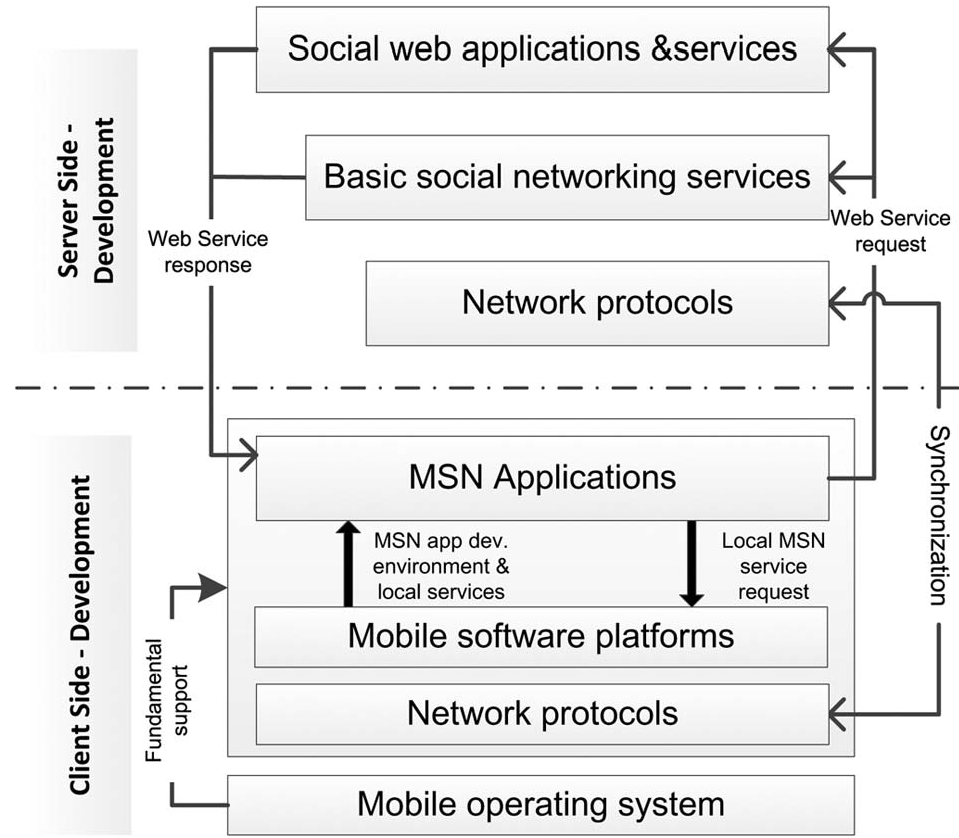 Fig 1: Development view of conventional MSNs focusing on OS-level APIs and Cloud-based SDKs.
Methodology: Routing through Human Behavior
The "How" of this paper rests on Opportunistic Data Routing. Since nodes are constantly moving, traditional IP-based routing fails. The authors contrast several approaches:
- Epidemic Routing: Floods the network (high overhead).
- Social Relationship Based (e.g., Bubble Rap): Uses "Social Centrality" to choose relay nodes. If a person is "popular" (high centrality) in a community, they are more likely to deliver a message effectively.
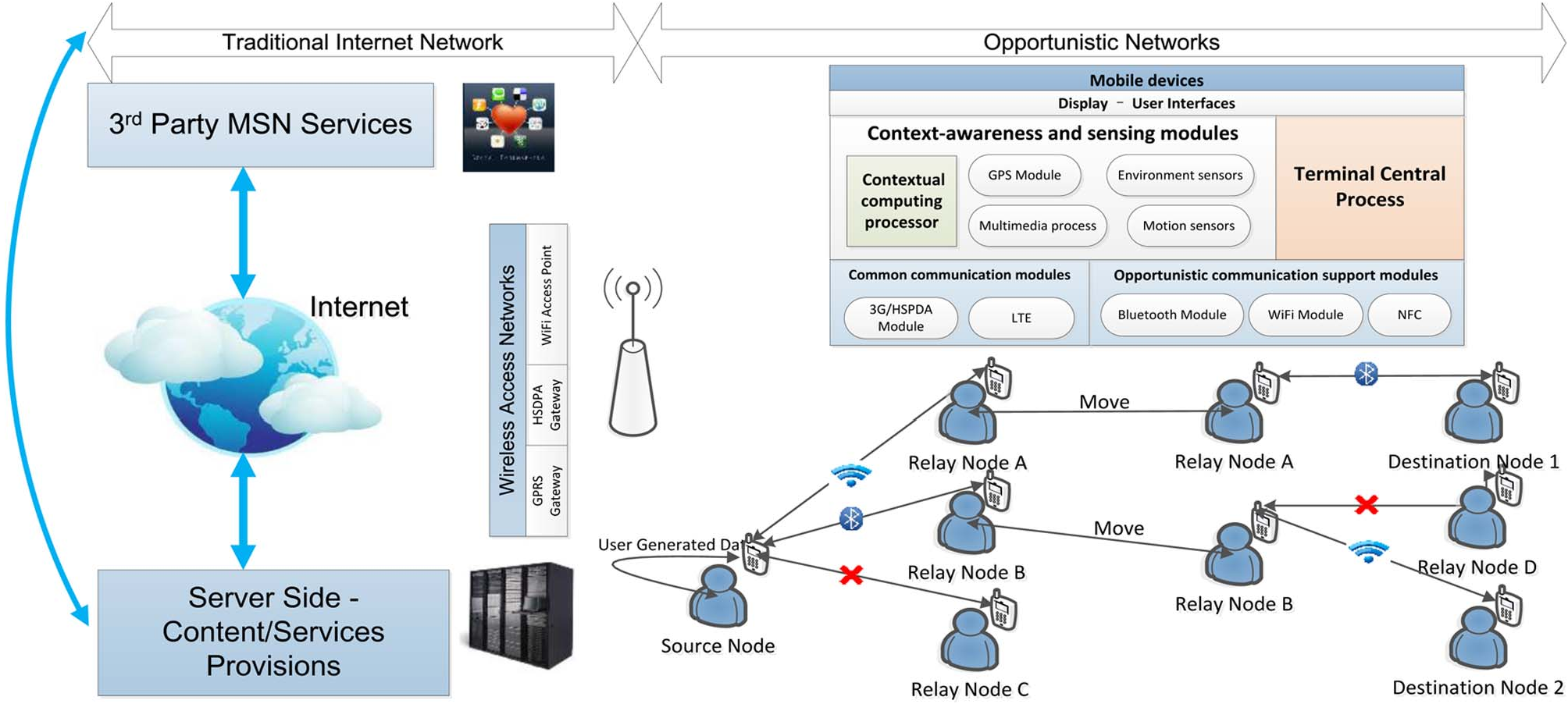 Fig 2: The physical architecture of future MSNs integrating ad-hoc peer-to-peer exchanges with traditional infrastructure.
Specialized Case Study: Vehicular Social Networks (VSN)
A standout section of the paper is the analysis of VSNs. Unlike humans, vehicles have:
- High Mobility: Topology changes in seconds.
- Energy Wealth: Unlike phones, car batteries are not a constraint for radio usage.
- Multi-Type Relationships: Human-to-Human (passengers), Machine-to-Machine (safety alerts), and Human-to-Machine.
Deep Insight: The Privacy-Utility Tradeoff
The Survey doesn't shy away from the darker side of MSNs. In opportunistic networking, you are essentially asking strangers' devices to carry your data. This creates a massive Privacy Gap. The authors highlight "Indirect Anonymity" problems where social attributes (interests, mutual friends) can be used to re-identify "anonymous" users via graph-matching algorithms.
Critical Analysis & Conclusion
This paper serves as a roadmap for researchers moving beyond the "App" layer into the "System" layer.
- Takeaway: The "Intelligence" of a mobile social network is no longer just in the recommendation algorithm on a server; it's in the Routing Logic on the device.
- Limitation: While the paper discusses WiTricity (Wireless Electricity) as a future solution for battery drain, this remains logistically far from reality for most MSNs.
- Horizon: The convergence of IoT (Internet of Things) and MSNs will likely turn "Objects" into social participants, where your car can "friend" a road sensor to optimize your commute.
Key Comparison Summary
| Feature | Conventional MSN | Future MSN |
|---|---|---|
| Network | Internet Only | Hybrid (Internet + Ad-hoc) |
| Connectivity | Rely on 4G/5G/Hotspots | Store-Carry-Forward |
| Storage | Server-side | Client + Server Side |
| Key Metric | QoS (Quality of Service) | Meeting Probability / Social Tie Strength |