
Decoding the Consumer Brain: A Deep Dive into EEG-Based Neuromarketing
A Survey on Neuromarketing Using EEG Signals
This paper provides a comprehensive survey of EEG-based neuromarketing, a field applying neuroscience to decode consumer preferences and purchase intent. It categorizes the experimental paradigms, computational pipelines—from signal preprocessing to deep learning classification—and identifies key SOTA achievements in predicting brand perception and product appeal.
TL;DR
Neuromarketing is moving from the lab to the storefront. This survey explores how EEG signals—the electrical whispers of the brain—allow us to peek into the "Black Box" of consumer decision-making. By bypassing subjective surveys, researchers are using machine learning to quantitatively measure brand appeal, memory retention, and purchase intent in real-time.
Context: Why Neuroscience in Marketing?
Every year, over $400 billion is spent on global advertising. Yet, the industry's reliance on post-hoc questionnaires is a fundamental flaw; consumers often cannot articulate why they chose a product, or their memories are distorted by social desirability bias.
Neuromarketing bridges the gap between unconscious reaction and conscious choice. By utilizing Electroencephalography (EEG), researchers can track brain activity with millisecond precision, capturing the exact moment a visual stimulus triggers a "reward" response before the participant even realizes they like what they see.
The Core Challenge: Noise in the Signal
The primary hurdle in this field is that the brain is a "noisy" environment. EEG signals capture not just cognitive processing but also muscle movements (EMG), eye blinks (EOG), and environmental electrical interference.
Authors highlight a critical pivot in the field: the move towards Independent Component Analysis (ICA) and Discrete Wavelet Transforms (DWT) to isolate pure neural signals from the clutter.
Methodology: The Neuromarketing Pipeline
The paper outlines a robust computational architecture for interpreting brainwaves:
1. Architectural Overview
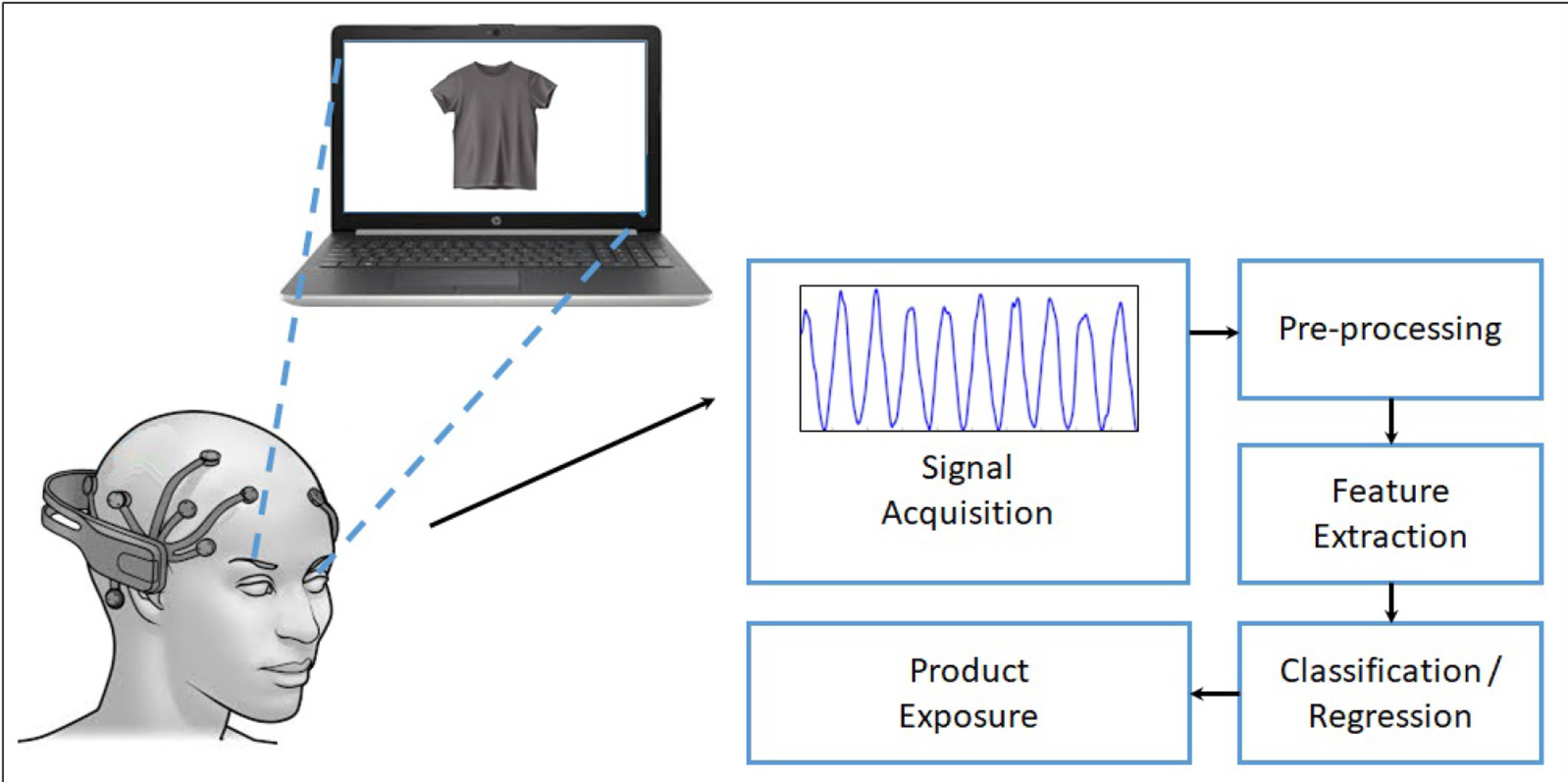
The workflow follows a linear path: Stimuli Presentation -> Data Acquisition -> Preprocessing -> Feature Extraction -> Classification.
2. Feature Extraction & Lobal Analysis
- The Frontal Lobe (The Decision Center): Researchers focus heavily on the prefrontal cortex. Left-side activation often signals "Approach" (liking), while right-side activation signals "Avoidance" (disliking).
- Frequency Bands:
- Theta (4-8 Hz): Linked to emotional engagement and memory.
- Alpha (8-13 Hz): Variations here are the gold standard for measuring "arousal" and "interest."
3. Machine Learning: From SVM to Deep Learning
While Support Vector Machines (SVM) remain a staple due to small dataset sizes, the survey notes a surge in Convolutional Neural Networks (CNNs) and Recurrent Neural Networks (RNNs). These models excel at recognizing spatiotemporal patterns in brainwaves, with some reaching accuracies over 90% in predicting user interest.
Key Results: What Can We Actually Predict?
The study summarizes diverse application victories:
- Brand Perception: Determining if consumers actually associate a brand with "luxury" or "reliability" regardless of what they say.
- Pricing Sensitivity: Identifying the "neural sting" of price points that trigger a pain response (Insula activation).
- Packaging Aesthetics: Using EEG to determine which color palettes induce the highest "visual attention" oscillations.
Critical Analysis: The Ethical Frontier
As a technical editor, I find the paper's section on ethics particularly vital. If we can predict purchase intent with 95% accuracy, are we creating "vulnerable" consumers? The authors argue for a "Transparency First" model, where neural data is used to enhance the user experience rather than to manufacture "programmed buyers."
Limitations
- Spatial Resolution: EEG cannot effectively peer into deep-brain structures like the Amygdala (the emotional core) as well as fMRI can.
- Demographic Bias: High-density hair (common in certain demographics) can still cause signal noise, leading to classification errors.
Conclusion
This survey establishes EEG-based neuromarketing as a formidable SOTA approach for the next era of digital commerce. By moving beyond "what" people buy to "how" their brains react, companies can design products that resonate on a biological level. The future of marketing isn't just about selling; it's about understanding the neural fingerprints of human desire.