
Understanding OSN Dynamics: A Deep Dive into Semantics and Security
A Survey of Online Social Networks: Challenges and Opportunities
This paper provides a comprehensive survey of Online Social Networks (OSNs), focusing on two critical research frontiers: Semantic Analysis (specifically sentiment detection) and Security/Privacy (covering phishing, Sybil, and spamming attacks). It categorizes state-of-the-art methodologies including machine learning, graph-based mining, and behavior analysis to address the challenges of massive multimedia data and user vulnerability.
TL;DR
The explosion of Online Social Networks (OSNs) has created a dual-front challenge: Semantic Noise and Security Vulnerabilities. This survey dissects how researchers are moving beyond simple keyword filters toward sophisticated behavioral modeling, graph mining, and machine learning to secure the social fabric of the internet.
Problem & Motivation: The Paradox of Connection
While OSNs facilitate global interaction, they have inadvertently created two massive bottlenecks:
- Semantic Ambiguity: Distinguishing between objective statements (facts) and subjective orientations (opinions) is difficult at scale, yet crucial for business intelligence and political analysis.
- The Identity Crisis: The "open membership" nature of OSNs allows attackers to create "Sybil" identities—fake profiles that mimic human behavior to steal data or spread malware. Traditional firewalls are useless here; the threat is social, not just digital.
Methodology: The Core Research Pillars
The authors structure the current research landscape into four primary domains, as illustrated in the following architecture:
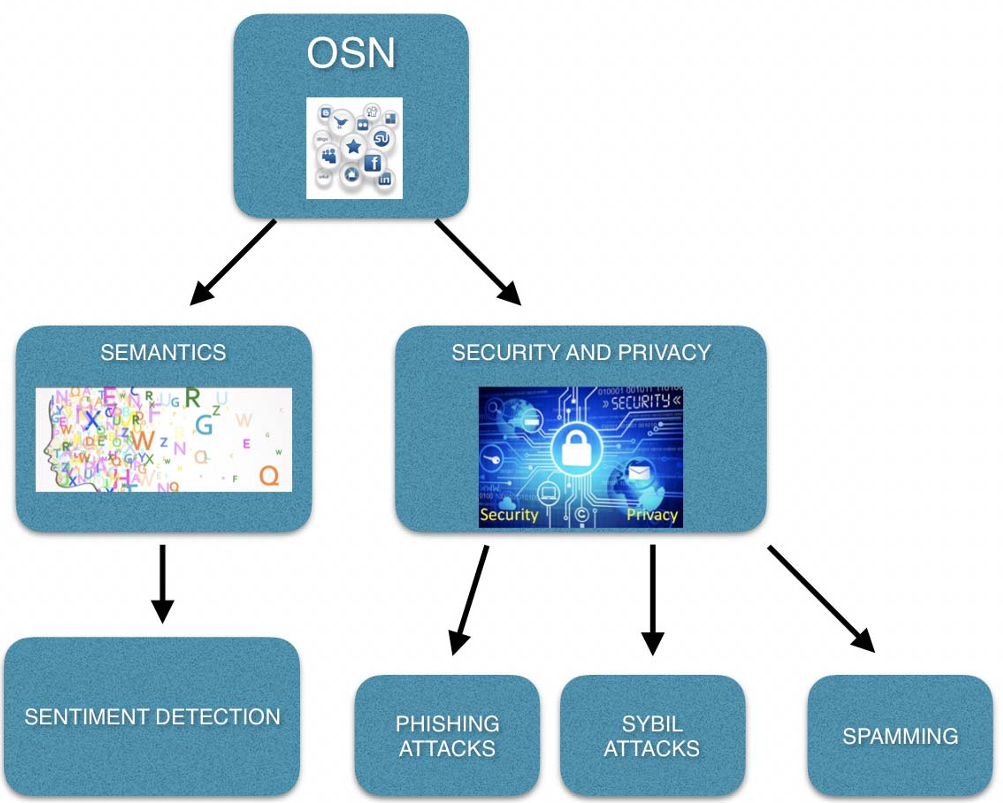
1. Sentiment Detection (The "Why" of Data)
The survey highlights a transition from simple lexicon-based approaches (counting positive/negative words) to S-PLSA (Sentiment Probabilistic Latent Semantic Analysis). By ignoring the literal word and looking at the latent intent, models can now categorize sentiment in complex movie reviews and social posts with higher nuance.
2. The Security Trifecta: Phishing, Sybil, and Spam
- Phishing: Moving from signature-based filters to Personalized Visual Information. If a user's unique "secret image" doesn't appear during login, the trust is broken immediately.
- Sybil Attacks: The survey discusses the power of Graph-Partitioning. Since Sybil nodes find it hard to establish trust-based links with "honest" nodes, they often form tight, isolated clusters categorized as "untrusted" by graph algorithms.
- Spamming: Beyond text, the paper notes the rise of Video Spam. This requires a shift toward evaluating social behavior and "clickstream" transitions through Markov chain models rather than just scanning text.
Comparative Analysis of SOTA Methods
The paper provides a roadmap of historical and then-modern solutions. The most significant shift in recent years has been from Text-based to Behavior-based detection.
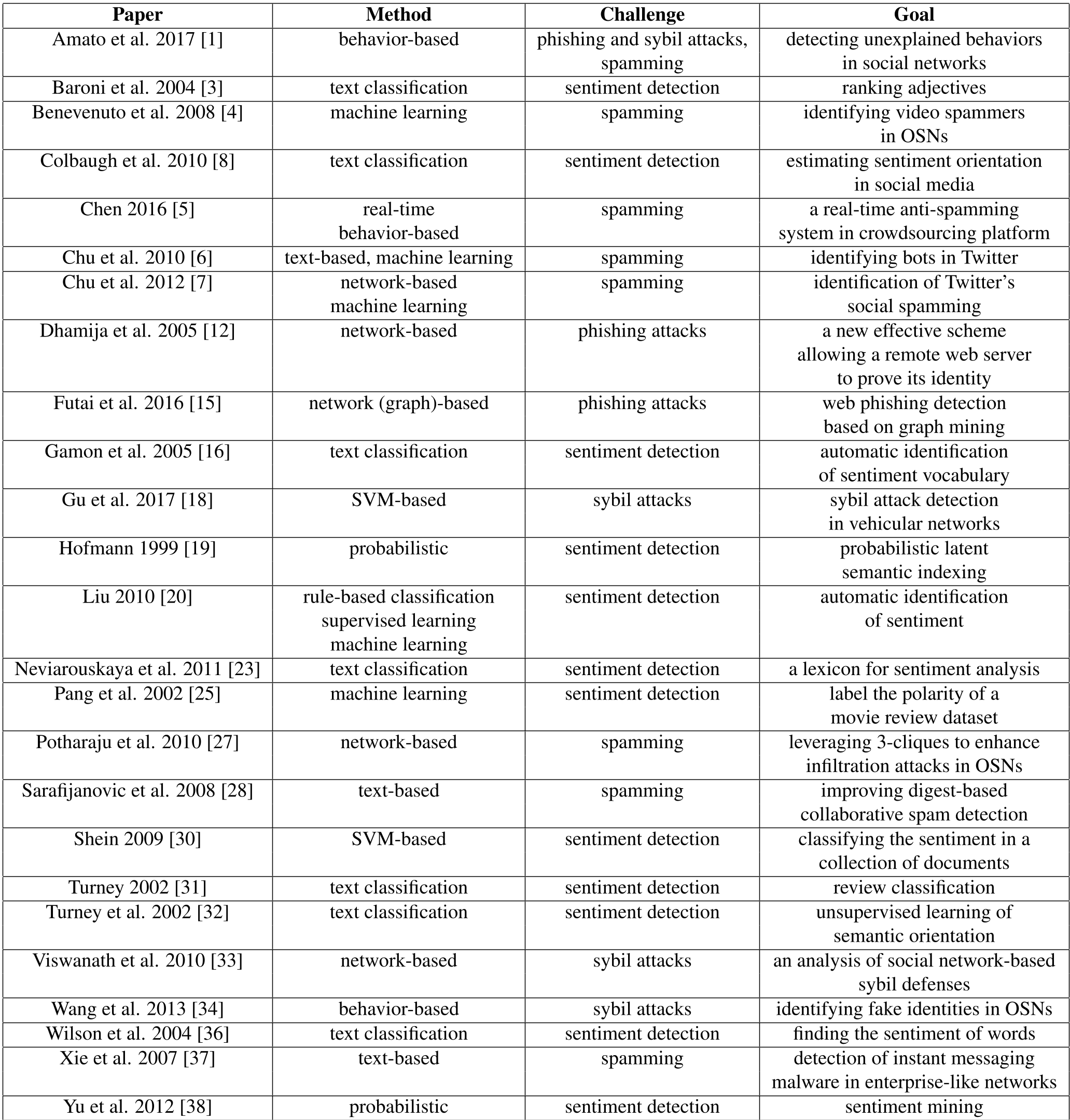
As shown in the table above, works like Benevenuto et al. (2008) and Amato et al. (2017) emphasize that identifying a "spammer" is more effective than identifying a "spam message." By analyzing the frequency of 3-cliques (triangular trust relationships), researchers can predict which users are likely to fall victim to an infiltration attack before it even happens.
Critical Insight: The Future of OSN Research
The real takeaway from this survey is the evolution of the attack surface. Early attacks were crude (keyword-heavy spam), while modern threats are structural (identity manipulation via Sybils).
Current Limitations:
- The "Cold Start" Problem: Graph-based sybil defense often fails if the network communities are naturally disconnected (isomorphism).
- Multimodal Spam: Detecting spam in images and videos remains computationally expensive and high-latency.
Conclusion: The battle for a safer OSN environment is shifting toward Anomaly Detection. Instead of defining what "bad" behavior looks like (which constantly changes), the future lies in modeling "normal" human behavior and flagging everything else as a "possible world" of unexplained activity.