
Socially-Aware D2D: Bridging the Gap Between Human Behavior and 5G Engineering
A Survey on Socially Aware Device-to-Device Communications
This paper presents a comprehensive survey of Socially Aware Device-to-Device (D2D) communications, a key 5G technology. It categorizes the integration of social-domain features—such as ties, community, trust, and selfishness—into D2D technical frameworks to reach beyond traditional physical-layer constraints and achieve State-of-the-Art (SOTA) performance in resource allocation and content dissemination.
Executive Summary
TL;DR: This paper argues that D2D (Device-to-Device) communication cannot reach its theoretical peak without integrating the Social Domain. By leveraging human social-ties, trust, and community structures, the authors demonstrate that technical issues like interference and battery drain can be mitigated while boosting cellular offloading by over 80%.
Academic Positioning: This is a landmark survey that bridges sociology and wireless telecommunications. It systematically classifies how "social awareness" transforms D2D from a mere proximity-based link into an intelligent, cooperative ecosystem.
The "Socially Unaware" Bottleneck
Prior D2D research focused almost exclusively on the Physical Domain (Signal-to-Interference-plus-Noise Ratio (SINR), distance, and spectrum). However, this creates a major friction point: Human Sociality.
- Selfishness: Why would a user sacrifice their battery to relay data for a stranger?
- Predictability: Random mobility models (like Random Waypoint) fail to capture that humans move in social clusters.
- Security: Proximity does not equal trust.
Methodology: The Socio-Technical Merger
The core insight of the paper is the mapping of Social Features to Technical Problems. The authors define four pillars of sociality in D2D:
- Social-Ties: Using kinship or friendship (extracted from OSNs like Facebook/WeChat) to predict communication demand.
- Social-Community: Grouping users with similar interests to optimize content caching.
- Social-Trust: Quantifying the confidence level between nodes to ensure secure relaying.
- Selfishness: Modeling users as rational agents who require incentives (credits/pricing) to cooperate.
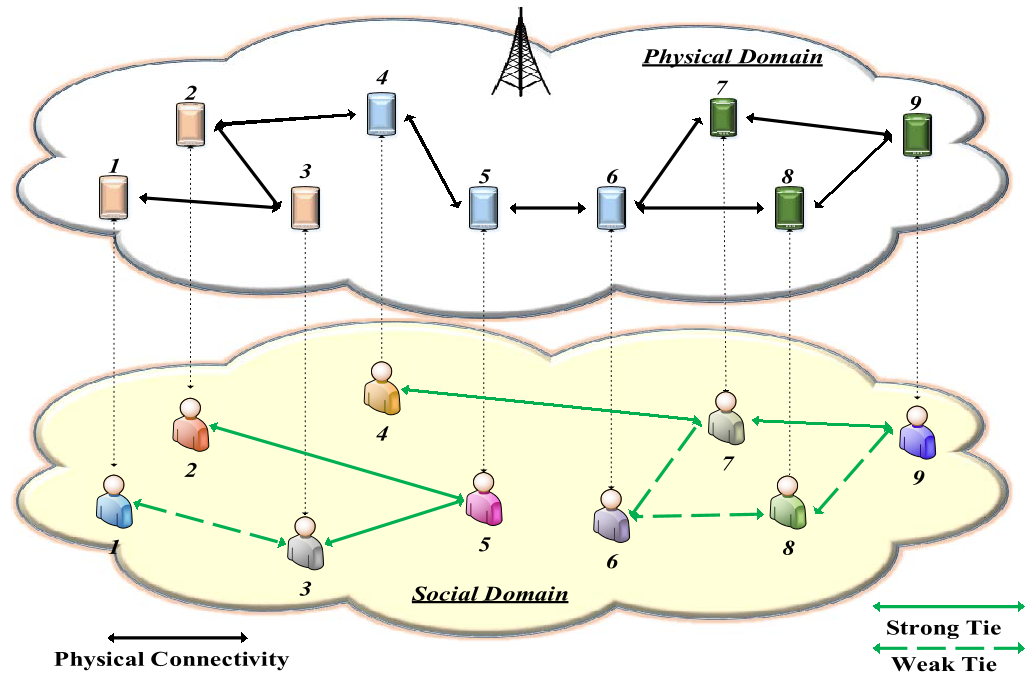 The interaction between Social, Content, and Physical domains as the new architectural paradigm.
The SGUM Framework
One of the standout methodologies discussed is Social-Group Utility Maximization (SGUM). Unlike standard game theory where users are 100% selfish, SGUM weights the utility of "friends," causing the Nash Equilibrium to migrate toward a socially optimal strategy, effectively bridging the gap between non-cooperative games and network-wide optimization.
Experiments and Quantified Results
The survey aggregates multiple studies using real-world traces (e.g., Sina Weibo data, mobility logs) to prove that social awareness isn't just theory:
- Resource Allocation: Community-aware algorithms reduced time complexity by up to 82% while improving throughput.
- Energy Efficiency: Socially-aware MAC protocols (SCD2D) reduced power consumption by 58% by selecting "religiously" sociable nodes as relays.
- Traffic Offloading: Large-scale analytics on platforms like Xender suggest that 40% of traffic is redundant and can be offloaded through social-group sharing.
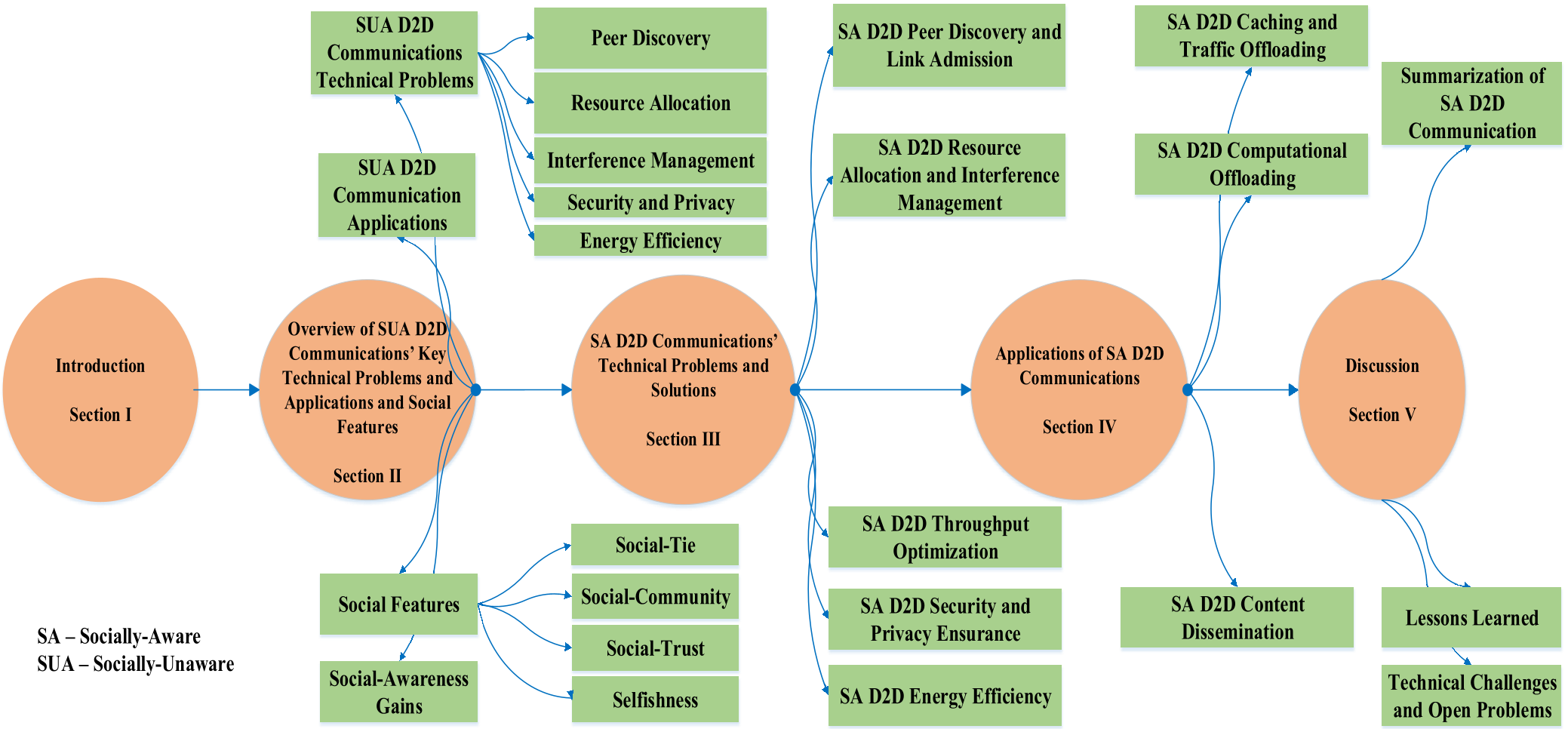 The taxonomy of socially-aware technical problems categorized by the authors.
Deep Insight: Why This Matters for 6G
The true value of this work lies in its objective treatment of Social-Trust. By showing that trust is a composite of predictability, dependability, and faith, the authors provide a mathematical foundation for Physical Layer Security (PLS).
Limitations: Despite the gains, the paper ignores the "Dark Side" of social awareness: Privacy. Extracting OSN data for network optimization creates a massive privacy paradox that the current infrastructure is not yet equipped to handle.
Conclusion: The Roadmap Ahead
The paper concludes that future D2D research must evolve from "Discovery" to "Incentivization." The move toward Ad-hoc Computational Offloading (UEs sharing CPU/GPU power) will be the next frontier, but it will rely entirely on the social-trust frameworks established in this survey.